Thursday, August 25, 2011
#631 - Lee Lacy
Card fact: This is the final Dodger card in the 1975 Topps set.
What I thought about this card then: I didn't see it. It was one of the last Dodger cards I needed to finish the team set.
What I think about this card now: It's a happy card as Lee Lacy poses there in Dodger Stadium.
Other stuff: Lacy was a backup infielder for the Dodgers throughout the 1970s before becoming a role player with the Pirates in the '80s and then a starter later in his career with Pittsburgh and Baltimore.
Lacy had trouble breaking through the Dodgers' vaunted infield in the '70s. He was one of those players that I wished would get a chance to be a starter -- preferably pushing Bill Russell out of the starting shortstop role. I was disappointed that Lacy was traded to the Braves in the Dusty Baker deal, figuring that would be Lacy's big break.
But it wasn't. Lacy returned to the Dodgers a year later as L.A. sent pitcher Mike Marshall to Atlanta. He enjoyed a pretty good World Series against the Yankees in 1977, going 3-for-7 with two RBIs in four games. But after 1978, he signed as a free agent with the Pirates.
Lacy moved to the outfield with the Pirates and was on the 1979 World Series-winning team. He hit above .300 four of the five years he was with Pittsburgh. He appeared in his most games between 1984-86 when he was in his late 30s.
Lacy's daughter, Jennifer Lacy, plays in the WNBA.
Back facts: "Singled" is not capitalized. Just want to make that clear one more time for all the grade school kids out there.
Other blog stuff: 1970s pop icons Gene Simmons and Rollie Fingers were each born on this date.
Thursday, August 18, 2011
#624 - 1975 Rookie Pitchers
Card fact: This is the last Dodger player card I needed to complete the team set for '75 Topps. Those 4-player rookie cards always eluded me.
What I thought about this card then: I didn't see it. In fact I didn't see it for quite awhile after 1975.
What I think about this card now: What a bad-ass crew, even if they weren't the most successful pitchers. I think Jim Otten is airbrushed, and I don't know why the background is blurred out.
Other stuff: Each player's first solo Topps card:
Doug Konieczny, Astros: 1976 Topps (his only solo Topps card)
Gary Lavelle, Giants: 1976 Topps
Jim Otten, White Sox: none
Eddie Solomon, Dodgers: 1978 Topps (he was alternately known as Eddie and Buddy on his cards. He died in a car accident at age 34).
Most successful career: Lavelle was a relief workhorse and two-time All-Star for the Giants, for whom he pitched for most of his 13-year major league career.
Most awesome middle name: For the second straight card, I have to go with the player without a middle name, Eddie Solomon.
Other blog stuff: The pink-yellow border combination takes the overall lead with its 53rd card. Also, this marks the end of the last subset in the '75 set. Up next, a player who just celebrated a milestone birthday.
Friday, August 12, 2011
#618 - 1975 Rookie Pitchers
Card fact: Scott McGregor is featured as a Yankee on this card, but he never pitched in the majors for the Yankees. He was dealt to Baltimore before his big-league playing career began.
What I thought about this card then: No knowledge of it. It took me a long time to figure out that there were Dodgers on these 4-player rookie cards.
What I think about this card now: I think it'd be both cool and creepy if Topps arranged it so the players on these cards were staring directly at each other. You see that Easterly is attempting to do so, but Johnson will have none of it.
Also, both Easterly and Johnson were on future cards in which my brothers and I looked at the backs and said promptly, "holy crap, look at that ERA! He's not good!" Easterly, though pitched for 13 seasons.
Other stuff: Each player's first solo Topps card:
Jamie Easterly, Braves: 1976 Topps
Tom Johnson, Twins: 1976 Topps
Scott McGregor, Yankees: 1978 Topps
Rick Rhoden, Dodgers, 1976 Topps
Most successful player: A slight edge to Rhoden over McGregor as Rhoden has a slim advantage in most career stats and pitched a few more years. Throw in Rhoden's golfing career, and his success skyrockets.
Most awesome middle name: McGregor should have insisted on at least ending his career with the Astros.
Other blog stuff: I apologize for skipping out on you the last few days. Usually I try to give some warning, but vacation departure came a lot quicker than originally planned. I should be back for awhile now.
Friday, July 8, 2011
#588 - Rick Auerbach
Card fact: This is the first card of Rick Auerbach wearing an actual Dodger uniform. He's airbrushed into a Dodger cap and uniform in the 1974 Topps set.
What I thought about this card then: OK, it's story time. When I was around 8 or 9 or whatever First Communion age is, I received a watch from my grandfather as a gift for the occasion. The watch had a brownish background, but when you tilted the glass toward the light, the brown would glow a deep orange. It reminded me of root beer and the orange glow the drink gives off if you have it in the right kind of glass. I claimed that the watch was "root-beer-colored." I went on a root beer kick. I coveted root beer candies, especially those root beer Bottle Caps candies. I wanted to go to the A&W drive-thru all the time.
When I pulled this card, it became an instant favorite for the same reasons. The deep orange and the brown. The orange stands in the background. It was a Root Beer card!
What I think about this card now: The adult in me sees a photo taken in Candlestick Park. Bleah. I need some root beer.
Other stuff: Auerbach came up to the majors with the Milwaukee Brewers, starting at shortstop for the young franchise at the age of 22 in 1972. He hit just .218 that season and was eventually acquired by the Dodgers as insurance for starting shortstop Bill Russell, who had some injury issues.
Auerbach hit .342 in a supporting role for the Dodgers in 1974. After a down year in '75, Auerbach was relegated to a pinch-hitting/back-up role. He wound up with the Reds (after bouncing through the Mets and Rangers organizations without ever playing in the majors for them), and hit above .300 twice for Cincinnati as a pinch-hitter.
Auerbach ended his career with the Mariners in 1981.
Back facts: I remember being taken aback by the cartoon because it lacked a cartoon figure in it. It was just a bunch of words! Also, I enjoy how Topps refers to "Dirty Al" Gallagher in the past tense. Gallagher may have ended his major league career in 1973, but he's still kicking!
Also, Russell apparently was so well-known to card collectors that he didn't require a first name in the write-up. By the way, the whole Bill Russell-Celtics' Bill Russell/Rick Auerbach-Red Auerbach thing was lost on me as a kid. I didn't follow basketball.
Other blog stuff: With this card, the orange-brown border combo reties the green-light green border combo for the overall lead with 50 cards apiece.
Wednesday, June 15, 2011
#570 - Jim Wynn
Card fact: This is the first and only Topps card of Jim Wynn featured in Dodger gear. He is airbrushed into an L.A. uniform in the 1974 Topps traded series, and he is airbrushed into a Braves cap (while wearing a Dodger jersey) in the 1976 Topps set.
What I thought about this card then: This is another one of those cards that I saw for the first time in my trip to Cooperstown in 1975. It became one of my all-time coveted cards because I didn't obtain it for years. It was one of the last Dodgers I needed to complete the '75 team set.
What I think about this card now: It doesn't really look like Wynn. But I think that's just because his enormous smile in the photo. He was more serious-looking on most of his other cards.
Other stuff: Wynn came over to the Dodgers from the Astros in a deal that sent Claude Osteen to Houston before the 1974 season. Wynn bounced back from a miserable '73 season and helped the Dodgers reach the World Series in '74. He was named the National League's Comeback Player of the Year.
It was Wynn's last great season. He tailed off in '75 and was dealt to the Braves in the deal that gained the Dodgers Dusty Baker. Wynn closed out his career with Atlanta, the Yankees and the Brewers.
But before his arrival in L.A., Wynn spent 1963-73 as a hard-slugging center fielder for the Astros. Nicknamed the "Toy Cannon," he hit more than 200 home runs for Houston, a considerable feat since he played his home games in the monstrous Astrodome.
Wynn, who had his uniform number retired by Houston, now does TV postgame analysis for the Astros and does community work for the team.
(EDIT: Wynn died at age 78 on March 26, 2020).
Back facts: Yaz remains the last Triple Crown winner. And Topps is just plain redundant with that blurb at the bottom (EDIT: Miguel Cabrera won the Triple Crown in 2012).
Other blog stuff: We have completed the entire N.L. All-Star starting roster with the addition of Wynn:
AL
1B - Dick Allen
2B -
3B - Brooks Robinson
SS - Bert Campaneris
OF - Bobby Murcer
OF - Jeff Burroughs
OF -
C - Carlton Fisk
P - Gaylord Perry
NL
1B - Steve Garvey
2B - Joe Morgan
3B - Ron Cey
SS - Larry Bowa
OF - Hank Aaron
OF - Pete Rose
OF - Jim Wynn
C - Johnny Bench
P - Andy Messersmith
Four Dodgers on the team. That's why the N.L. won, you know.
Monday, May 23, 2011
#547 - Von Joshua
Card fact: This card is among the first five Dodgers I acquired in 1975, although I couldn't tell you how I received it.
What I thought about this card then: Always liked the helmet. It appeared shiny to me.
What I think about this card now: At this point, Joshua already had been featured on four Topps cards, which I think is a little strange considering he had no more than 159 at-bats in any season to that point.
Other stuff: Joshua was a backup outfielder for the Dodgers for five seasons until he was picked up on waivers by the Giants prior to the 1975 season. I became furious at the Dodgers for allowing Joshua to go to the enemy when he proceeded to bat .318 in 545 at-bats for Giants in '75. It's the first moment of hatred for the Giants that I can remember.
Joshua enjoyed three straight seasons as a starter -- two with the Giants and then one with the Brewers. But he returned to the Dodgers in 1979 and became a supporting outfielder again. His final season was with the Padres in 1980.
Joshua was a hitting coach in the Dodgers organization for nine seasons. He also worked for the White Sox, Blue Jays and Cubs. He became the Chicago Cubs' hitting coach in 2009 after Gerald Perry was let go. He has spent the last two seasons coaching for Iowa, the Cubs' Triple A team.
Back facts: The write-up reads like a how-to for beginning hitters.
Lee Smith now holds the longest errorless streak at 546 games between 1982-92.
Other blog stuff: You'll be happy to know that I made it through this post without my nose running all over the keyboard. I know that is TMI, but I just wanted to let you know what I go through for this blog.
Thursday, April 28, 2011
#523 - Tom Paciorek
Card fact: One of the first Dodgers that I obtained in 1975. Steve Yeager and Geoff Zahn were the first, and then it gets hazy after that. But I know Paciorek was in the next group.
What I thought about this card then: I remember noticing the sweat under Paciorek's helmet and that he seemed like he needed to clean himself up.
What I think about this card now: A nice view of Dodger Stadium in the background.
Other stuff: Paciorek was a top prospect when he was drafted by the Dodgers. He was a touted defensive back for the University of Houston and eventually had his number retired by the team. But with L.A., he had trouble breaking through in the outfield and ended up being a platoon-type player.
The Dodgers traded him to the Braves in the Dusty Baker deal. Paciorek received a few more at-bats with Atlanta and hit well his first season with them, but struggled after that and was released twice by the Braves. The Mariners picked him up and that is where he found his niche. In 1981, he hit .326 as a starter during the strike-shortened season and finished in the top 10 in MVP voting.
Paciorek continued as a semi-regular with the White Sox for three years before finishing up with the Mets and Rangers. He played for 18 seasons even though many of those were in a platoon role.
After his playing career, he became a broadcaster, most notably with the White Sox and the Braves. Chicago's Ken "He Gone" Harrelson reportedly hung the nickname "Wimpy" on Paciorek, who was broadcaster through 2007.
Back facts: I'm pretty certain that in 1975 I didn't know what a halfback was or why Steve Garvey was being mentioned on the back of Paciorek's card.
Other blog stuff: On this date in 1956, Frank Robinson hit the first of his 586 career home runs.
Saturday, April 2, 2011
#498 - Al Downing
Card fact: I don't totally remember, but I believe this was the first Dodger that I pulled from a pack of '75 minis.
What I thought about this card then: I really did like the pink & yellow cards in this set. This is the only Dodger player with the pink-yellow border, so I held it in high esteem.
What I think about this card now: I'm not sure where Al Downing is standing in the ballpark, but the photo angle presents a nice outfield view of Dodger Stadium.
Other stuff: Downing is known most for surrendering Hank Aaron's record-setting 715th home run in 1974, but he had a full career with several successful seasons. It took me a long time to learn that Downing was a regular starter during the Yankees' dynasty days of the early 1960s. He led the American League in strikeouts in 1964.
Downing continued to start for New York until the late '60s when injuries forced him to the bullpen. He was traded to Oakland in 1970, then traded to Milwaukee six months later, where he went 2-10 to finish the 1970 season. Milwaukee sent Downing to the Dodgers in a deal for Andy Kosco. Downing followed by going 20-9 for L.A. and winning the Comeback Player of the Year Award.
Downing had a couple more seasons as a starter for L.A. before he became a part-time starter/reliever between 1975-77.
Downing has worked as a broadcaster and is on the speaker circuit with L.A. He signed at a card show I went to a few years ago. I had a chance to talk to him, just me and him, but I was too absorbed in cards to realize the opportunity. Oh, well.
Back facts: Topps means "Who was the youngest player in Major League history?"
Other blog stuff: Two Dodger greats of the 1970s, Don Sutton and Reggie Smith, each were born on this date in 1945.
Tuesday, March 8, 2011
#473 - Ken McMullen
Card fact: You don't see too many close-ups of players wearing batting helmets from this time period. Usually, if they are wearing a helmet, they're involved in some sort of game action.
What I thought about this card then: I had the mini card. I thought the helmet was cool.
What I think about this card now: It doesn't really pertain to this card, but Ken McMullen may hold a Dodger card record. He played for L.A. on two different occasions. His first card for the Dodgers was in the 1964 set. He didn't have another card with the Dodgers until the 1973 set (and he's actually in an Angels uniform on that card). That's a gap of eight years between Dodger cards. I don't know if that's the longest gap for a Dodger player, but I can't think of anyone else right now.
Other stuff: McMullen came up with the Dodgers, but was traded a couple years into his major league career in the deal that also sent Frank Howard, Phil Ortega, Pete Richert and Dick Nen to the Senators in exchange for Claude Osteen and John Kennedy. McMullen became a consistent starter at third base for the Senators from 1965-69.
He was then traded to the Angels and started a couple of years for California. By the time he was shipped back to the Dodgers (in the deal that also brought Andy Messersmith to L.A.), he was a supporting player. The Dodgers had rising star Ron Cey at third base by 1973, so McMullen was a back-up.
In an extraordinarily sad development, McMullen played for the Dodgers in 1974 while his wife was losing a battle with cancer. She had been diagnosed with cancer while she was pregnant, but refused treatment until after the baby was born. She died in '74.
McMullen later played with Oakland and Milwaukee, ending his career in 1977. After his playing career, he created an annual youth fund-raising golf tournament and served as a community liaison with the Dodgers.
Back facts: I love these old-fashioned baseball terms. I probably last heard someone call a left-hander a "portsider" when Joe Garagiola was calling games on television.
Other blog stuff: Two players in this set are celebrating birthdays today. Jim Rice is 58. Dick Allen is 69.
Tuesday, February 1, 2011
#440 - Andy Messersmith
Card fact: With this card, we are now two-thirds of the way through the 1975 Topps set.
What I thought about this card then: I didn't have it, but I was aware of it, and, damn, did I want it. Andy Messersmith was my favorite pitcher that I never saw play.
What I think about this card now: Messersmith's Topps Dodgers cards are the most uninteresting cards that I have seen for a pitcher. In his 1973, 1974, 1975 and 1976 cards he is basically in the same mug shot pose. You can't see his arms in any of the photos. I have a very limited picture of what Messersmith looked like pitching because he was not shown in a pitching pose with L.A.
Other stuff: Messersmith is known mostly for his role in bringing down the reserve clause in 1975. Messersmith followed the path begun by Curt Flood and Catfish Hunter, and refused to sign a contract with the Dodgers after they would not give him a no-trade clause. The Expos' Dave McNally, also on a one-year reserve clause at the time, joined the fight, although he would retire at the end of the season.
Messersmith won the case before an arbitrator and signed a deal with the Braves. It was this decision that kicked off free agency. Messersmith struggled with Atlanta (and I have to say as a kid I thought "serves him right"). He was shipped to the Yankees where he didn't do any better. Messersmith closed his career back with the Dodgers in 1979, interestingly playing with a no-trade deal.
Lost in all this is the fact that Messersmith was a terrific pitcher, first with the Angels and then with the Dodgers. He is one of only 17 pitchers to win 20 games in the American and National leagues (Roy Halladay recently became the 17th). He also won back-to-back Gold Gloves while with the Dodgers.
Messersmith came to the Dodgers from the Angels in the deal that sent Bill Singer, Frank Robinson, Bobby Valentine and Billy Grabarkewitz to the Angels. He pitched in two games of the 1974 World Series against the A's but lost them both.
Messersmith later worked as a coach for Cabrillo College in Santa Cruz County in California.
Back facts: The other 20-game winner in the N.L. that year was Phil Niekro.
Also, how do you get "Andy" out of "John Alexander"?
Other blog stuff: Time to add the third Dodger to the 1974 N.L. All-Star roster:
AL
1B - Dick Allen
2B -
3B - Brooks Robinson
SS - Bert Campaneris
OF - Bobby Murcer
OF -
OF -
C - Carlton Fisk
P -
NL
1B - Steve Garvey
2B - Joe Morgan
3B - Ron Cey
SS - Larry Bowa
OF - Hank Aaron
OF - Pete Rose
OF -
C - Johnny Bench
P - Andy Messersmith
The N.L. is one player away from being complete. All it needs is another Dodger.
Thursday, January 6, 2011
#414 - Manny Mota
Card fact: We're reviving some old, forgotten border color combos lately. It's been 46 cards since the last light blue-green bordered card.
What I thought about this card then: It was one of the last Dodger cards I picked up from the set. Then, when I went about collecting the team set for the '75s, it was the last card I needed. I don't know why Manny Mota was so elusive.
What I think about this card now: "Pinch-hitting for Pedro Borbon, Manny Mota ... Mota ... Mota."
Other stuff: Manny Mota is one of the great reasons to be a Dodger fan. Ever since coming over to the Dodgers from the Expos in the deal that returned Maury Wills to the Dodgers and sent Ron Fairly to the Expos, he has become synonymous with the Dodgers. For a long time, he was the greatest pinch-hitter in major league history, holding the record for the most career pinch-hits. I was quite proud of that.
That record has since been broken, but Mota remains a point of pride for Dodger fans as he's been a coach for L.A. for more than 30 years, which is one of the longest coaching tenures with one team in major league history.
Mota also has the second best batting average in Los Angeles Dodger career history (Mike Piazza is first).
Mota had two sons who played in the major leagues, Andy and Jose.
Back facts: If you look at the stats, you can tell that Mota's at-bats dropped off significantly in 1974. That's because this was the first year that Mota was used almost exclusively as a pinch-hitter. He would be used in that role for the next eight years with L.A.
Other blog stuff: This was almost a daytime post. Blogger has been quite bitchy the last hour or so.
Wednesday, December 8, 2010
#390 - Ron Cey
Card fact: Well, the moment has arrived. This is my most favorite card in the set. It's also my most favorite card of all-time. Favorite card when I was a kid. Favorite card now. I traded HANK AARON for this card, for crying out loud. And, no, I don't regret it one bit.
What I thought about this card then: Must. Have. Card.
What I think about this card now: Between the two blogs, I'm sure I have posted this card more often than any other. It's about the 6th or 7th time. I think I've said all I have to say about it. It became my favorite during 1975, I traded the '75 Aaron card for it, and then somehow, tragically, I lost that first '75 Cey card.
Why did Cey become my favorite then? Well, I've studied my younger self enough to come to the conclusion that I liked players with long hair and mustaches and that wore helmets. Add the fact that he was a Dodger, and I think it was a natural fit.
Other stuff: Cey is the best slugger the Los Angeles Dodgers have ever had. He led the franchise in career home runs until Eric Karros broke it. He came through in the clutch in some big postseason moments, most notably during the 1977 NLCS against the Phillies and the 1981 World Series against the Yankees. I remember being especially proud of him when he broke the N.L record for RBIs in the month of April in 1978. And how about the diving catch on a bunt by Bobby Murcer in the '81 World Series?
"The Penguin" had a distinctive trot around the bases -- very much like a waddle. And his batting stance was memorable, too.
I still have no idea why the Dodgers traded him to the Cubs after the 1982 season. No one has been able to give me a good reason. Hey, I liked Pedro Guerrero, too, but put him in the damn outfield.
Cey is now one of the Dodgers' biggest ambassadors, a frequent TTM and in-person signer -- as I will attest. His daughter, Amanda, is a big-time event/party planner in San Francisco.
Back facts: I didn't know what monuments were as a 9-year-old. I thought those rectangular drawings in the cartoon were gas station pumps. I thought Jimmy Piersall was fielding a fly down at the local Sunoco station.
Also, I double-checked the game facts in the write-up. They're all correct. Cey was 3-for-4 with 7 RBIs, two homers and a bases-loaded single. He also struck out looking.
Other blog stuff: This is the second Dodger all-star on the N.L. team so far, so let's add Cey to the list:
AL
1B -
2B -
3B - Brooks Robinson
SS - Bert Campaneris
OF - Bobby Murcer
OF -
OF -
C - Carlton Fisk
P -
NL
1B - Steve Garvey
2B - Joe Morgan
3B - Ron Cey
SS -
OF - Hank Aaron
OF - Pete Rose
OF -
C - Johnny Bench
P -
Saturday, November 20, 2010
#376 - Steve Yeager
Card fact: Feast your eyes on the first Dodger card I ever pulled from a pack that I purchased with my own allowance.
What I thought about this card then: Well, it was just about the coolest card on the planet for a couple of months. I distinctly remember standing in the middle of the playground at school (our school had a very expansive playground area), staring at my Steve Yeager card. I took my cards to school quite often in 4th, 5th and 6th grade.
This card is probably the reason why I like this particular batting pose on cards so much. It's also probably the reason why I like cards that feature players in their batting helmets.
What I think about this card now: Yet another orange-brown bordered Dodger card. Humph.
Also, check out those sideburns.
Other stuff: As much as I liked this card, Yeager was a constant thorn in my Dodger-rooting side as a kid. He couldn't hit, and he always batted eighth in the order. I don't know how many rallies I saw die because he came up to bat.
Yet, I was fiercely proud of Yeager when his injury led to the invention of that flap that hung from the chin of a catcher's mask to protect a catcher from getting struck in the throat. The flap came about after Yeager was hit in the throat by a broken bat from teammate Bill Russell, piercing his esophagus. Yeager was standing in the batting circle at the time, and he had nine pieces of wood taken out of his neck. Trainer Bill Buhler later made the flap that covered the neck. Now, catcher's masks are created so the helmet comes down to protect the neck area.
Yeager was a good defensive catcher with a terrific throwing arm. And he was the best indication that I had that the Dodgers were going to win the World Series against the Yankees in 1981. The light-hitting Yeager hit two home runs in that series and the Dodgers won 4 games to 2.
Yeager is known for a variety of non-baseball things among Dodger fans. He is the nephew of famed pilot Chuck Yeager. He had a small part in the Major League movies. He once posed for Playgirl. I always thought he was trying to look like Michael Caine.
He later became a coach in the Dodgers' organization.
Back facts: I believe my first knowledge of what a grand slam was came from this card.
Other blog stuff: Here is the first Dodger card I pulled in 1975:
That is the finest piece of history I'll ever own.
Thursday, November 4, 2010
#361 - Dodgers/Walter Alston
Card fact: This is the 15th card in the set to feature the "brown-orange" color combination (not to be confused with the "orange-brown" combination). Out of those 15 cards, three have been Dodgers. So, the Dodgers represent one-fifth of the cards with this color combination, which suspiciously resembles the Giants' color combination. I am not putting it past Topps to pull something sneaky like this even way back in 1975.
What I thought about this card then: Naturally, I thought it was cool to see all of the Dodgers in one place. It was the one team card that meant something to me.
What I think about this card now: It is sad to see Walter Alston relegated to a tiny circle on the team card. Up until this point, Alston had received his own card in most of the sets since he became manager (his '62 Topps card is terrific, I have to feature it one day). I didn't know that when I was collecting in '75. Otherwise I would've been disappointed. Manager cards rule!
Other stuff: The Dodgers were coming off their first pennant victory and World Series appearance since 1966. After four straight seasons of finishing in second place in the N.L. West, L.A. had finally placed first and beaten Pittsburgh in the NLCS. They would go on to lose to Oakland in the World Series.
Alston was nearing the end of his 23 years as Dodger manager. The 1974 team would be his last World Series team, after taking the Dodgers to the Series in 1955, 56, 59, 63, 65 and 66. He retired in 1976 after signing 23-straight one-year contracts.
Back facts: This is a successful, veteran team so there wasn't a lot of trading or airbrushing going on with the Dodgers. But Jim Brewer, Willie Crawford and Don Sutton are the only connections (besides Alston) between the 1966 N.L. champs and the 1974 N.L. champs.
Other blog stuff: Time to figure out how well Topps represented the National League champs of 1974. Normally this gets a little tedious. But this one is going to be fun for me.
The Dodgers used just 35 players in 1974. That is tied for the second-least among the teams featured so far. Topps didn't leave out anyone big from the previous year. In fact, out of the players left out of the set, the one with the most at-bats had a whopping 18.
The player that didn't get a card who I found the most interesting is Charlie Manuel, the current Phillies manager. He played in four games for the 1974 Dodgers.
So, Topps featured 26 of the 35 players, which is pretty darn good. Here is where the Dodgers rank in comparison to other teams reviewed so far:
1. Tigers 78.37% of players featured
2. Orioles 78.13%
3. Dodgers 74.29%
4. Giants 71.43%
5. Indians 71.11%
6. Royals 70.59%
7. Red Sox 70.27%
8. Angels 68.89%
9. Expos 68.29%
10. Cardinals 65.12%
11. White Sox 65.0%
12. Phillies 62.5%
13. Pirates 61.5%
14. Padres 55.8%
Third place. I'm quite happy about that.
Monday, October 4, 2010
#330 - Mike Marshall
Card fact: This is the official halfway point of the 1975 Topps set. I have reviewed 330 cards and there are 330 more to go. You didn't think I'd get this far did you?
What I thought about this card then: I did not see it. Mike Marshall's 1976 Topps card was the first one of his that I knew. It was also an action shot and it was a favorite. I read a long time ago that at some point in Marshall's career, he refused to pose for photos for Topps, so Topps was forced to take photos of him during games. That worked out pretty well for the collectors, who got some cool photos of Marshall. But later Marshall disappeared from card sets altogether, so I think he put the kiebash on having his photo in card sets completely.
What I think about this card now: Marshall has that look about him that is standard for relievers today, but wasn't too common then. I think Marshall, Rollie Fingers and Sparky Lyle blazed the trail for the wild-looking closers to come.
Other stuff: Mike Marshall is known for his record-shattering relief performances during the 1974 season, as well as for his passionate opinions on pitching methods. In 1974, Marshall appeared in 106 games and 208 1/3 innings pitched. All of them came in relief. He also appeared in 13 straight games for the Dodgers. That record, along with the 106 games pitched, remain major league records. Marshall won the National League Cy Young Award in '74 and finished third in the MVP voting. He was an All-Star in both '74 and '75.
Marshall also played for the Tigers, Pilots, Astros, Expos, Braves, Rangers, Twins and Mets. His emergence in relief pitching actually started with the Expos during the 1972 season, when he finished fourth in the Cy Young voting. The following year he pitched in 92 games for the Expos, which helped Montreal land Willie Davis in a trade with the Dodgers for Marshall.
Marshall was later traded to the Braves for Lee Lacy and Elias Sosa in mid-1976. He never did pitch quite as often as with the Dodgers, although he enjoyed a resurgence with the Twins in the late '70s, appearing in 90 games in 1979.
Marshall has several degrees and a Ph.D. in kinesiology, a word that confused the heck out of me as a kid. He has taught college courses on pitching and human movement and believes his methods would eradicate pitching injuries. But his beliefs have been at odds with conventional pitching methods.
Back facts: Take a look at those fascinating numbers in 1973 and 1974. He appeared in 106 games in relief and had just 21 saves. He could have set a save mark that would have lasted forever!
Other blog stuff: The orange-brown combo is creeping back toward the top again. After all those pink-and-yellow league leaders cards, orange-brown is now just one card away from pink-yellow.
Friday, August 27, 2010
#294 - Geoff Zahn
Card fact: This is Geoff Zahn's rookie card.
What I thought about this card then: This was the second Dodger card that I acquired in 1975, after Steve Yeager. For a long time, it was just those two Dodgers cards in my collection (it was probably just a matter of weeks, but everything seems longer when you're 9).
So, it was a cherished card, and I can't believe I forgot to scan the original version of it.
But after I saw his 1976 card, a new thought began to develop: I thought he looked like a circus clown. Something about the hair and the look on his face, it was all I could see when I looked at his cards from those two years.
What I think about this card now: It's very unusual seeing Dodger Stadium with no people in the stands. Also, these particular border colors go very well with the Dodgers uniforms.
Other stuff: Zahn didn't last long with the Dodgers. After toiling in the minor leagues for six years, he pitched 29 games for L.A., even taking Tommy John's spot in the rotation after he suffered a season-ending arm injury in 1974. But early in 1975, he was traded to the Cubs in the Burt Hooton deal.
Zahn didn't last long with the Cubs either, getting released. He signed with the Twins and became a steady starting pitcher for four seasons. He then signed as a free agent with the Angels and helped the team to the American League Championship Series with an 18-8 record in 1982 at age 36. He pitched in the majors until 1985. He is now a motiviational and Christian speaker with his own website.
Back facts: When I was 9, a lot of the cartoons were so confusing. What was a Capital? Why was it being punished? Why was a baseball flying over that weird building?
But I loved Zahn's career 1.94 ERA so much that it didn't matter anymore.
Other blog stuff: Jim Thome is the big 4-0 today.
Thursday, July 29, 2010
#269 - Doug Rau
Card fact: I'm not 100 percent sure on this, but I believe this is the only '75 Topps card that I have that I also have in mini form and O-Pee-Chee form. The rare '75 trifecta!
What I thought about this card then: Doug Rau was a childhood favorite. I rooted for the underdog quite a bit as a kid, and Rau was the No. 4 starter in the Dodgers starting rotation of my youth. You can't get much more underdog than a No. 4 starter.
What I think about this card now: Was this photo taken at Vero Beach? Did the Dodgers color code the bleachers at their spring training site to match the Dodger Stadium seat coloring? If they did, that is awesome.
Other stuff: As mentioned, Rau was a key part of the Dodgers' pitching staff during their success of the late 1970s. The rotation that I knew growing up was: Don Sutton, Tommy John, Burt Hooton, Doug Rau and Rick Rhoden. I badly wanted Rau and Rhoden to become stars. They didn't reach the star level, but they did do pretty good for themselves.
Rau reached double figures in wins for five consecutive seasons with the Dodgers. His 1977 World Series showing was plagued by a famous mound argument with Tommy Lasorda (Lasorda sets an all-time record for cursing during the 3-minute conversation). But Rau was a bit more effective in the '78 World Series.
Arm trouble caught up to Rau in 1979, and he missed the entire 1980 season. His last season was 1981 with the Angels.
Rau's first major league at-bat was a memorable one -- he tripled. It took another 35 years before another pitcher tripled in his first MLB at-bat.
Back facts: This is one of my favorite cartoons in the set. Apparently sports fans always smoke pipes while watching television.
Other blog stuff: I'm taking another short break on this blog. I'll resume with a card of a four-decade player in a few days.
Friday, July 2, 2010
#244 - Bill Buckner
Saturday, June 5, 2010
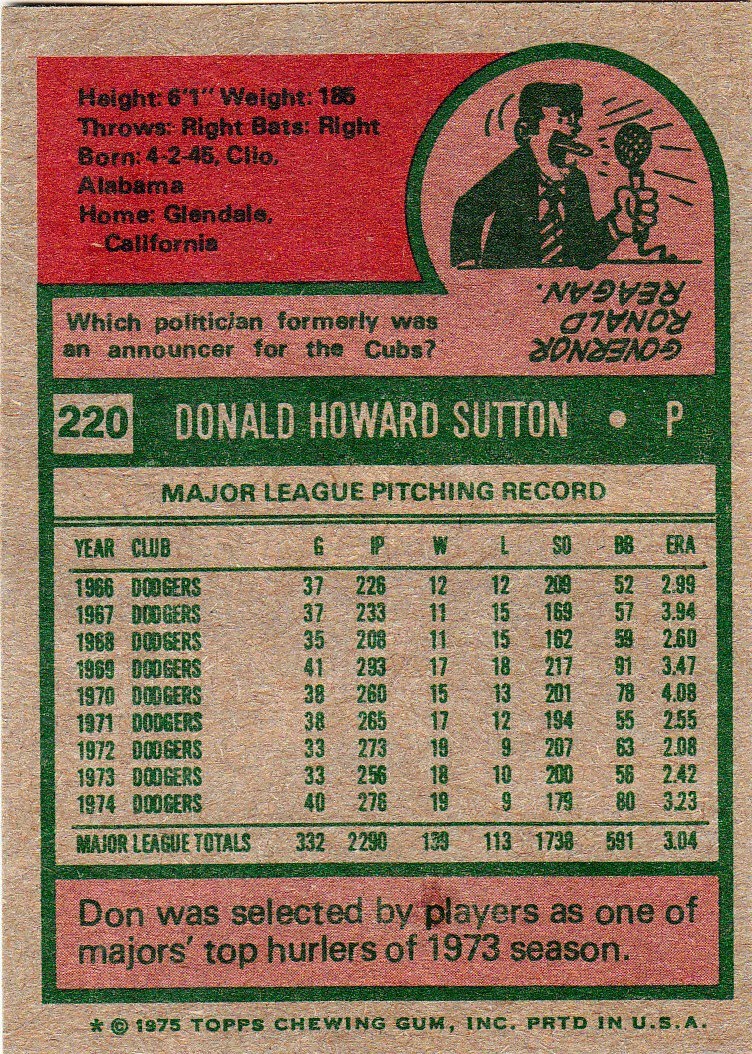
#220 - Don Sutton
Saturday, May 1, 2010
#186 - Willie Crawford
What I thought about this card: I thought it was quite cool. Crawford's tilted helmet made the whole card. I'm not sure what happened to my original card. It's possible I upgraded this card at a young age and scrapped the original.
What I think about this card now: One of the most severe tilts on a background that I've seen so far. Of course, I scanned the card in tilted so I'll just shut up about that.
Other stuff: Crawford was one of the best high school athletes to come out of Los Angeles. He was a big football standout and many football colleges came after him. But baseball did, too. Nobody pursued him more than Charlie O. Finley and Tommy Lasorda.
Can you imagine being 18 years old and having those two guys talking your ear off? Finley was the owner of the Kansas City Athletics and Lasorda was a scout for the Dodgers. Lasorda won, signing Crawford two days after he graduated from high school. Crawford never played in the minor leagues, and was in the World Series the very next year.
He never reached the lofty expectations people held for him. He was expected to become a star of Willie Mays stature, but he struggled to find playing time year after year. His frustration with that led to an alcohol problem that he eventually kicked after his playing career ended. Crawford spent 11 years with the Dodgers, then was traded to the Cardinals, where he spent one season. He was then traded to the Giants and is pictured in an airbrushed Giants helmet on his 1977 card, but he never played for them. He finished out his career with the Astros and the A's.
After returning to the Dodgers for the 1978 season, he didn't make the team and retired at the age of 31.
Back facts: This was one of my favorite cartoons from the set. A base that's on fire! Loved it.
Other blog stuff: On this date in baseball history, in 1974, Pirates pitcher Dock Ellis intentionally hit Pete Rose, Joe Morgan and Dan Driessen, then threw two balls behind Tony Perez's head before walking him. Manager Danny Murtaugh then took Ellis out of the game before he did anymore damage.


