Showing posts with label Angels. Show all posts

Monday, August 29, 2011

#635 - Chuck Dobson


Card fact: Chuck Dobson is wearing an airbrushed Angels cap and uniform. Dobson was acquired by the Angels in June of 1974. This is also Dobson's first Topps card since the 1972 set and the final Topps card issued during his career.

What I thought about this card then: Never saw it.

What I think about this card now: I like the stacked signature in the corner. It's a bit unusual.

Other stuff: Dobson pitched fairly successfully for the Kansas City and Oakland A's from 1966-71. Known as a strikeout pitcher, he won in double figures from 1967-71 and led the American League in starts with 40 and shutouts with five in 1971.

Arm and shoulder problems plagued him and eventually cost him the 1972 season and most of the 1973 season. He was property of the Mexican League Mexico City Tigers when purchased by the Angels. He pitched for the Angels in '74 and '75 and in the minors in 1976.

Dobson is known for two other things. One is being Reggie Jackson's roommate as the two were the first regular interracial roommates in baseball history. Also, Dobson appears in dramatic fashion on one of the best-known baseball cards, but it's not his card.

(EDIT: Dobson died at age 77 on Nov. 30, 2021).


Back facts: Dobson gets a card number ending in "5" strictly based on his performance of at least three years prior to this card.

Other blog stuff: Since I made a statement that this card was the only one I had in regular, mini and OPC form, I have since acquired the Dobson card in all three forms. Why Chuck Dobson? Hey, you take what you can get with the '75 set.

Friday, August 26, 2011

#632 - Morris Nettles


Card fact: This is Morris Nettles' rookie card.

What I thought about this card then: I didn't see it.

What I think about this card now: This is the first 1975 O-Pee-Chee card I ever obtained. When I was trying to complete the set in 2004, the dealer that I went to a lot owned rows and rows of '75s. There were some OPC's mixed in, too. Not knowing that it was an OPC card at the time, since the fronts of the '75s are the same as Topps, I bought it and didn't realize it wasn't Topps until I got home.

I went through the same process several other times in '04 and now I have about 15 OPC cards from '75.

Other stuff: Nettles came up to the Angels in 1974 and found a spot in the outfield later in the season. The following season, the Angels rewarded the speedy player with the starting center field job. But a young Mickey Rivers took over the position in no time, Nettles was moved aside, and he managed just a .231 average in 1975.

Nettles was dealt to the White Sox after the season in the Bill Melton trade. Nettles never made it to the majors again, playing the 1976 season in the Chicago and Cleveland organizations.


Back facts: If I'm being picky -- and I am -- the cartoon figure is not standing in the on-deck circle.

Other blog stuff: On this date in 1991, No. 1 draft pick Brien Taylor signed a record $1.55 million contract with the Yankees. All your Brien Taylor cards just laughed at you.

Monday, July 18, 2011

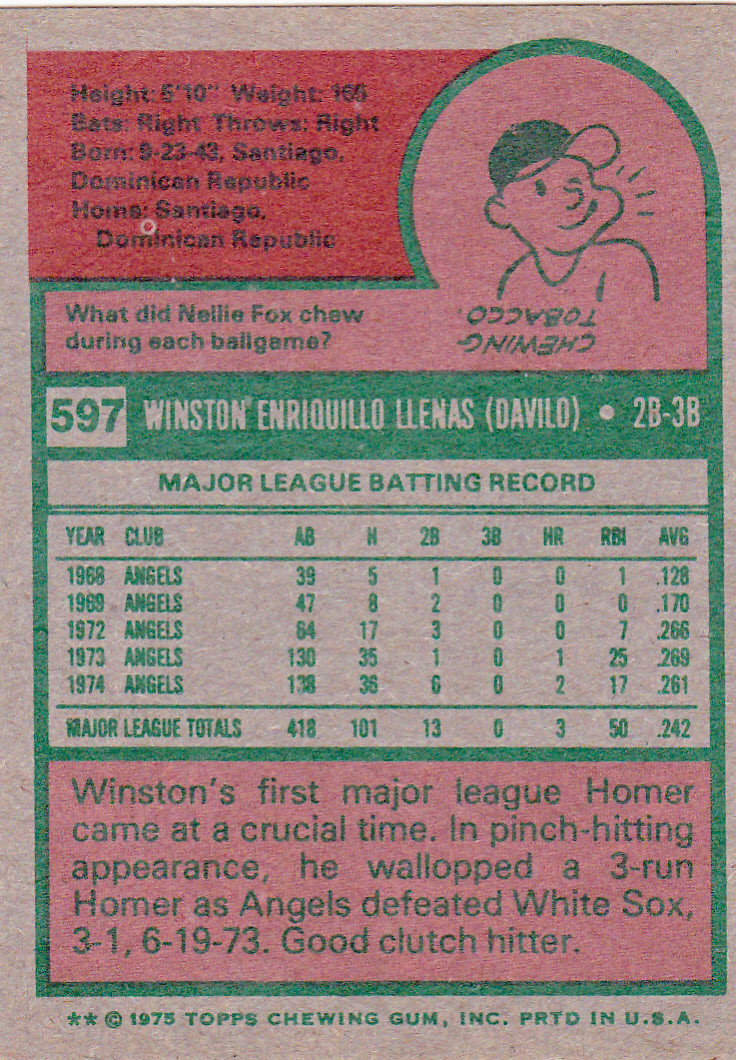
#597 - Winston Llenas


Card fact: This is Winston Llenas' final Topps card.

What I thought about this card then: I had the mini card, as I did with several of the Angels cards. I thought the bunting pose was cool.

What I think about this card now: Llenas is also shown bunting in his only other solo Topps card, in the 1974 set. He had seven sacrifice bunts for hits in his career. Is that enough to show him bunting in back-to-back sets?

Other stuff: Llenas started out in professional baseball when he signed as a teenager with the Kansas City A's back in 1961. He was released but a year later signed with the L.A. Angels. He played in the minors for the next six years before getting called up in 1968.

Llenas played with the Angels between 1968-69 and then 1972-75. He was used a lot as a pinch-hitter and led the American League in pinch-hits and pinch-hit at-bats in 1973. He finished his career batting .230.

His number is retired by Aguilas Cibaenas of the Dominican Winter League, where Llenas led the team to repeated success as a player, manager, GM, and team president.


Back facts: Well, we've finally got a player displaying a "chaw," but it's a cartoon Nellie Fox on the back of this card.

Other blog stuff: The green-light green border combo has moved back into sole possession of the overall lead with its 51st card.

Saturday, June 18, 2011

#573 - Orlando Pena


Card fact: This is the final Topps card of Orlando Pena issued during his career.

What I thought about this card then: I didn't see it.

What I think about this card now: I believe Pena is wearing a Cardinals uniform in this photo as he was traded by the Cardinals to the Angels in September of 1974.

Other stuff: Pena was known as a junk-ball pitcher, but used his variety of pitches to compete in the majors from 1958 to 1975. His first baseball card was in the 1959 Topps set. From that point, his appearance in the major leagues was sporadic. He was used as a reliever with the Reds at the start of his career, but when he went to the Kansas City A's, he became a starter. He lost a league-high 20 games in 1963.

Pena returned to a relief role for the A's and the Tigers, appearing in 50 games a season regularly. But by the late '60s, he was back in the minor leagues. Pena lacks a baseball card from 1969-73 as he bounced between the minors, the Indians, Pirates and Orioles.

He found a spot with the Cardinals in 1974, and enjoyed a renaissance at age 38, appearing in 46 games and registering a 2.21 ERA. He had one more season with the Angels in '75. After his career, he became a scout for the Tigers. Even at age 77, he's still listed as a scout.


Back facts: Hank Aaron might be on more '75 cartoons than any other player. The phrasing of the question is kind of odd.

Other blog stuff: The blog is taking a breather for a couple of days. It will be back with a new entry soon though.

Tuesday, May 24, 2011

#548 - Charlie Sands


Card fact: This is the final card issued of Charlie Sands during his career. It is also one of three cards in the set of Angels catchers. Tom Egan and Ellie Rodriguez are the other two. All three are posed in catcher's crouches.

What I thought about this card then: Didn't see it. Sands was another one of those players I had never heard of until trying to complete the set decades later.

What I think about this card now: You've got to give Sands bonus points for wearing the chest protector and the shin guards. Neither Egan nor Rodriguez went that far.

Other stuff: Sands was a backup catcher for the Yankees, Pirates, Angels and A's between 1967-75. Sands played in just one game with the Yankees in '67, but stayed the entire season with the big league team because he was a Rule V draft pick-up.

After 1967, Sands didn't play in the majors again until 1971. He had one at-bat for the Pirates in the 1971 World Series.

Sands is also known for catching all 29 innings of what was once the longest game in professional baseball. Playing for the Miami Marlins on June 15, 1966, Sands helped the team beat the St. Petersburg Cardinals (coached by Sparky Anderson) 4-3.

The record for the longest pro game is now the famed 33-inning affair between Pawtucket and Rochester in 1981. But that game was suspended in the 32nd inning and resumed two months later. The 29-inning game remains the longest uninterrupted professional game.

One other thing: Sands was the only major league player by the name of Sands until future Dodger great Jerry Sands was called up to the majors this year. The two are not related.

(EDIT: Charlie Sands died on Aug. 22, 2016)


Back facts: John Summers definitely is known more by his nickname "Champ." Champ Summers would play 11 major league seasons, mostly for the Reds and Tigers and appear in the World Series with San Diego.

Also, the copy writer on this card must have a lisp. I'm pretty certain "missed" does not have three s's.

Other blog stuff: Speaking of Ellie Rodriguez, he turns 65 today.

Sunday, May 8, 2011

#533 - Rudy Meoli


Card fact: This is one of just four Topps cards of Rudy Meoli during his career.

What I thought about this card then: Sadly, I never saw it.

What I think about this card now: I have read a number of times now about how this was considered one of the great cards in the set by kids collecting in 1975. I'm sure if I saw it when I was a kid, I would think the same thing. It is an action card during a time when action cards barely existed. Not only that, it is one of the more unusual action cards that you will see -- a batter popping straight up. No doubt the catcher is running madly right now attempting to grab the foul ball.

The combination of the unusually dramatic photo and the yellow-red border made young collectors believe this player was a superstar. All of the yellow-red bordered cards evoked the same belief, since all of the all-star cards also featured yellow-red borders, only with a star for the position instead of a baseball.

Other stuff: Meoli was a backup shortstop for the Angels, Cubs and Phillies. He started out as a potential starting shortstop candidate with California and received the starting job in 1973, but managed to hit just .233 in 305 at-bats. The rest of his career, which lasted until 1979, was as a supporting player.


Back facts: Meoli's six RBIs came in a game the Angels won 19-8. His inside-the-park home run was in the fifth inning with the Angels already winning 16-5. Each starting pitcher in that game lasted two-thirds of an inning.

Other blog stuff: I also have the OPC version of the Meoli card. If you're wondering why I'm not showing the OPC version, it's because I've already done so.

Friday, April 29, 2011

#524 - John Doherty


Card fact: This is the only card of John Doherty issued by Topps during his career.

What I thought about this card then: I had the mini card. He reminded me of Moose from the Archie comic books. Who didn't read Archie when they were a kid?

What I think about this card now: That is one impressive display of the single ear-flap helmet.

Other stuff: Doherty's major league career lasted just two years, 1974 and 1975 with the Angels. He was a part-timer first baseman and outfielder. He played in 74 games in '74 and just 30 games in '75. In 1977, he was traded to his hometown Boston Red Sox, but never played in the majors for them.

Doherty is one of two people named John Doherty to play in the majors. The other is pitcher John Doherty, who played for the Tigers in the mid-1990s. I interviewed pitcher Doherty many times during his first year of pro ball in Class A Niagara Falls. I believe the first time I saw him on the roster that year, I thought of the card of first baseman Doherty. Then I probably immediately looked to see if they were related. They aren't.


Back facts: Nothing like seeing a liner screaming toward you in the dugout.

Other stuff: On this date in 1953, Babe Ruth League baseball became known by its current name. It used to be called the Little Bigger League.

Monday, April 4, 2011

#500 - Nolan Ryan


Card fact: This is the first time in Nolan Ryan's career that Topps gave him a card with a century number. He would receive it again in the 1978 set (#400) and the 1986 set (#100). Then, late in his career, Topps handed over card No. 1 to him. He appeared at that spot from 1990-92.

It's also the fourth and final time Ryan appears in the set. He appears in the set more often than any other player.

What I thought about this card then: My brother had this card. I associated Nolan Ryan with him for a period.

What I think about this card now: Out of all the cards in this set that I would like to upgrade (there actually aren't that many), this is at the top of the list. But it's such a pricey card, that I've never pulled the trigger on another one.

Other stuff: So what do I say about someone who many consider the greatest pitcher of all-time? Well, I had a feeling of indifference toward him for much of his career, combined with periodic disgust and admiration.

Ryan pitched for teams that were a long way from me -- the Angels, Astros and Rangers (I don't remember his Mets days). I remember him mostly with the Astros. I can recall working as a paper boy and reading about him signing his big contract with Houston as I bagged newspapers.

I wasn't very happy when he no-hit the Dodgers for his record fifth no-hitter. I remember one of the networks switching to the Astros-Dodgers game to show Ryan's 9th inning and pleading with Dusty Baker to get a hit.

But the rest of his career -- on and off the field -- has been enjoyable. I like that he was able to assemble a Rangers team that finally could win some games and reach the World Series. I've been waiting for that ever since I was a collector in 1975.


Back facts: I have known that Ryan's real first name is Lynn for a long, long, long time. I had a crush on a girl in 9th grade whose name was Lyn. It was the first time I knew anyone with that name since I read the back of the '75 Ryan card. I wondered whether the female version of the name had just one "N." You know, like Francis and Frances. I still don't know for sure.

By the way, the last name of my 9th grade crush is the same as a super-famous rookie one-year wonder. Feel free to guess.

Other blog stuff: It is time to take a moment to review the set.

Ready? Let's go!

1. COLOR COMBINATIONS

The orange-brown combination continues to lead the way, but its lead is getting smaller and smaller. Other combinations have crept closer, led by the pink-yellow combination, which is just three cards away:

1. Orange-brown: 45
2. Pink-yellow: 42
3. Purple-pink: 41
4. Green-purple: 40
5. Green-light green: 38
6. Yellow-red: 31
7. Blue-orange: 22
8. Brown-orange: 22
9. Brown-tan: 22
10. Light blue-green: 22
11. Yellow-light blue: 22
12. Red-blue: 21
13. Red-orange: 21
14. Green-yellow: 21
15. Tan-light blue: 21
16. Red-yellow: 20
17. Orange-yellow: 20
18. Yellow-green: 16

2. POWDER BLUE UNIFORMS

Cleaning up here. 15 more powder blue appearances, adding up to 64, so far.

3. LOOKING UP

Six more players looking into the distance for a total of 17. I would've thought there would be more.

4. DUDE LOOKS LIKE A LADY

Not a single player looked girlie in the last 100 cards. The 400s must be the domain of the manly. Grand total stays at 9.

5. DECEASED

Nine more players are no longer with us. That's a total of 48 so far.

6. CHAW

Don Carrithers is added to the list. Four players so far were not afraid to display that disgusting habit.

7. MLB SONS

Three more players had sons that played in the majors, too. That's a total of 22 at this point.

8. ROOKIE CUP/ALL-STAR

7/14

Not a single rookie cup in the last 100 cards.

9. MOST POPULAR FIRST NAME

Jim remains ahead of Dave/David. Twenty players in the set are named Jim.

10. MINIS

Another mini surge. There have been 78 cards so far that I have in mini form. That's up to 15.6 percent of the set.

OK, I'm done looking back. ... Well, not really. The whole blog is about looking back, isn't it?

Anyway, the next card is a dude named Robinson. But it's not the guy you're thinking of -- unless you know this set very well.

Friday, March 11, 2011

#476 - Ed Figueroa


Card fact: This is Ed Figueroa's rookie card.

What I thought about this card then: I had the mini card. I apparently didn't like it very much because there are creases all over it. I wish I had scanned it to show its miserable condition.

What I think about this card now: Digging the blue glove. The man should be a Dodger.

Other stuff: First things first. Ed Figueroa was the home starting pitcher in the first major league game I ever saw in person. He pitched for the Yankees at the time, and most importantly, he lost.

Figueroa was acquired by the Yankees from the Angels in the trade that sent Bobby Bonds to the Angels (the Yankees also acquired Mickey Rivers). Figueroa had just had his breakout season in the majors, going 16-13 for last-place California in 1975.

While with the Yankees, he won 20 games in 1976, becoming the first Puerto Rican pitcher to win 20 games in the major leagues. Figueroa continued to be a top-line starter for the Yankees during their years of three straight World Series appearances from 1976-78. His postseason record, however, was miserable. He was 0-4 in seven starts with a 7.47 ERA.

Figueroa ran into arm problems in 1979 and pitched in just 16 games. He was purchased by the Rangers in mid-season 1980, but struggled mightily in Texas. He ended his career rejoining Billy Martin in Oakland, in 1981.

Figueroa, who was first signed by the Mets, and served in the Vietnam War, is the uncle of Astros pitcher Nelson Figueroa. After retirement, Ed started a restaurant in his native Puerto Rico, which he still runs.


Back facts: Figueroa was a busy guy before reaching the major leagues. He was 28 by the time he broke through as a starter/reliever with the Angels in 1974.

Other blog stuff: Players in this set who were born on this date are Cesar Geronimo (#41) and Dock Ellis (#385).

Wednesday, February 2, 2011

#441 - Bobby Heise


Card fact: Bobby Heise is airbrushed into an Angels cap. He was acquired from the Cardinals in a deadline deal in July of 1974. But Heise would be dealt to the Red Sox before this card even hit the streets.

What I thought about this card then: Didn't see it.

What I think about this card then: This is one of about a dozen cards in the set that I have in OPC form.

Also I like how the facsimile autograph is positioned along Heise's jersey. It's as if he signed it himself!

Other stuff: Heise was a utility infielder who played in the majors for 10 years for seven teams. He is probably most known for playing for four pennant-winning teams, but never playing in the postseason. He was on the 1969 New York Mets, the 1971 San Francisco Giants, the 1975 Boston Red Sox and the 1977 Kansas City Royals.

This is the final card issued during Heise's career, even though he would play in '75 and '76 for the Red Sox and '77 for the Royals. After his career he became both a fire fighter and a police officer.


Back facts: There is the mention of Heise getting dealt to the Red Sox. It's basically Topps documenting its own failure. It went through all that effort to airbrush Heise as an Angel, and he ends up on the Red Sox roster in 1975.

Other blog stuff: On this date, 1970s blond bombshells Farrah Fawcett and Christie Brinkley were born.

Sunday, January 9, 2011

#417 - Skip Lockwood


Card fact: Skip Lockwood appears to be airbrushed into an Angels cap and uniform, which is somewhat puzzling. That's because he was airbrushed into an Angels cap on his 1974 Topps card, after he was traded from the Brewers to the Angels in October 1973. You would think that with an entire year to get a photo of Lockwood in an Angels uniform that Topps would be able to go without the airbrushed look. But that cap ain't looking right.

What I thought about this card then: Oh, boy, this was one of those cards that I really, really liked for no reason. My brother had this card. I thought it was very cool. I think it was because of his name, which is strange because "Skip" is actually a terrible first name. It's a step away from "Skippy," and no one wants that.

What I think about this card now: What is that mountain/hill/mound called that appears in the background of all of those Cactus League photos? I know someone has mentioned it before. Help out the poor Northeasterner.

Other stuff: Lockwood is known mostly for his relief work for the New York Mets during the late 1970s. But before that he was a starter, and before that he was a third baseman. He converted to pitcher in the minor leagues. After coming up with the Seattle Pilots, he was a starter for the Brewers in the early '70s. When he came over to the Angels in an eight-player deal, he became a relief pitcher.

Lockwood bounced from the Angels to the Yankees to the A's to the Mets in a matter of months before finding his niche at Shea Stadium. He pitched there for five years. His final season was 1980 with the Red Sox.

Lockwood later became a bank president and CEO of an internet marketing company (he's a graduate of MIT). He's also a motivational speaker.


Back facts: As you can see, "Skip" was a nickname.

Also, you see at the bottom the write-up that conveys the panic that Topps felt about all the traveling Lockwood did between the end of 1973 and mid-1975. First they mention the Brewers trade, then they cram in at the end that he's not really an Angel at all! Oops! He was traded to the Yankees after their little airbrush creation.

The Yankees released Lockwood in early April of 1975, so even the sentence that Topps included at the last minute was obsolete by the time many kids pulled this card from a pack.

Other blog stuff: On this date in 1980, Duke Snider was elected to the Hall of Fame in his 11th year on the ballot. I suppose there may have been some complaints that it took him so long to get into the Hall, I don't know for sure. But I guarantee you it was nothing compared to the wailing and gnashing that goes on now.

Friday, December 10, 2010

#392 - Bruce Bochte


Card fact: This is Bruce Bochte's rookie card.

What I thought about this card then: I had the mini card. I didn't like it. I thought Bochte was wearing makeup.

What I think about this card now: Signing your name with a lower-case letter to start your first and last name is a definite attempt to set yourself apart. Either that or Bochte really didn't like the capital letter "B."

Other stuff: Bochte was a good contact hitter for the Angels, Indians, A's and especially the Mariners. His 1979 season with Seattle led to his only All-Star appearance. He drove in 100 runs and hit .316 that year. Bochte played 12 seasons in the majors, finishing up with Oakland in 1986.

After his career, some labeled him as a spacey kind of guy for his thoughts on nature, earth and how human beings fit into the whole thing. It's called cosmology, and there is no way I can explain it sufficiently. This where-are-they-now article about Bochte gives you his thought process better than I could.


Back facts: Frank Isbell is another old-timey player. He played for the White Sox between 1898-1909.

Other blog stuff: On this date in 1971, the Mets traded Nolan Ryan and three prospects to the Angels for Jim Fregosi.

Tuesday, November 9, 2010

#366 - Ken Sanders


Card fact: Ken Sanders is airbrushed into an Angels cap on this card. He was released by the Indians in mid-season of 1974 and picked up by the Angels a week later.

What I thought about this card then: It absolutely freaked me out. I just addressed this card on the other blog. I was disturbed by the ball player who kind of looked like a woman -- but not really. Unlike some of the other players that we laughed at and tried to sneak into friends' collections, this card genuinely bothered me. I didn't want it in my collection at all.

What I think about this card now: I don't know why guys got haircuts like that in the '70s.

Other stuff: Sanders was a career relief pitcher for 13 seasons and nine teams from 1964-76. He started just one of the 408 games in which he appeared. His best stats are the 1.75 ERA he put up for the Brewers in 1970, and the league-leading 83 games he appeared in for Milwaukee in 1971.

But Sanders didn't play for an above .500 team (except for a brief appearance with the '68 Oakland A's) until the end of his career, which explains his 29-45 career won-loss mark. After his career, Sanders went to work for the Players Alumni Association. He also built a successful career in real estate.


Back facts: The write-up sounds so formal. "Accepted chances"? Does that mean he had the option of turning down the ball if it came to him? According to Baseball Almanac, 13 chances is the record for a major league pitcher, but Sanders is not listed. Perhaps Sanders' feat happened in a minor league game.

Other blog stuff: Television's "The Incredible Hulk," Lou Ferrigno, was born on this date in 1951. Too bad we don't have a card with a green-purple color border today. It was named in honor of the Hulk.

Saturday, October 16, 2010

#342 - Leroy Stanton


Card fact: This is the first card that I ever saw in both regular-sized form and mini form. In 1975, during my first year of collecting cards, my friends and I had so few cards that there were players that we knew to be on regular-sized cards and players that we knew to be on mini cards. It was as if players on regular-sized cards didn't exist on mini cards and vice versa, even though we knew that they did.

I had the mini version of the Leroy Stanton card first. When I saw the regular-sized version if Stanton, it practically blew my 9-year-old mind.

What I thought about this card then: This was my favorite Angels card in the set. It was also one of my favorite cards in the set, period. I liked the batting pose.

What I think about this card now: The jacket under the uniform is obvious, but we didn't give it a thought as kids. It never seemed strange.

Other stuff: Stanton started out with the Mets, but came over to the Angels in the deal that also brought Nolan Ryan to California in exchange for Jim Fregosi (I mentioned this trade just four cards ago). Stanton had five productive seasons for the Angels.

He was selected by the Mariners in the expansion draft, and became one of the team's leading sluggers (along with Ruppert Jones and Dan Meyer) with 27 home runs and 90 RBIs in 1977, Seattle's first season. The next year, Stanton hit just .183 with three homers, and that was his final season.

(Edit: Stanton died in a car crash at age 72 on March 13, 2019).


Back facts: The cartoon is etched in my brain, but I haven't hard the term "tweener" in decades.

Also, this is the second straight time that the card write-up mentions a very impressive game by the player featured.

Other blog stuff: Here is the mind-blowing regular-sized card and mini-sized card, side-by-side:

Sunday, September 19, 2010

#317 - Joe Lahoud


Card fact: This card lifts the "green-yellow" combo out of second-to-last place in the color combo standings.

What I thought about this card then: I had the mini card. I never knew how to pronounce Joe Lahoud's last name. I think we called him "Joe Loud" as kids, which I know isn't right.

What I think about this card now: I'm thinking how difficult it is to come up with something to say about this card.

Other stuff: Lahoud was an outfielder-designated hitter for chiefly the Red Sox, Brewers and Angels throughout the 1970s. His best season was 1974 when he set career single-season records in just about every category, despite playing in just 127 games and having 325 at-bats. His biggest achievement that year might have been hitting .271 as he hit .223 for his career.

According to baseball-reference, Lahoud is one of the few major league players with a Lebanese-American background. Wikipedia says his grandfather played in the Negro Leagues. Also according to B-R, Lahoud was kicked off his college baseball team for mouthing off to the coach.


Back facts: That's right, Johnny Mize was "The Big Cat." You hear that Rockies fans? Johnny Mize. Not Andres Galarraga. Johnny Mize. Find your own nickname.

The write-up at the bottom is interesting, not only because it highlights Lahoud performing well against what is now his new team, but it neglects to mention that the Brewers LOST that game.

While playing for Milwaukee, Lahoud hit a grand slam in the top of the ninth that turned a 3-0 deficit into a 4-3 lead. But the Angels tied the game with a run in the bottom of the ninth. And then the Angels scored again in the 10th on a Leroy Stanton walk-off home run to win 5-4. So much for Joe's "biggest hit."

Other blog stuff: For the second post in a row, I'm showing the mini card next to the regular-sized card.


The mini card has water damage, which you probably can't see. But in person it's obvious it either went through the wash or got dropped in a puddle. Or both.

Wednesday, August 18, 2010

#285 - Ellie Rodriguez


Card fact: This is the seventh card in the set of a player posed in a catcher's crouch. I would have thought there would have been more by now.

What I thought about this card then: Believe it or not, this was a "dude looks like a lady" card. As a youngster, I thought Rodriguez looked girlish. Maybe it was because his first name was "Ellie" or maybe it was because the first time I saw this card it was owned by my friend Jennifer. I don't know. It's just what I thought at the time.

What I think about this card now: The cap reminds me very much of a cap I wore as a kid. But instead of the "A" on the cap, it had an "L.A." as in the old Los Angeles Angels. A well-meaning relative bought me a "Dodgers" cap that actually was a "Los Angeles Angels" cap, patterned after the Angels' caps of the 1960s. I didn't know any better at the time and wore it.

Other stuff: Ellie Rodriguez was coming off possibly his best year in the majors as he played in a career high 140 games and had a career high 395 at-bats in 1974. He came over to the Angels from the Brewers in an eight-player deal. Rodriguez was the semi-regular catcher for the Brewers. Before that he played for the expansion Royals and briefly with the Yankees.

Rodriguez ended his career as a back-up with the Dodgers in 1976 (his 1977 Topps card was the first Dodger I pulled that year). He is now a consultant and scout for the independent Atlantic League of Professional Baseball.

(EDIT: Ellie Rodriguez died at age 79 on April 23, 2026).


Back fact: It seems rather odd that Topps chose Rodriguez for a card number that ended in "5." Those numbers were usually reserved for semi-stars.

Also, the Red Rooster has been featured on the blog already.

Other blog stuff: On this date in 1975, Ralph Kiner, Babe Herman, Earl Averill, Bucky Harris and Judy Johnson were inducted into the Baseball Hall of Fame.

Wednesday, July 21, 2010

#261 - Andy Hassler


Card fact: This is Andy Hassler's rookie card.

What I thought about this card then: Never saw it.

What I think about this card now: Yet another Angel in this set who is wearing a black arm patch. As Steve, from White Sox Cards, commented in the last Angels player post, the patch is in the memory of an Angels prospect, Bruce Heinbechner, who died in a car accident in the spring of 1974.

Other stuff: Hassler played 14 seasons for six different teams. Everyone can use a lefty on the mound. During the 1975 and 1976 seasons, he lost a franchise record 17 straight games. This was the time when the Angels had Nolan Ryan and Frank Tanana on the staff, so fans must have just thrown up their hands when it was Hassler's turn on the mound.

But Hassler had his moments. He pitched two one-hitters. He participated in the postseason with the Royals in 1976 and 1977 (losing twice to the Yankees) and the Angels in 1982. He also was on the Cardinals' NL championship team in 1985.

(EDIT: Sadly, Andy Hassler died at age 68 on Christmas day, 2019).


Back facts: Since this set came out, two other National Leaguers have hit two grand slams in one game. The first was the Cardinals' Fernando Tatis, who hit two in ONE INNING off the Dodgers' Chan Ho Park in April of 1999. What a sickening day that was. The second happened just last year, when Josh Willingham hit grand slams in back-to-back innings for the Nationals.

Also, in case you were wondering about Hassler's major league debut, he started the game against the Yankees, pitched four innings, allowed six hits, five walks, two runs and took the loss in a 3-0 defeat.

Other blog stuff: Today is the Mad Hungarian's birthday. Al Hrabosky turns 61.

Monday, June 21, 2010

#236 - Angels/Dick Williams


Card fact: Dick Williams was the third of of three managers for the Angels in 1974, so I wouldn't be a bit surprised if Williams is airbrushed into his Angels cap. It looks fairly legitimate, but I don't have the card in hand now to give it a good study.

What I thought about this card then: Team card. Zzzzzzzzzzz.

What I think about this card now: I'm having a hard time believing the guy in the blue plaid sport coat is an actual member of the club. It looks like the team was doing some charity work and took the guy in off the street.

Other stuff: The Angels out-and-out stunk in the mid-1970s. In 1974, Bobby Winkles wasn't getting it done, so he was canned and replaced with coach Whitey Herzog, who managed four games on an interim basis. Williams then finished out the season and lasted until the middle of the 1976 season, when the Angels continued to emit a putrid odor and replaced Williams with Norm Sherry.

Keep this in mind: all of this happened with Nolan Ryan pitching for the team. Frank Tanana, too.

Of course, Williams went on to manage the Padres, Expos and Mariners, and also led the Red Sox and A's to the World Series. The Angels were probably the low point of his Hall of Fame career.


Back facts: I count at least six or seven players on this checklist whose photos are airbrushed in this set. The Angels made quite a few transactions around this period.

Other blog stuff: Let's see if Topps left off anyone important from the 1974 Angels team when it put out the 1975 set.

The Angels used a whopping 45 players in the 1974 season, the most of any team that has been featured so far. Topps did its best and put 31 of those players in the 1975 set. Five of the players are airbrushed into other uniforms as Frank Robinson, Bob Oliver, Tom McCraw, Sandy Alomar and Rudy May all left the team in deals.

Topps didn't miss anyone notable. Paul Schaal played more games at third base than any other player for the Angels in 1974, but it amounted to just 165 at-bats and he didn't play after 1974.

So with all those players, Topps managed to feature 68.89 percent of the 1974 Angels in the 1975 set. Here is where the Angels rate with the teams mentioned so far:

1. Tigers 78.37% of players featured
2. Orioles 78.13%
3. Giants 71.43%
4. Royals 70.59%
5. Red Sox 70.27%
6. Angels 68.89%
7. Expos 68.29%
8. Phillies 62.5%
9. Padres 55.8%

Sunday, May 30, 2010

#215 - Bobby Valentine


Card fact: This is about the sixth or seventh Angels card that has shown the player wearing a black patch or piece of tape on their left sleeve. If it was worn as a memorial for someone, I can't find it here. If anyone knows why so many Angels wore that in 1974, I'd love to hear the reason.

What I thought about this card then: I vaguely recall someone having the mini card.

What I think about this card now: It's odd to see Bobby Valentine so young.

Other stuff: Whenever I think of Bobby Valentine now, I think of his stints on ESPN and his time as a manager with the Mets and Rangers and how colorful he was/is during those times. But Valentine was once a promising young player for the Dodgers -- the team's first-round draft choice in 1968. He struggled a bit to stay in the majors with L.A., but still had enought promise that the Dodgers were able to get Andy Messersmith for Valentine in a trade with the Angels. Then Valentine suffered a horrific leg fracture in 1973 when he got his spike caught in a fence while chasing a flyball. After that he bounced from team to team and never fulfilled that promise.

I was always amused by Valentine and wonder what his behavior was like as a player. He must've been crazy.


Back facts: You can see that Topps thought Valentine still had enough promise to deserve a card number that ended in "5."

Other blog stuff: Birthday time: Today is Manny Ramirez's 38th birthday. Win a World Series before you turn 39, Manny, and I don't care what you do after that.

Sunday, May 2, 2010

#187 - Denny Doyle

Card fact: Back-to-back yellow-red cards. That's the first time that's happened.

What I thought about this card then: Never came across it. However, Denny Doyle was mentioned quite a bit during my childhood. We thought he was kind of goofy-looking. My brother, especially, did. And that was strange, because Doyle was on the Red Sox at the time and the Red Sox are his favorite team. But anyone and anything was fair game for my brother.

What I think about this card now: That's a nice mountain view. Also, I like Doyle's signature.

Other stuff: Like I said, I knew Doyle as a Red Sox second baseman. He was a pivotal part of the Red Sox's pennant drive in 1975. It's strange for me to see Doyle as an Angel or a Phillie, the teams he played on before coming to the Red Sox.

Doyle's career was rather short, lasting from 1970-78. When he was replaced at second base by Jerry Remy in 1978, he retired at age 35. He was known as a good fielder, but an average or even below average hitter. Doyle and his brothers have operated a very successful baseball academy for the last three decades.

(EDIT: Denny Doyle died at age 78 in December 2022).

Back facts: Doyle's younger twin brothers are Blake and Brian Doyle. Blake played nine years in the minors. Brian made a big impact in his first year with the Yankees during the 1978 World Series against the (*ahem*) Dodgers. I thought it was a fiendish plot that this guy I never heard of would get big hits against my team. Just more evidence that the Yankees were the devil. Fortunately, he was out of the majors by 1982.

Other blog stuff: Yellow-red just moved into third place with this card. If you include the all-star cards we have come across so far, yellow-red actually holds the lead with 19 cards.