Showing posts with label green-yellow. Show all posts

Thursday, September 15, 2011

#650 - Dave May


Card fact: This is the last of five players with the last name "May" in the set. The others were Lee, Carlos, Milt and Rudy.

What I thought about this card then: My brother had this card. We thought the card was weird and May a bit odd-looking. It's not the most flattering photo.

What I think about this card now: May is airbrushed into a Braves cap and jersey because he was JUST TRADED FOR HANK AARON.

Other stuff: May was an outfielder who came up with the Orioles. He didn't hit a lot with Baltimore and was traded to Milwaukee, where he became a productive offensive threat. In 1973, he enjoyed his best season, hitting 25 home runs, knocking in 93 and hitting .303.

In 1974, he fell off quite a bit, batting only .226. That led to the trade that made May an answer to a trivia question: "Who did the Braves acquire in a trade for Hank Aaron?" May was dealt to Atlanta, along with player-to-be-named Roger Alexander, for Aaron on Nov. 2, 1974.

May played only part-time for the Braves for two seasons, then was traded to Texas in another big deal as the Rangers shipped Jeff Burroughs to Atlanta. May spent one year with the Rangers, then returned to Milwaukee and finished his major league career in Pittsburgh in 1978.

May's son, Derrick, played for the Cubs and five other teams from 1990-99.

(EDIT: May died on Oct. 20, 2012)


Back facts: Well, Topps was a bit bold with the write-up, but it's spot-on. That is what people know about Dave May.

Also, if the cartoon leaves you wondering and you have all the time in the world, here is far too much information, on baseball's longest throws. Glen Gorbous is mentioned somewhere in there, eventually.

Other blog stuff: On this date in 1975, Mets rookie Mike Vail extended his hitting streak to 23 straight games. This is one of the earliest baseball-on-TV viewing memories that I have.

Wednesday, September 14, 2011

#649 - Jack Heidemann


Card fact: This is the only Topps card of Jack Heidemann in which he's featured wearing long hair and a mustache. From 1970-73, he's clean-shaven. When he reappears on a Topps card in 1977, he's also clean-shaven.

What I thought about this card then: Never saw it.

What I think about this card now: When I was trying to complete the set in 2004, this was the first card I came across in which I had never heard of the player. This was absolutely stunning to me. I had prided myself on knowing 1970s players, especially from the period when I collected as a kid. I didn't think it was possible that there were players in the '75 set that I didn't know.

It turns out there was more than Heidemann. There are probably 30-40 players in the set in which I had never heard of them until I completed the set in 2004. But that's the fun of collecting cards.

Other stuff: Heidemann was a first-round draft pick of the Indians and played the 1970 season as Cleveland's starting shortstop. In 133 games and 445 at-bats, Heidemann hit .211 and struck out 88 times. His playing time decreased after that, partly because of an inability to hit and partly because of injury.

He played with Cleveland through 1973. With the Cardinals in 1974, he enjoyed his best year, which probably explains Topps giving him a card in '75 after no card in the '74 set. He then went to the Mets and was used as a utility infielder both by New York and the Milwaukee Brewers between 1975-77.


Back facts: This is the last cartoon in the set featuring an animal.

Other blog stuff: In case you don't read Night Owl Cards, I announced over there that after this blog is finished, I will be doing another set blog. However, I won't be starting it right away. I need a break from doing two blogs.

I'm reasonably sure which set I will feature once I decide to start another blog. But I'm not ready to reveal that now. Stay tuned.

Monday, September 12, 2011

#647 - Claudell Washington


Card fact: Well, well, rookie cup, where have you been? It's been 135 cards since the last rookie cup. And this is the final Topps All-Star Rookie cup card in the set.

What I thought about this card then: My friend, the A's bandwagon fan, had this card. He instantly declared it cool. Who was I to argue?

What I think about this card now: For the first time -- and keep in mind I have seen this card for 35 years -- I am realizing that there is a bat in the photo. I don't know how I've missed that for so long. But it certainly makes Claudell Washington look that much more ominous.

Also, that signature is very tiny.

Other stuff: Washington was an instant success with Oakland. Picked up off the sandlots in Berkeley, Calif., as a 17-year-old, he was 20 years old when he reached the majors. A decent World Series showing in '74 (he was 4-for-7), signaled a star in the making. In 1975, he reached the All-Star Game during a year in which he hit .308 and racked up 182 hits.

But Washington couldn't sustain that pace throughout his career. He was traded five times during a 17-year career and signed as a free agent three other times. All told, he played for the A's, Rangers, White Sox, Mets, Braves, Yankees and Angels. He had some success with just about every team, although his time in Chicago was marred by an oversleeping incident, causing fans to roll out the "Washington Slept Here" joke.

Washington hit three home runs in a game twice, once in each league. He revived his up-and-down career during a five-year stint with the Braves, although that was also marred by confessions of drug use and a trip to a drug diversion program.

Washington finished up with some decent seasons with the Yankees. Of interest to no one but me, he was one of the final cards I needed to complete the 1989 Topps set.

(EDIT: Claudell Washington died on June 10, 2020).


Back facts: The cartoon implies that Dick Stuart was a poor fielder, but doesn't come right out and say it. So I will. Dick Stuart was a poor fielder.

Other blog stuff: The 1974 Topps All-Star Rookie Team is complete. So let's have a look at it!

1B - Mike Hargrove
2B - Larry Milbourne
3B - Bill Madlock
SS - Bucky Dent
OF - Bake McBride
OF - Greg Gross
OF - Claudell Washington
C - Barry Foote
P - Frank Tanana


That's not an epic team, but everyone on that squad enjoyed decent and long careers. Some, like Tanana and Gross, remade themselves later in their career and extended it as a result. The average career span for the nine players is exactly 14 years.

Wednesday, August 31, 2011

#637 - Ted Martinez


Card fact: I've lost track of the number cards in which the signature doesn't match the name listed on the bottom. But here is another example. Ted Martinez refers to himself as "Teddy."

What I thought about this card: I first saw this card in the possession of my friend Jamie, the Mets/Yankees lover.

What I think about this card now: It's a great '70s card. The pinstriped Mets uniform, the Shea Stadium scoreboard, the American flag.

Other stuff: Martinez played nine seasons in the major leagues, mostly at shortstop. But he also played a lot of second base and the outfield. He was mostly a backup, but did appear in over a 100 games in 1972, 74 and 75. He played for the Mets, Cardinals, A's and Dodgers.

Martinez played on pennant-winning teams with the Mets (1973), A's (1975) and Dodgers (1977-78). But he never played in the postseason with L.A. Interestingly, it was with the Dodgers where he revived his career (after not playing in 1976), as a utility infielder.

Martinez managed and coached in the Dodgers organization after his playing career.


Back facts: That cartoon always freaked me out as a kid. "What happened to his legs?"

Other blog stuff: Former Tiger/Ranger/Rockie/Red Sox/Brewer/Ray Gabe Kapler was born on this date in 1975.

Friday, August 26, 2011

#632 - Morris Nettles


Card fact: This is Morris Nettles' rookie card.

What I thought about this card then: I didn't see it.

What I think about this card now: This is the first 1975 O-Pee-Chee card I ever obtained. When I was trying to complete the set in 2004, the dealer that I went to a lot owned rows and rows of '75s. There were some OPC's mixed in, too. Not knowing that it was an OPC card at the time, since the fronts of the '75s are the same as Topps, I bought it and didn't realize it wasn't Topps until I got home.

I went through the same process several other times in '04 and now I have about 15 OPC cards from '75.

Other stuff: Nettles came up to the Angels in 1974 and found a spot in the outfield later in the season. The following season, the Angels rewarded the speedy player with the starting center field job. But a young Mickey Rivers took over the position in no time, Nettles was moved aside, and he managed just a .231 average in 1975.

Nettles was dealt to the White Sox after the season in the Bill Melton trade. Nettles never made it to the majors again, playing the 1976 season in the Chicago and Cleveland organizations.


Back facts: If I'm being picky -- and I am -- the cartoon figure is not standing in the on-deck circle.

Other blog stuff: On this date in 1991, No. 1 draft pick Brien Taylor signed a record $1.55 million contract with the Yankees. All your Brien Taylor cards just laughed at you.

Tuesday, August 2, 2011

#612 - Terry Hughes


Card fact: This is the only solo Topps card in Terry Hughes' career. He appears on a four-player rookie card as a Cardinal in the '74 Topps set.

What I thought about this card then: It was one of my Red Sox-loving brother's first Red Sox cards from the set, so it makes me think of my brother.

What I think about this card now: There are a lot more major leaguers who are looking like Hughes these days. It was a look that was out of style for a long time, but now it seems to be coming back.

Other stuff: Hughes was the No. 2 overall draft choice by the Cubs in the 1967 draft. He came up the majors with the Cubs for three at-bats, but spent the rest of his time in the minors before finally being purchased by the Cardinals in 1973.

Hughes appeared briefly with St. Louis, then was traded along with Reggie Cleveland and Diego Segui to the Red Sox. Hughes had his career highlight for Boston in 1974, appearing in 41 games and batting .203.

Hughes returned to St. Louis and the minors in 1976. He never appeared in another major league game after his '75 card hit stores. He is now a middle school phys ed teacher in his native South Carolina.


Back facts: Hey! A Dodger cartoon! It's been awhile.

Other blog stuff: "Archie Bunker," the late Carroll O'Connor, was born on this date 87 years ago.

Sunday, July 24, 2011

#603 - Lew Krausse


Card fact: This is the final Topps card issued of Lew Krausse during his career.

What I thought about this card then: This is another one of those cards that I associate with my brother because it was part of his collection. I was relieved that he had the card because we both didn't know what to make of the guy.

What I think about this card now: Krausse had Topps cards from 1963-73, but wasn't issued one in '74 because he barely played in the majors in '73. If you look at those earlier cards, he looks his age. But that '73 season must have been trying, because when I was a kid I thought Krausse was about 51 years old based on this photo. It still looks that way to me (although I concede I was being a little harsh as a youngster). Krausse was actually 31 at the time of this photo.

Other stuff: Krausse came up to the majors with the Kansas City A's in 1961 and was the youngest player in the big leagues at the time. He remained with the A's through the '60s, working as both a starter and reliever.

Krausse was dealt to Milwaukee and then to Boston. He returned to the A's in '73 but didn't get called up and was purchased by the Cardinals, where he played one game. Krausse made a comeback with the Braves in '74, pitching in 29 games. He was released after the season, signed again by the A's, and pitched in the minors in '75.

Krausse's father, also named Lew, pitched for the Philadelphia A's in the early '30s.

(EDIT: Lew Krausse died on Feb. 16, 2021)


Back facts: Of course, the Cubs do have lights now, installing them 13 years after this cartoon hit packs.

Other blog stuff: On this date in 1975, the Royals fired Jack McKeon and replaced him with Whitey Herzog. It proved to be a solid move as the Royals would make the playoffs three straight years under Herzog. But McKeon is still managing to this day.

Sunday, July 17, 2011

#596 - Ollie Brown


Card fact: This is Ollie Brown's first card as a Philadelphia Phillie, the last of his six major league teams. He is airbushed into an Angels cap in the 1974 Topps set.

What I thought about this card then: It was a mild favorite. When we would go to my grandma and grandpa's house on Sundays, they were able to pick up the Philadelphia Phillies games on television (we couldn't do that where we lived even though we were only 13 miles away). I distinctly remember seeing Ollie Brown in one of the games.

What I think about this card now: It looks very similar his 1976 Topps card, except better. This one has Brown with a mustache, wearing a helmet and in front of a batting cage.

Other stuff: "Downtown" Ollie Brown began with the Giants, playing four years for them in the 1960s and demonstrating a terrific throwing arm.

The Padres made Brown their No. 1 pick in the expansion draft in 1968. He was their starting right fielder for three-plus seasons before being traded to the A's in May of 1972 (for Curt Blefary and Mike Kilkenny).

Brown spent the next three years with the A's, Brewers and Astros, mostly in a supporting role. He was picked up on waivers by the Phillies before the 1974 season and used quite a bit as a pinch-hitter for Philadelphia from 1974-77, including in the playoffs against the Dodgers.

Brown's brother Oscar played for the Braves in the early '70s. Another brother, Willie, was a star running back for USC in the '60s and played in the NFL with the Eagles and Rams.

(EDIT: Brown died in April 2015).


Back facts: Not much to mention except it sure would be great to see the blooper pitch back in baseball.

Other blog stuff: The green-yellow border combination is heavy on the head-and-shoulders shots for some reason. The last nine cards with that color border have been head shots, some of the super-tight variety. And there are some other notable head shots preceding the previous nine. Just thought you should know.

Thursday, June 9, 2011

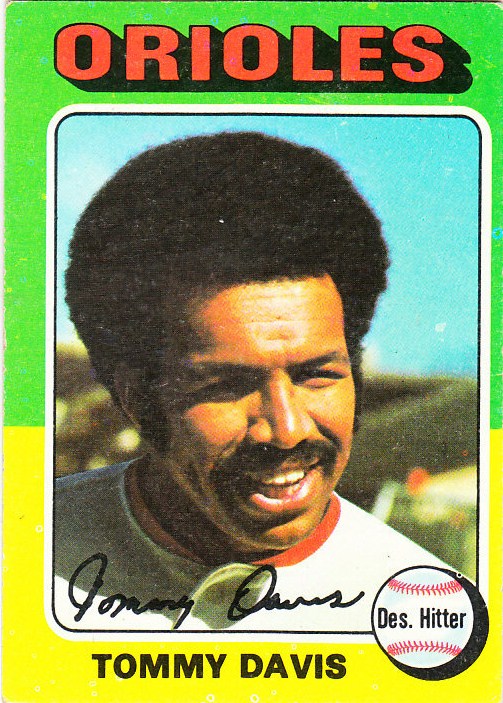
#564 - Tommy Davis


Card fact: There aren't a lot of capless players in this set -- thank goodness -- but Davis is not the first. Two other players have been featured without a cap -- if you don't include the Ralph Garr card, in which his helmet has fallen off his head in the photo.

What I thought about this card then: I had the mini card, and it is one of the first cards I think of when I think of my minis. It almost kind of came to represent the minis. The king of the minis. It's hard to argue with a guy in an Afro on a mini card.

What I think about this card now: I don't know why Davis is pictured without a cap. Many times Topps featured players without a cap because they had been traded recently or Topps believed a player was about to be traded (perhaps rumors of a trade were afoot). But Davis was in the midst of a four-year stay with the Orioles at this point.

Other stuff: Davis was a well-traveled player between 1959-76, competing for 10 teams in his major league career. But he didn't begin to bounce around until after suffering a broken ankle while sliding into second base during a game with the Dodgers in 1965.

Davis had been a two-time N.L. batting champion with standout seasons for the Dodgers in 1962 and 1963. His 153 RBIs in 1962 is still a Dodger record. He possessed both speed and power. But after the injury, his power diminished and he was dealt to the Mets after the 1966 season.

After one quality season with New York, he was shipped to the White Sox and then the Pilots and then the Astros, all within a three-year period. While with Houston, then Oakland, then the Chicago Cubs, he was more of a part-time player. It wasn't until he arrived in Baltimore and became the Orioles' full-time designated hitter, that Davis began to show what he exhibited back in the mid-1960s. He drove in over 80 runs in 1973 and 1974.

Davis finished his career with the Angels and Royals. He later became a coach for the Mariners (he is featured as a coach in the 1982 Donruss set).

(EDIT: Tommy Davis died April 3, 2022 at age 83).


Back facts: I'm not sure, but this might be the most jam-packed card in the set. We'll have to check out Frank Robinson and Hank Aaron before I know for certain.

Other blog stuff: R.I.P. to 1960s Tigers hero Jim Northrup, who died Wednesday at age 71:


This was the final Topps card of his career.

Saturday, May 21, 2011

#545 - Billy Williams


Card fact: You're looking at one of two cards in the set that was purchased for me by my mother. The other one was the Carl Yastrzemski card. My mom went through a very brief phase of buying me cards several years ago. Unfortunately, it stopped as quickly as it began.

What I thought about this card then: I had the mini card. I associate Billy Williams with being with the A's and wearing a mustache, even though that is not how the majority of baseball fans from the '60s and early '70s remember him. But that's what collecting cards as a 9-year-old can do.

What I think about this card now: Williams is airbrushed into an A's cap. It's not a bad job, although I don't think the A's wore electric-green caps. The border colors sure do match with the photo though.

Other stuff: Williams was traded to the A's in October of 1974 after 16 seasons with the Cubs. One of the most beloved Cub players of all-time, Williams enjoyed a Hall of Fame career in which he hit for both power and average. He finished second in the MVP voting in both 1970 and 1972.

Once I figured out that Williams was more Cub than A, I knew him mostly as the guy who Steve Garvey surpassed as the player with the most consecutive games played in the National League (1,207-1,117).


Back facts: A fill-in-the-blank trivia question! That's a first.

Other blog stuff: Let's see regular-sized Billy next to mini-Billy:

Monday, May 9, 2011

#534 - Alex Johnson


Card fact: Alex Johnson is wearing an airbrushed Yankees cap, as if you couldn't tell. Whoever was given the task of airbrushing players into Yankees caps for the '75 set, had a difficult time.


What I thought about this card then: Never saw it. One of those cards that I saw for the first time when I was completing the set 7 years ago.


What I think about this card now: Is that a scoreboard in the background? I can't tell.


Other stuff: Johnson was one of the most confounding baseball players of the '60s and '70s. A player with enormous talent and a powerful build, Johnson was dealt from team to team because managers and teammates couldn't get along with him.


Johnson played for the Phillies, Cardinals, Reds, Angels, Indians, Rangers, Yankees and Tigers. His best seasons were with the Reds in 1968 and 1969 and with the Angels in 1970 when he won the A.L. batting title.


But Johnson, who was widely considered as a pleasant and amiable fellow off the field, infuriated his teammates with his on-field play, refusing to hustle on the bases or run down plays in the outfield (his fielding ability was sporadic, especially early in his career). While with the Angels, he was fined and suspended repeatedly. It got so tense that Johnson wouldn't speak to his fellow teammates (he was in reported scrapes with teammates while with the Reds, too). He started shouting obscenities at teammates and the media. After being suspended indefinitely, his cause was taken up by Marvin Miller and the players union. The union's argument was that Johnson was emotionally unstable and the team should have recognized that.


Johnson later finished his career with the Indians, Rangers, Yankees and Tigers. His lackadaisical habits in the field continued to be a problem, and he was out of the majors at age 32. He played a year in Mexico and then took over his father's trucking service.

(EDIT: Alex Johnson died on Feb. 28, 2015).


Back facts: Johnson's brother was a halfback for the New York Giants.


Other blog stuff: The green-yellow border combination continues to be the recent domain of the airbrushed photo. Four of the last five green-yellow bordered cards feature airbrushed subjects. Johnson was airbrushed since he was purchased by the Yankees in early September of 1974.

Tuesday, April 19, 2011

#514 - Jose Cruz


Card fact: Ladies and gentlemen, the second-worst airbrushed cap in the entire set. Rudy May is still the worst, but this is very piss-poor.

What I thought about this card then: Unfortunately, I never saw it.

What I think about this card now: The "H" is so freakishly large and the cap is so freakishly traffic-cone orange that I'm sure an actual cap like that could be viewed from space.

Also, Cruz's signature cites his nickname "Cheo."

Other stuff: Jose Cruz was one of the most popular and effective hitters ever to play for the Houston Astros. I remember him being a pain in the booty to the Los Angeles Dodgers during the 1980s. He was the one player that I feared on that team.

Cruz started out in St. Louis, but was purchased by the Astros in late October of 1974, necessitating the airbrushed monstrosity. Cruz blossomed with Houston and became very popular as the Astros began to field contending teams in the '80s. I remember Howard Cosell being particularly enamored with Cruz during the 1980 postseason.

Cruz was an All-Star only twice despite three straight seasons of hitting above .300 during the mid-1980s. He lasted 19 years, retiring after part of a season with the Yankees in 1988. He later became a base coach for the Astros for a number of years, only recently departing in 2009.

Cruz's son, Jose Cruz Jr., played for 12 years in the major leagues.


Back facts: I'm pretty certain that sinker cartoon has appeared in other years of Topps sets.

Other blog stuff: OK, it's not Jose Cruz's birthday, but it IS his son Jose's birthday today. The former Mariner, Blue Jay, Giant, Diamondback, Red Sox, Dodger, Padre and Astro is 37 today.

Sunday, April 3, 2011

#499 - Marty Perez


Card fact: This is the first green-yellow bordered card to feature a player who isn't airbrushed into his uniform since the Bruce Bochte card at #392. Since then we've had Mike Wallace, Gene Garber and Ross Grimsley, all wearing airbrushed caps.

What I thought about this card then: I didn't see it. My first knowledge of Marty Perez was when I pulled his 1977 Topps card when he was with the Giants.

What I think about this card now: Not a lot to say. I do know those Braves uniforms from the '70s get stranger and stranger the farther we get away from that decade.

Other stuff: Marty Perez was one of those players that seemed to play for only bad teams. He spent most of his time with the Braves, which slowly sank to the bottom of the N.L. West each year he was with the team. Later he played for bad Giants and A's teams. He did have a one-game stint with the 1977 World Series champion Yankees. But he was traded to Oakland in April of that year in the Mike Torrez deal.

Perez started for Atlanta for five-plus seasons, which sums up the '70s for you. Perez was a shortstop with no power, little ability to get on base and average fielding skills. Yet he had more than 400 at-bats from 1971-77.

Perez ended his career with the Mets in 1978, although he didn't play for them.


Back facts: "Shortstopping???????"

Other blog stuff: Tony Orlando was born on this date in 1944. He's 67. It's a toss-up between which song I heard more as a kid, "Rhinestone Cowboy" or "Tie a Yellow Ribbon Round the Old Oak Tree." But I'd say Orlando's tune wins out. It was everywhere.

Sunday, February 20, 2011

#458 - Ross Grimsley


Card fact: Ross Grimsley is airbrushed into an Orioles cap on this card. He was traded from the Reds to the Orioles on Dec. 4, 1973 in a deal that sent Junior Kennedy and Merv Rettenmund to the Reds. The trade worked out pretty well for the Orioles.

What I thought about this card then: I remember think that there was something "off" about this card, but not being able to figure out exactly what it was. I knew nothing about airbrushing and usually airbrushed cards didn't register with me. But this one did.

What I think about this card now: Even though it's an obvious airbrush job, the Orioles bird doesn't look too bad.

Other stuff: Grimsley was another one of those eccentric pitchers of the 1970s. He was known both as "Scuz" and "Crazy Eyes," and wore a giant white man's Afro once he was able to get away from the Reds' strict grooming rules. During the '72 season, he reportedly corresponded with a self-described witch who was sending him good luck charms. Grimsley has some classic baseball cards (specifically 1978, 1980 and 1981 Topps).

Grimsley was a strong, young pitcher for Cincinnati and pitched in four games of the 1972 World Series against the A's. He won 18 games in his first year with Baltimore in '74. He signed as a free agent with Montreal in 1977 and proceeded to win 20 games for the only time in his career in 1978.

Grimsley's career ended quickly after that. He was traded to Cleveland in 1980, and ended his playing career back with Baltimore in 1982. He later became a coach in the minor leagues.


Back facts: Another Dodgers cartoon question.

Other blog stuff: This is the last player card for awhile. We begin another subset tomorrow as we relive the 1974 postseason.

Sunday, February 6, 2011

#444 - Gene Garber


Card fact: This is the eighth and last card in a streak of eight straight cards that I have in mini form, many of which I pulled in 1975.

What I thought about this card then: I liked it. Gene Garber was a Phillie, he had a mustache. What's not to like?

What I think about this card now: Only because I'm aware that Garber was acquired by the Phillies in mid-season of 1974 did I figure out that Garber is airbrushed into a Phillies cap. It's a fairly good job. Garber was with the Royals until July of 1974.

Other stuff: Garber was the first sidearm pitcher I ever knew. He is mostly known for his role as a relief pitcher for the Braves from 1978 to 1987. He was a true bullpen guy, appearing in 931 games and starting just nine of them, including eight starts with the Royals in 1973.

Garber had most of his success with Atlanta. He saved 30 games for the Braves when they won the N.L. West in 1982. I have always admired him for stopping Pete Rose's 44-game hitting streak in 1978. I didn't like Rose, and when Garber struck out Rose on a change-up in his final at-bat, Rose whined that Garber "was pitching like it was the 7th game of the World Series" to which Garber replied "I had an idea that Pete was hitting like it was the last game of the World Series."

Garber ended his career back with the Royals in 1987 and 1988. He became a farmer after his career and is known for marketing "Emu Oil." He raises Emu as well as other poultry for eggs.


Back facts: Elton "Icebox" Chamberlin played from 1886-1896. Eat your heart out, William Perry, Chamberlin was the original "Refrigerator"!

Other blog stuff: Thanks to reader MJ, and later reading a report on the wire, I learned that Woodie Fryman (card #166) died on Friday. RIP, Woodie.

Monday, December 20, 2010

#401 - Mike Wallace


Card fact: This is Mike Wallace's first solo card. Wallace is featured on just two Topps cards by himself (he's on one of those 4-rookie cards in the '74 set). In both of them, he is airbrushed into the cap of his new team. He is airbrushed into a Rangers cap in the 1977 set.

What I thought about this card then: I was deprived as a child. I never saw it. For the longest time, I only knew Mike Wallace as the guy on 60 Minutes.

What I think about this card now: One of the more obvious and terrible airbrushing attempts in the set. The cap is barely on Wallace's head and the N.Y. logo is much, much too big. Wallace's long hair isn't helping matters.

Other stuff: Mike Wallace played five seasons in the majors. He came up with the Phillies in 1973. In his first game, the second part of a doubleheader against the Mets, he threw a complete game, allowing one run, walking none and getting the victory. He worked almost exclusively as a reliever during his career, starting just four games.

In 1974, he was traded to the Yankees and went 6-0 for New York. He remembers teaming with another pitcher on a combined shutout against Jim Palmer and the Orioles during September of that year. After that, he pitched with the Yankees in '75, then with St. Louis and Texas before his major league career ended in 1977.


Back facts: The write-up says Wallace "joined the Yankees last June." The trade between the Yankes and Phillies was May 3, which means Topps is saying Wallace joined the Yankees from the minor leagues. He began his New York career with Syracuse, the Triple A team of the Yankees then.

Other blog stuff: Both Cecil Cooper and Oscar Gamble were born on this date in 1949. They're both 61 today.

Friday, December 10, 2010

#392 - Bruce Bochte


Card fact: This is Bruce Bochte's rookie card.

What I thought about this card then: I had the mini card. I didn't like it. I thought Bochte was wearing makeup.

What I think about this card now: Signing your name with a lower-case letter to start your first and last name is a definite attempt to set yourself apart. Either that or Bochte really didn't like the capital letter "B."

Other stuff: Bochte was a good contact hitter for the Angels, Indians, A's and especially the Mariners. His 1979 season with Seattle led to his only All-Star appearance. He drove in 100 runs and hit .316 that year. Bochte played 12 seasons in the majors, finishing up with Oakland in 1986.

After his career, some labeled him as a spacey kind of guy for his thoughts on nature, earth and how human beings fit into the whole thing. It's called cosmology, and there is no way I can explain it sufficiently. This where-are-they-now article about Bochte gives you his thought process better than I could.


Back facts: Frank Isbell is another old-timey player. He played for the White Sox between 1898-1909.

Other blog stuff: On this date in 1971, the Mets traded Nolan Ryan and three prospects to the Angels for Jim Fregosi.

Wednesday, November 24, 2010

#380 - Sal Bando


Card fact: This is the third Oakland A's card that has featured a green-and-yellow border. That can't be coincidence, seeing as the A's were the defending World Series champs.

What I thought about this card then: I didn't see a card of Sal Bando until he was a Milwaukee Brewer. I do remember my friend, an Oakland A's fan, talking about him a lot though.

What I think about this card now: Topps cut the poor coach/manager out of the shot!

Other stuff: Bando was one of the key members of the Swingin' A's dynasty in the 1970s, playing third base for them for 11 years, first in Kansas City and then in Oakland. Bando was the captain of those often dysfunctional teams and was known as much for his fielding as his hitting. He never won a gold glove, with Brooks Robinson in the same league as him.

Bando finished second in the MVP voting in 1971 and was in the top five in MVP voting in both 1973 and 1974 (despite hitting just .243 in 1974). As with most of the A's from those teams, he departed as a free agent, signing with Milwaukee in 1976. He had two solid seasons for the Brewers before age and injury caught up with him. The final games of his career were in the American League Division Series against the Yankees in 1981.

Bando later became the general manager for the Brewers (something I totally forgot). He was GM for seven years and was probably most noted for letting Paul Molitor go to the Blue Jays.

Bando's younger brother, Chris, also played in the majors. For the longest time, I thought Chris was Bando's son.
 
(EDIT: Sal Bando died at age 78 on Jan. 20, 2023).


Back facts: Have you ever seen that "How It's Made" show when they featured baseballs? I saw that and also the one where they show how graphite softball bats are made. Always interesting stuff.

Other blog stuff: It's a rare morning posting today. Stupid blogger wouldn't let me upload an image last night.

Also, I'm taking a break on the blog for a little bit. Everyone enjoy their Thanksgiving.

Tuesday, September 28, 2010

#326 - Wayne Twitchell


Card fact: My copy of this card is miscut. You can see the blue border from another card showing at the top. I am assuming that the blue is from a card with a blue-and-orange border, because I believe that the cards in the row adjacent to the row featuring the Twitchell card would have been upside down. That is, if I understand the printing process of the time correctly.

If they weren't upside down, then the card could have a red-and-blue border or a tan-and-blue border, because the blue border on those cards was on the bottom half of the card, unlike the blue-and-orange borders, which were on the top half.

As you can see, I've put way too much thought into this.

What I thought about this card then: I had the mini card. I think my brother and maybe a friend had the regular-sized Wayne Twitchell card, too, and then the regular-sized card worked its way into my collection. It was one of the more common card pulls in the '75 set, according to my little circle of scruffy kids.

Also, I thought Twitchell looked goofy. He has a similar pose to that of Phillies pitcher Ron Schueler in this set.


Both are lanky pitchers (Twitchell was 6-foot-6 and Schueler 6-4). Both pitched for the Phillies. And both posed in Candlestick Park. I half-believed those were the only kind of pitchers the Phillies had.

What I think about this card now: Well, I'm saddened by it because Twitchell just passed away less than two weeks ago at age 62 after battling cancer.

Other stuff: Twitchell pitched for the Phillies most of his career, but came up to the major with the Brewers. After a trade, he became a regular part of the Phillies' starting rotation in 1973, reaching the All-Star Game. He suffered a setback in his 1974 season and pretty soon was relegated to a relief role.

The Phillies traded Twitchell to the Expos in 1977. After a couple of so-so seasons with Montreal, he spent his final season in 1979 with the Mets and Mariners. Knee ailments hampered his career and forced him to call it quits early.

He later worked in real estate, but returned to his high school alma mater to help out as a coach. He was inducted into the Oregon State Hall of Fame. This is a detailed account of Twitchell's career.


Back facts: The write-up is a pretty cool career highlight for Mr. Twitchell. That's well worth a major league career right there.

But I admit that as a kid I competely missed the write-up. Instead, I liked the cartoon strawberry and was alarmed by Twitchell's 5.22 ERA in 1974.

Other blog stuff: On this date in 1975, four Oakland A's pitchers -- Vida Blue, Glenn Abbott, Paul Lindblad and Rollie Fingers -- combined to pitch a no-hitter against the Angels on the last day of the season. It was the first time in MLB history that as many as four pitchers combined on a no-hitter.

Friday, September 24, 2010

#322 - Ed Goodson


Card fact: This is the last card of Goodson pictured in a Giants uniform. The following year, the photo on his card shows him weirdly airbrushed from a Braves uniform into a Dodgers cap and uniform.

What I thought about this card then: I had the mini card. Because of the way Goodson's arm is positioned, I thought he was on a bus or a subway, holding onto the handles with other commuters.

What I think about this card now: Goodson appears to be hanging out in the dugout with his buddies. I can't believe I missed that when I was a kid.

Other stuff: Goodson played for eight seasons. He started out as a part-time infielder for the Giants before ending up as a glorified pinch-hitter for the Dodgers in the late 1970s. He played in 100 games in a season only once, enjoying his best seasons with the Giants in 1973 and 1974. He was traded for the Braves, but only played their briefly.

Goodson was traded to the Dodgers as part of the Dusty Baker deal that sent Jimmy Wynn, Jerry Royster, Tom Paciorek and Lee Lacy to the Braves. Goodson had one at-bat each in the 1977 NLCS and World Series. He was released by L.A. before the 1978 season and signed by Cleveland, but didn't play for them.


Back facts: Bill "Bugs" Moran pitched in 15 games for the White Sox in 1974. He didn't get a card in the '75 set, or any Topps set, to my knowledge. He got a cartoon, but not a card!

Other blog stuff: The No. 1 song on this date in 1975 was "Fame" by David Bowie. Bully for you, chilly for me.