Showing posts with label Royals. Show all posts

Saturday, September 17, 2011

#652 - Lindy McDaniel


Card fact: This is the final Topps card issued during Lindy McDaniel's career. His last major league season was in 1975.

What I thought about this card then: My brother had this card. To us, McDaniel looked like the definition of a veteran major leaguer. I don't think we ever voiced it, but on the inside, we were thinking "now there's a guy who's been around and knows his ... uh ... stuff."

What I think about this card now: Whenever I see guys who played in the '50s wearing powder blue uniforms, it does not look right.

Other stuff: McDaniel pitched for 21 seasons in the majors, and is known as one of the greatest relief pitchers. He began with the Cardinals and started for them in 1957 and 1958. But after that he was almost exclusively a relief hurler. He led the league in saves in 1959, 1960 and 1963. His 1960 season was his best. He saved 26 games, recorded a 2.09 ERA, went 12-4, finished third in the Cy Young Award voting, and fifth in the MVP balloting.

McDaniel moved on to the Cubs and then the Giants and was effective throughout the '60s. But he returned to the level of his Cardinals days after being dealt to the Yankees for Bill Monbouquette in 1968. He enjoyed a stellar 1970 season, saving 29 games and recording a 2.01 ERA for New York.

After six years with the Yankees, New York sent McDaniel to Kansas City in the Lou Piniella trade. McDaniel pitched two seasons for the Royals before retiring.

McDaniel has his own web site, in which you can check out all his Topps cards.

McDaniel's 1971 Topps card happens to be up for a coveted spot in the esteemed Cardboard Appreciation Hall of Fame at Night Owl Cards.

EDIT: Lindy McDaniel died on Nov. 14, 2020.


Back facts: This was my first experience with a player whose career was so long that the stats are crammed onto the back of the card. I had never seen so many years of stats until viewing the Lindy McDaniel card. Topps even squeezed the card number to get all the stats on the back.

Also, I know many, many people don't need an explanation as to who Darrell Royal is, but I sure did when I was a kid. Even today, as someone who pays very little attention to college football, I can tell you only the most basic facts about Royal.

Other blog stuff: The green-purple border combination is now in a first-place tie with the pink-yellow border combo with 55 cards apiece.

Tuesday, August 23, 2011

#629 - Joe Hoerner


Card fact: This is Joe Hoerner's penultimate Topps card. His final card is in the 1977 set as a Ranger.

What I thought about this card then: This was a card that I obtained early in the '75 season and I traded it in that deal for some '75 minis.

What I think about this card now: That's some funky hair that Hoerner's got going there.

Other stuff: Hoerner was a full-time, sidearm relief pitcher for 14 seasons and 493 games, not a start among them. He was one of the early left-handed relief specialists, and he especially made his mark pitching for the World Series champion Cardinals in 1967. His best seasons were in the late '60s and early '70s for the Cardinals and the Phillies.

Hoerner came up with the Colt .45s in 1963. His first major league appearance came in a gimmick game for Houston as the team fielded an all-rookie starting lineup against the Mets.

He was traded from the Cardinals to the Phillies in the famed Curt Flood deal. After his time with the Phillies, his performance fell off as he pitched for the Braves, Royals, Rangers and Reds. His final big league pitch, in 1977, hit the Pirates' Frank Taveras, who charged the mound. Hoerner punched Taveras, and after the brawl, was tossed from the game.

After his career, Hoerner did some promotional work with the Cardinals and was involved in charitable causes. He died in a farming accident at age 59 in 1996, reportedly getting pinned between a tractor fender and a tree trunk.


Back facts: I have no idea what the average number is for players making their major league debut in a season. Obviously, the number is much higher now than it was in 1974. But I don't know if 144 was a lot more than in 1973 or 1975, for example.

Other stuff: On this date in 1980, Charlie O. Finley got out of the baseball business, selling his Oakland A's team to the Haas family for $12.7 million.

Tuesday, August 16, 2011

#622 - 1975 Rookie Outfielders


Card fact: The Cincinnati Reds are abbreviated as the "Cinn. Reds" on this card. Apparently someone thought they were the "Cinnamon Reds."

What I thought about this card then: Didn't see it.

What I think about this card now: This was the toughest of the rookie cards for me to obtain and one of the toughest cards in the whole set to finally land. No one likes giving up their Fred Lynn rookies. That's why this one is off-center, miscut and there's a weird printing flaw next to Lynn's head.

The funny thing is I found another version of this card in a rummage sale a couple years ago. It's in similar shape -- maybe slightly better -- and I've replaced this card with the rummage sale one.

Other stuff: Each player's first solo Topps card:

Ed Armbrister, Reds: 1976 Topps
Fred Lynn, Red Sox: 1976 Topps (with the rookie cup!)
Tom Poquette, Royals: 1977 Topps (with the rookie cup!)
Terry Whitfield, Yankees: 1978 Topps

Most successful career: Lynn was a huge favorite in Boston, my brother's favorite player, an MVP his rookie year, and hit more than 300 career home runs.


Most awesome middle name: As intrigued as I am about what a land of Berts might look like, I have to go with "Rosanda." It sounds like something you'd get tattooed on your chest underneath a giant heart.

Other blog stuff: A happy 81st birthday to former Monday Night Football announcer Frank Gifford.

Friday, August 5, 2011

#615 - 1975 Rookie Pitchers


Card fact: We've got back-to-back "rookie pitchers" cards here. Unlike the previous one, I believe everyone is wearing a non-airbrushed cap.

What I thought about this card then: Never saw it.

What I think about this card now: Hank Webb looks like he's just spotted the team mascot that has always freaked him out.

Other stuff: Each player's first solo card:

Pat Darcy, Reds: 1976 Topps
Dennis Leonard, Royals: 1976 Topps
Tom Underwood, Phillies: 1976 Topps (with a rookie cup!)
Hank Webb, Mets: 1976 Topps (his only solo Topps card)

Most successful player: Dennis Leonard was a three-time 20-game winner who won three postseason games. Tom Underwood, who died in November 2010, pitched for 11 seasons.


Most awesome middle name: Gaylon Matthew proves that more is better. Also, how cool is it that two players on this card have "Patrick Leonard" in their name?

Other blog stuff: On this date in 1975, the first seven Phillies who come to bat in a game against the Cubs get a hit against starter Bill Bonham to set  a major league record. Mike Schmidt hit a home run to make it 5-0 and send Bonham to the showers. The next batter, Johnny Oates, proceeds to single for the eight straight hit. Pitcher Dick Ruthven's sacrifice bunt is the first out.

Tuesday, June 14, 2011

#569 - Frank White


Card fact: This is Frank White's first solo card. That's the third straight card in which that is the case. However, this is not White's rookie card. He appeared on a four-player rookie card in the 1974 Topps set.

What I thought about this card then: I didn't see it. But, like most Royals of the period, I associate him with my friend Jeff from Kansas. White was another favorite of his. Those 1976 Topps Royals were hard to keep because Jeff was always after them. Who knew that in upstate New York I'd have a tough time holding on to Royals cards?

What I think about this card now: White is listed as being 5-foot-11, but he looks as short as teammate Freddie Patek in this photo.

Other stuff: White played all 18 of his major league seasons for the Royals and is still with Kansas City as a color commentator.

White came with Kansas City in 1973 and after some early struggles offensively, became a mainstay in the infield, winning the Gold Glove eight times and playing in the postseason for the Royals seven separate years. White even became a solid offensive player, showing some power in the mid-80s by slugging more than 20 home runs in 1985 and 1986.

White's number 20 was retired by the Royals. He later worked as a coach before moving into the Royals' front office for several years. He now works on Royals broadcasts.


Back facts: White's graduation from the Royals Academy is mentioned on several of his baseball cards. The Royals Academy always fascinated me. I envisioned it as an actual school where players would attend classes and learn nothing but baseball. But actually it was not much more than Kansas City setting up a complex in Florida in which it would teach fundamentals and life skills to up-and-coming ballplayers who maybe weren't top prospects. It lasted only from 1971-75 before closing up shop. White and U.L.Washington are its most famous graduates.

Other stuff: A happy 85th birthday to former Brooklyn Dodgers great Don Newcombe.

Friday, May 20, 2011

#544 - Steve Mingori


Card fact: The orange-brown border combination is back in the lead again with 47 total cards.

What I thought about this card then: I didn't see it. But the 1976 Steve Mingori card was a personal favorite, probably because I was influenced by my friend the Royals fan, and the fact that Mingori was left-handed.

The mid-to-late '70s Royals are one of my all-time favorite non-Dodgers eras. So folks like Mingori stand out to me.

What I think about this card now: I like the batter-pitcher confrontation going on in the background. They seem like the only two people on the field (or maybe the pitcher is really an infielder. It's hard to tell).

Other stuff: Mingori's career spanned the entire 1970s, starting with the Indians in 1970 at age 26 and ending with the Royals in 1979. He spent 1973-79 with Kansas City, which was his hometown team.

Mingori became a valued left-handed reliever for the pennant-winning Royals. He threw sort of side-armed, which complemented other righty relievers out of the pen like Mark Littell. Mingori appeared in seven games for the Royals in the postseason between 1976-78.

Mingori worked as a pitching coach with the Blue Jays after his playing career. He died in 2008 at age 64.


Back facts: Well, that's a cool cartoon. According to baseball-reference.com, 11 major league players were born on Feb. 29th, including Pepper Martin, Al Rosen and Terrence Long.

Other blog stuff: OK, this blog is dedicated to the '70s, so this is the only reason I would mention this. On this date 65 years ago, Cher was born.

Monday, April 25, 2011

#520 - Amos Otis


Card fact: The last three purple-pink bordered cards have been of players with a card number ending in a zero. Reggie Smith, Nolan Ryan and Amos Otis.

What I thought about this card then: I didn't see it. The first card of Otis that I saw was his 1976 card. I associate that card instantly with my friend Jeff, who was from Kansas. His family moved to New York and it was my first knowledge of a Royals fan.

Otis was Jeff's favorite player and he raved about him the way I saw no one else do unless they were a Yankee fan. I wondered what a strange world it would be to live in an area where the majority of people were rabid Royals fans (keep in mind, the Royals were good every year then).

What I think about this card now: I like the wide view of the ballpark in the background. ... oh, and the sideburns.

Other stuff: Otis was a central part of the great Royals teams of the late 1970s. He manned center field and received three gold gloves with his easygoing fielding manner that often included the now-standard one-handed catch.

Otis was acquired from the Mets in a deal for Joe Foy that proved to be a horrible trade for New York. Otis proceeded to make the All-Star team four straight years. He finished fourth in the MVP voting in 1978, and hit over .400 against the Yankees in the American League Championship Series.

In 1980, Otis hit over .400 again when the Royals faced the Phillies in the World Series. Otis played 14 of his 17 seasons with the Royals. He ended his career in 1984 with the Pirates.


Back facts: Why in the world would you capitalize "thefts"?

Other blog stuff: Former Twins and Cubs player Jacque Jones (whatever happened to him?) was born on this date in 1975.

Wednesday, March 30, 2011

#495 - Nelson Briles


Card fact: This is Nelson Briles' only card in a Royals uniform. That '74 Topps Traded airbrush atrocity doesn't count.

What I thought about this card then: Didn't see it.

What I think about this card now: I love how the Royals in the background, who may or may not be playing catch, frame Briles. It's a nice photo.

Other stuff: Briles was a control-type pitcher for the Cardinals, Pirates, Royals, Rangers and Orioles. He pitched in some big games and did well in them. With St. Louis as a youngster in 1967, he threw a complete-game victory in Game 3 of the World Series against Boston. With the Pirates in 1971, he threw a two-hit shutout against the Orioles in Game 5 of the World Series.

Briles won 19 games for the Cardinals in 1968 but his performance fell off and he was shipped to the Pirates. After a couple of 14-win seasons, Pittsburgh sent him to Kansas City. After a couple years there, Briles finished out his career with the Rangers and Orioles.

Briles was known for his singing ability. He performed a night club act for a little while and sang the National Anthem during the 1973 World Series.

Briles also worked as a broadcaster and front office man for the Pirates and Mariners. He died in 2005 of a heart attack at age 61.


Back facts: Well, I like that highlight in the write-up!

Other blog stuff: Remember the last card and all the discussion of game-show host Peter Marshall? Well, today is Marshall's 85th birthday.

Monday, March 7, 2011

#472 - Bruce Dal Canton


Card fact: This is one of the cards I received in the first trade I ever made. It was with my good friend, Mario.

What I thought about this card then: I thought Bruce Dal Canton looked very grown up. He must be at least 45 or 50 years old, I thought. In fact, he's 32 at the time of this photo.

What I think about this card now: He has to be one of the happier-looking players in this set.

Other stuff: Dal Canton was mostly a relief pitcher for several teams between 1967-77. He pitched for the Pirates, Royals, Braves and White Sox. His best seasons were at the tail end of his time with the Pirates and during his stay with the Royals. He came over to Kansas City with Freddie Patek in a deal that worked fairly well for the Royals.

Dal Canton didn't become a major leaguer through traditional channels. He was a school teacher when he was signed by the Pirates during an open tryout. After his major league career, he returned to his teaching roots by becoming a minor league instructor for the Braves, a job he held for several years.

Dal Canton died in 2008 from esophageal cancer at age 66.


Back facts: That is the worst drawing of New York State I've ever seen.

Other blog stuff: The No. 1 song in the country on this date in 1975 was "Best of My Love" by the Eagles. Probably my least favorite Eagles song of all-time. Or maybe that's "Witchy Woman."

Saturday, January 29, 2011

#437 - Al Cowens


Card fact: This is Al Cowens' rookie card.

What I thought about this card then: I had the mini card. Cowens wasn't known yet for being a decent hitter, but I thought he was cool anyway.

What I think about this card now: Never mind the card. What's up with my scanning? I must have gone through a lazy period back when I was scanning the set. The last couple cards have been way crooked.

Other stuff: Cowens came up with Kansas City and was a big part of the Royals' AL West championship teams in the late 1970s. His breakout year was in 1977 when he finished second in the AL MVP race to Rod Carew. He also received his only Gold Glove award that year.

Cowens was involved in one of the most notorious on-field brawls in baseball. While with the Royals in 1979, Cowens was hit in the face by a pitch from the White Sox's Ed Farmer. His jaw was broken. Farmer also hit the Royals' Frank White, breaking his hand. I remember it being a big deal and very upset that this guy I had never heard of had taken out two players on one of my favorite teams.

A year later, Cowens was on the Tigers (he was traded to the Angels in the Willie Mays Aikens deal after the '79 season, then dealt in May of 1980 to Detroit for Jason Thompson). Detroit faced Chicago and Farmer was pitching. Cowens hit an infield grounder. While Farmer turned to watch the fielding play, Cowens ran to the mound instead of first and attacked Farmer. A warrant was issued for Cowens' arrest and he was suspended by the league. The two players would later make up during that season.

Cowens later signed with Seattle and spent much of the '80s with the Mariners. He later played in the Pacific Senior League. He died in 2002 at age 50 from a heart attack.


Back facts: Al Bumbry was featured on card #358. Unfortunately, his cartoon is not about Al Cowens.

Other blog stuff: On this date in 1958, Dodgers catcher Roy Campanella suffers a broken neck in a car accident in Long Island. Campanella is paralyzed for the remainder of his life.

Wednesday, January 5, 2011

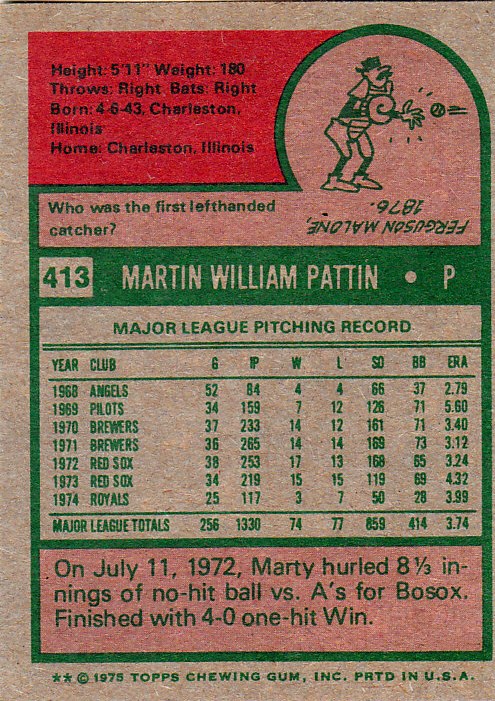
#413 - Marty Pattin


Card fact: This is the first green-purple bordered card in 67 cards. This is another color combo that I thought would contend as the top border combo. But like purple-pink, it has fallen off quite a bit.

What I thought about this card then: I didn't see it.

What I think about this card now: This is one of my least favorite cards of the set. There is way too much space above Marty Pattin's cap in the photo. And the lettering for his name doesn't match the lettering for any other card in the set. There is too much space between the letters. It looks like a counterfeit version of a '75 Topps card.

Other stuff: I equate Pattin with the Royals, where he spent the final seven years of a 13-year career. But he started out with the Angels, and then became an original Seattle Pilot. He is mentioned a few times in the book "Ball Four." When the Pilots moved to Milwaukee, Pattin became an All-Star with the Brewers.

Pattin was traded to the Red Sox in the big deal that landed George Scott for the Brewers. He won 32 games in two seasons for the Red Sox, then was dealt to Kansas City for Dick Drago. With KC, his role changed as he split between starting and relieving. He pitched in the postseason in four years for the Royals and his final appearance as a major leaguer was throwing a shutout inning against the Phillies in the 1980 World Series.

Pattin later worked as the head coach for the University of Kansas during the 1980s.

(EDIT: Marty Pattin died at age 75 on Oct. 3, 2018.)


Back facts: Reggie Jackson broke up Pattin's no-hitter on July 11, 1972. He singled after Joe Rudi struck out.

Other blog stuff: Two 1970s actresses that I constantly confuse were born on back-to-back days. Dyan Cannon was born on Jan. 4th and Diane Keaton on Jan. 5th.

Tuesday, December 7, 2010

#389 - Tony Solaita


Card fact: This is Tony Solaita's rookie card.

What I thought about this card then: I never saw it. I did pull his 1978 Topps card and knew at an early age that he was the first and only major league player to be born in American Somoa.

What I think about this card now: What is that ghostly Royals figure in the dugout doing?

Other stuff: Solaita was known as a terrific and powerful hitter in the minor leagues, but didn't get much of a shot in the majors until coming up with Kansas City in 1974. From that point he was mostly a backup first baseman and designated hitter with the Royals, Angels and Blue Jays. He then played in Japan in the early 1980s.

After his career, he returned to American Somoa -- he grew up there as a boy before moving to Hawaii -- and helped revive Little League baseball there.

Solaita was murdered in 1990 in a dispute over a land transaction.


Back fact: Those might be the most lengthy minor league stats in the whole set. Check out that 1968 season in High Point-Thomasville.

Other blog stuff: Johnny Bench was born on this date 63 years ago. He'll always be Mr. Krylon Spray Paint to me.

Sunday, November 7, 2010

#364 - Doug Bird


Card fact: This is the first post on this blog composed during the time change. So I began this post as it approached 2 a.m., and now it is just after 1 a.m. So, I'm going back in time as I document collecting the 1975 Topps set. I'm going back in time while I go back in time! That's heavy, man.

What I thought about this card then: This is another player that shares his first name with my brother. But I don't think my brother was too fond of Doug Bird. I know we thought the guy's last name was funny.

What I think about this card now: If Bird wasn't wearing the baseball duds, he'd look like he stepped off the set of Little House on the Prairie.

Other stuff: Bird was a consistent reliever for the Royals during their rise to prominence. He relieved for them in the 1976, 77 and 78 A.L. Championship Series against the Yankees. But Bird also worked as a starter. In 1976, he started 27 games, then went back to full-time relieving in 1978.

Bird was later traded to the Phillies, and then he signed with the Yankees as a free agent. The Yankees proceeded to trade him to the Cubs. With Chicago, Bird was used mostly as a starter. Bird ended his career in 1984 with the Red Sox.

(EDIT: Doug Bird died on Sept. 24, 2024 at age 74).


Back facts: The 30 saves that Bird compiled in his first two years in the major leagues amounted to half of his total for his career, which last 11 years. He saved 60 games overall.

Other blog stuff: On this date in 1973, New Jersey became the first state to allow girls to play Little League baseball.

Thursday, October 14, 2010

#340 - Paul Splittorff


Card fact: It's been 66 cards since the last purple-and-pink bordered card. That's a long time for a color combination that's a favorite to win the color combo World Series.

What I thought about this card then: I didn't see it, although the first card of his I did see looks a lot like this one. Like many of the Royals from the '70s, I associate Paul Splittorff with my friend Jeff, who moved to my neighborhood from Kansas.

What I think about this card now: Between the purple-and-pink border and the powder blue uniform they're doing their darndest to distract you from the palm tree in the corner. But I see it!

Other stuff: Splittorff was a career Royal, pitching 15 years for Kansas City. He was there for the bad times and the good. He won 20 games in 1973, the first Royal to win 20. He also won 19 during the Royals run of pennants in the late 1970s.

Because of Splittorff's glasses, he was one of the first nerdy-looking players that I knew. But I also distinctly remembering something that Splittorff did that was definitely not nerdy. He used to stare down batters after striking them out. It was weird and cool at the same time. I wonder how that would go over today.

Splittorff became a broadcaster for the Royals after retiring. Recently there's been a lot of talk about his broadcasting. He began to sound funny on the air and viewers speculated that he was drunk or had a stroke. Splittorff said he hadn't had a stroke, but was suffering from an illness that affected his speech. He took some time off. He's back working, but apparently still not 100 percent. From what I've read, some fans just want him off the air.

EDIT: In May of 2011, his family confirmed that Splittorff was suffering from oral cancer and melanoma. He died on May 25.


Back facts: Splittorff apparently earned a card number ending in zero based on his 1973 showing, because 1974 was a bit of a comedown.

Other blog stuff: On this date in 2009, I started "1975 Topps (it's far out, man)."

Yup, this blog is one year old today! I whipped through 340 cards in 365 days. That's not too bad. Or it's awfully sloppy. One of the two. Thanks for reading. It's been a lot of fun.

Thursday, September 16, 2010

#314 - Buck Martinez


Card fact: This is Buck Martinez's first card since the 1972 set. He appeared in the 1970, 71 and 72 Topps sets before disappearing into the minors.

What I thought about this card then: This is one of the cards that I pulled when I was on vacation during the summer of '75. Those are some of the most special cards in the set for me.

What I think about this card now: Martinez always looks like a little man on his cards, especially when he's in a catcher's crouch. He's 5-foot-11, so apparently it's an illusion or something. Maybe it's the mustache. I don't know.

Other stuff: Martinez was a no-hit, good-field backup catcher for just about all of his 17 years in the major leagues. He played for the Royals, Brewers and Blue Jays, but only played in more than 100 games in a season once in his career. His lifetime batting average is .225.

Martinez is known now more for his broadcasting, as he's been a broadcaster for most of the last 20-plus years, mostly with the Blue Jays and Orioles. He's also appeared on national telecasts often over the years. I got to know his announcing when I was in college, as he appeared on Blue Jays broadcasts, and I would watch those games when I lived in Buffalo. Martinez has a very distinctive voice, and I always wondered how that played when he was a catcher or during his brief time as the Blue Jays' manager. Were players going around imitating Buck? I'm guessing they were. (If you want to waste some time, look up "Buck Martinez" and "fisted.")


Back facts: The write-up on the back starts off OK, even though it's going all the way back to 1967 because Martinez's stats are atrocious. But then it descends into jibberish. "He led A.A. cathers .994 Percentage. 1973." Apparently, there was a shortage of both the letter "c" and prepositions in 1975.

Other blog stuff: Here is that card that I pulled while on vacation in '75. ... vacation (*sigh*)

Saturday, August 28, 2010

#295 - Vada Pinson


Card fact: This is Vada Pinson's first card appearance in a Royals uniform. But he bounced around a lot at the end of his career.

What I thought about this card then: I didn't see it. But I associate his 1976 Topps card with my friend Jeff from Kansas, the Royals fan.

What I think about this card now: It looks like Pinson got trapped in the lion exhibit at the zoo.

Other stuff: Pinson was one of the top offensive players of the 1960s with the Cincinnati Reds, enjoying most of his success in the early part of the decade, ranking among the league leaders in several categories. He could hit home runs and he could steal bases.

After 11 years with the Reds, he was traded to the Cardinals. He then skipped around to the Indians, Angels and Royals. After his career ended in 1976, he became a coach for several teams (he's even featured on a coach card in the 1982 Donruss set).

Pinson has received a lot of backing for induction into the Hall of Fame, but he hasn't come too close to election. He's still eligible for election by the Veterans Committee (I wouldn't hold my breath).

Pinson died of a stroke in 1995. He was 57 or 59. There's some dispute about his birth year.


Back facts: Paul Richards was a major league catcher for several teams (as well as manager, executive, and pretty much everything). The throwing with both hands refers to his minor league days when he once pitched with both hands. I don't think he ever threw with both hands as a catcher. That'd be a little pointless.

Other blog stuff: "Orange-brown," the "candy corn design," has just taken the overall lead in the color combo race with its 25th card. It can bask in its glory for another 10 cards or so, then the lead will change again.

Wednesday, July 28, 2010

#268 - Hal McRae


Card fact: This might be the first card I ever pulled from the first pack of cards I ever bought. It is between this card and another card that I haven't featured yet. I don't think I'll ever figure out which one it was, unless I undergo hypnosis.

What I thought about this card then: It's a rather bland card, but because it came out of that first pack, I studied it forever and thought it was a very cool card and McRae was a very cool dude.

What I think about this card now: It's rather bland. But I don't know whatever became of that original card.

Other stuff: Hal McRae was a key member of the Royals' pennant-winning teams of the late 1970s. Traded from the Reds partly because of his less-than-stellar fielding abilities, McRae blossomed as a designated hitter for the Royals and was known as a doubles machine. He finished fourth in the A.L. MVP voting in 1976 and was a three-time all-star.

McRae had a hard-nosed playing style and his slide into second base that knocked Willie Randolph almost into left field during the 1977 ALCS led to a rule saying that players had to slide into second base, rather than try the cross-block tactic that McRae did.

After 19 years in the majors, McRae later became a coach and manager, managing both the Royals and the Devil Rays. He is now the video coordinator for the Marlins, and that's a bit interesting as his video tirade is one of the most well-known in sports history.

McRae is the father of former major leaguer Brian McRae, who played for the Royals, Cubs, Mets, among other teams.


Back facts: McRae had 539 at-bats and 88 RBIs in 1974. It seems a bit odd to be mentioning his pinch-hitting abilities.

Other blog stuff: With this card, "green-purple" has officially tied "pink-yellow" for the overall color combo lead with 23 cards. But "pink-yellow" will bounce back soon.

Friday, July 9, 2010

#251 - Fran Healy


Card fact: This is the second appearance of Fran Healy in the 1975 set. His first appearance was entirely unintentional. ... I think.

What I thought about this card then: Never saw it.

What I think about this card now: Wow, Healy could really get low to the ground in that catcher's crouch. His elbows practically have grass stains.

Other stuff: I may not have seen the Healy card when I was a kid, but Healy was a big part of my growing up years. Since I lived in Yankee country -- before the days of 70 cable channels -- I saw a lot of Yankee games on WPIX, Channel 11. But I listened to even more games on the radio, because I had a radio in my bedroom, but not a TV. Fran Healy was a member of the Yankees' broadcasting crew in the 1980s and he seemed to be on the radio a lot more than on TV. Healy and Phil Rizzuto were quite a pair. Healy seemed a bit of a goof-head, like Rizzuto, but it made for interesting listening.

Healy later was a broadcaster for the New York Mets, and I saw him a lot on the old SportsChannel station, paired up with another colorful broadcaster, Keith Hernandez.

Even when Healy was a player, I heard a lot about him -- first from my Royals friend from Kansas, and then, after he was traded to the Yankees for Larry Gura, from my friends who were Yankees fans. Healy received notice with the Royals for catching Steve Busby's two no-hitters. And when he was with the Yankees, he was known as one of Reggie Jackson's few friends on the team.

He sure received a lot of publicity for a backup catcher.


Back facts: No, no, not that John Edwards. Edwards was a catcher for the Reds and Astros in the 1960s and early '70s. He set the record in 1969 with the Astros with 1,135 putouts. It remains the record.

Other blog stuff: I have to say I'm enjoying the new template designer now that I've adjusted to it. I can get a better representation of the border colors up in the header. Just trying to serve you, the reader.

Sunday, June 13, 2010

#228 - George Brett


Card fact: This is George Brett's rookie card. What else do you need to know?

What I thought about this card then: I did not see it in 1975. However, this card is the first card I acquired solely because it was a player's rookie card. The "rookie card" was still a novel concept when I purchased this card (probably around 1980, 1981). But I had to know it was a desirable card to seek it out in a mail-order catalog and buy it. I can remember only one other card I ordered with the Brett card (you'll see it soon), and I remember being quite pleased when Mr. Brett arrived -- even though it has a faded stripe through the middle of it. I thought I had gotten a steal on the price.

What I think about this card now: I was very happy that I went through the trouble of getting the card when I was a teenager, because when I worked to complete the set six years ago, the price of the Brett card had ballooned to one of the highest in the set. The card I had ordered as a teen was still in decent shape, enough for me to not even consider buying a new Brett card.

Other stuff: It's interesting that the two most coveted rookie cards in this set (Yount and Brett) are five cards apart.

Otherwise, you all know George Brett. He was my non-Dodger hero during his career. His home run against Goose Gossage in the 1980 ALCS was, for me, the sign that the Yankee dynasty that I had endured for most of the previous four years was about to end. The Yankees were conquerable! Brett had just shown how it was done. The Dodgers followed suit in 1981.

I remember Brett's quest for .400 in 1980 very well. I can recall sitting in my grandmother's home during that summer, reading the newspaper accounts of Brett's latest games. I also remember those same newspapers detailing his hemorrhoids battle during the 1980 postseason. George Brett taught me the misery that is hemorrhoids. I never knew what they were before 1980. It was all quite horrifying.

One other thing. A guy I work with knows the Brett family. He says they're all nuts. I believe him.


Back facts: Brett had a fairly decent rookie season, but he was beaten out by Bill Madlock at third base for mention on the Topps All-Rookie team. No gold cup for George.

Other blog stuff: With this card, the green-purple color combo (Incredible Hulk) ties the pink-yellow combo (marshmallow peeps) for the most cards so far with 21 each.

Tuesday, April 13, 2010

#169 - Cookie Rojas

Card fact: I'm going to say this is the first appearance of a batting donut in the set. I'm too tired to research it -- I just got off of work -- so if you want to prove me wrong, go nuts.

What I thought about this card then: Unfortunately, I didn't see it.

What I think about this card now: Cookie really held onto those glasses didn't he? I think everyone gave up on those kind of frames when the '60s ended, but Rojas seemed to wear them until the bitter end.

Other stuff: Rojas is well-remembered in Philadelphia and Kansas City, where he spent most of his major league time. The infielder also had an avid following in Cuba, the place of his birth.

Rojas was a regular infielder for the Phillies in the 1960s, then was traded to the Cardinals in the controversial Curt Flood deal. Rojas didn't last long in St. Louis, going to Kansas City shortly afterward. As the Royals' second baseman, his career re-blossomed and he was an All-Star four straight years. Eventually, Frank White surpassed Rojas' Royals record for most games played at second base, but a lot of fans remain fond of Cookie.

Rojas coached for quite awhile and is now an announcer for the Marlins. His son, Victor Rojas, was an announcer for the Rangers and is now an MLB Network studio host.

Back facts: Hub Pruett was a pitcher for the St. Louis Browns, Phillies, New York Giants and Boston Braves between 1922-32. He pitched with a unique fadeaway delivery and struck out Babe Ruth 15 of the 30 times he faced him, including 10 times the first 13 times the two faced off.

Other blog stuff: I said in the last post that if I didn't come up with a decent name for the green-yellow combo that I would put up a poll. Well you didn't know the next green-yellow card would come up so soon did you?

So there's a poll up. There are several suggestions there made by readers, as well as a couple lame suggestions by me. Please vote, or pick the last option and tell me to keep trying if you don't like any of the options.