Friday, September 23, 2011
#657 - Bob Oliver
Card fact: This is the last Topps card issued of Bob Oliver during his career.
What I thought about this card then: This is one of the first cards I ever saw in 1975. It came out of my brother's first packs of cards. It's still strange to see this card with sharp corners and no scuff marks, because in my mind, the Oliver card I see is my 8-year-old brother's card.
Oliver has the honor of being one of the first cards I saw in my first two years of collecting. In 1974, the year in which we received some cards from my mother and threw them away at the end of the season, Oliver's card is one of my early memories.
What I think about this card now: Oliver is airbrushed into an Orioles cap. He was traded from the Angels to the Orioles in September 1974. The bird logo on Oliver's cap is freakishly huge.
Other stuff: Oliver made a brief appearance with the Pirates in 1965, then didn't resurface in the majors until 1969 after he was picked up by the expansion Royals.
He was a key offensive component of the Royals, enjoying a breakout year in 1970 when he drove in 99 runs. He was dealt to the Angels in early May of 1972, and he produced a powerful 1973 season for California.
After that, he settled into a utility role for the Angels, Orioles and Yankees, finishing up in 1975. He later managed in an independent league and operated his own baseball school. Oliver is the father of longtime lefty hurler Darren Oliver. In fact, both Olivers were teammates of Nolan Ryan during their careers.
(EDIT: Bob Oliver died on April 19, 2020, at age 77).
Back facts: Topps goes through all of that trouble painting that giant smiling birdie, and the Orioles go and trade him to the Yankees before the card even hits the stores.
Other blog stuff: I'd like to direct your attention to the "Reeling in the Years" segment on the sidebar. It lists all of the set-related blogs of which I'm aware. Some haven't been publishing for awhile. But several have been added since the start of this blog, including most recently, the 1986 Topps blog, which is a blog I actually considered starting myself at one time.
Monday, September 5, 2011
#641 - Jim Northrup
Card fact: This is the final Topps card issued of Jim Northrup during his career. He retired after the 1975 season.
What I though about this card then: Never saw it.
What I think about this card now: It is blatantly obvious that Northrup is wearing a Tigers uniform. But that weirdly airbrushed Orioles cap -- it must've been fun to airbrush the Oriole cartoon bird back in the day -- probably fooled a few kiddies.
Northrup was traded to the Expos in August of 1974. He was then purchased by the Orioles on Sept. 16, 1974 and played eight games for them to close out the year. He played in 84 games for Baltimore in 1975.
Other stuff: Northrup is known for his timely and dramatic hitting with the Detroit Tigers, specifically during the 1968 season, a year in which the Tigers won the World Series.
Northrup, the Tigers' regular right fielder (but he played a lot of center field, too), hit five grand slams in 1968, including one in Game 6 of the World Series that helped Detroit tie up the Series with the Cardinals after trailing 3 games to 1.
Northrup also delivered the decisive blow in Game 7 of the Series, connecting for a two-out, two-run triple off of Bob Gibson in the seventh inning. Northrup also hit a home run off of Gibson in Game 4 of the Series.
Northrup was a streaky hitter who enjoyed his best seasons between 1968-70. He became a regular with Detroit in 1966. In the early '70s when Billy Martin took over as the Tigers' manager, Northrup clashed with the manager, once saying, "He took all the fun out of the game."
After his playing career, Northrup played pro softball, worked as a broadcaster for the Tigers, and in several business ventures. Northrup died three months ago at age 71, suffering from various ailments, including Alzheimer's Disease.
Back facts: Well, that's an interesting cartoon. I'm assuming that by 1886, they're referring to Old Judge cards, which were among the first to be included with tobacco products and sold to consumers. But there were baseball "cards" issued by various businesses going back to the 1860s.
Other blog stuff: On this date in 1918, the Red Sox won Game 1 of the World Series against the Cubs, 1-0, on a six-hit shutout by Babe Ruth. The World Series was moved up a month because of World War I.
Friday, August 19, 2011
#625 - Boog Powell
Card fact: This card really marks the homestretch for this set. With the exception of two cards, it is all players from here on out.
What I thought about this card then: Oh, my goodness, it was a laugh riot. It was the funniest card we ever saw at that young age.
What I think about this card now: The card was the very first Cardboard Appreciation subject on my other blog. It was the first one for all the reasons you can think of -- and for a few more that you can't think of because you're not 9 anymore.
Other stuff: Boog Powell made up the meat of the order for the Orioles' lineups through the 1960s and into the 1970s. He was at the tail end of his Orioles career at this point, as this is his final Topps card as an Oriole.
Powell won AL MVP honors in 1970 and finished second behind Harmon Killebrew in 1969. He hit six home runs in the postseason. He absolutely wore out the Twins in back-to-back ALCS.
Powell was traded to the Indians in February of 1975, so he was already with another team by the time this card came out. He finished his major league career in 1977 with the Dodgers. Powell is now known just as much for his barbecue as his playing career.
And just one more thing:
BOOOOOOOOOOOOOOOOOOOOOOOGGGG!!!!!!!!!!!!!!
Back facts: I missed posting on Powell's 70th birthday by two days.
Other blog stuff: The orange-brown border combination bounces back to join the pink-yellow combo at the top with its 53rd card.
Sunday, August 7, 2011
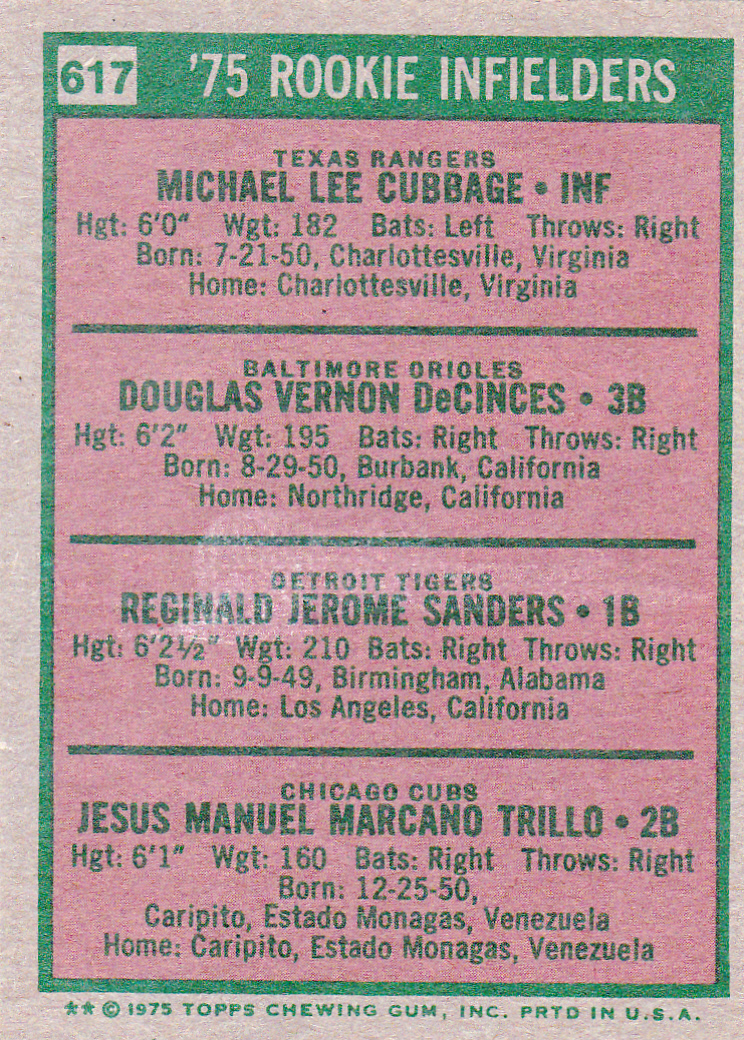
#617 - 1975 Rookie Infielders
Card fact: You never knew Reggie Sanders played for the Tigers, did you? But it's not that Reggie Sanders.
What I thought about this card then: Did not see it.
What I think about this card now: Manny Trillo is not wearing a live Cubs hat. It is most likely an airbrushed A's cap.
Other stuff: Each player's first solo Topps card:
Mike Cubbage, Rangers: 1976 Topps
Doug DeCinces, Orioles: 1976 Topps
Reggie Sanders, Tigers: no solo card. His career lasted 26 games in 1974. He died in 2002.
Manny Trillo, Cubs: 1976 Topps
Most successful player: Toss-up between Doug DeCinces and Manny Trillo. DeCinces played 19 seasons in the majors and hit 237 home runs. Trillo played 17 seasons, was an All-Star for the Cubs and Phillies and had a great 1980 NLCS.
DeCinces was just in the news last week for a bit of ugliness.
Most awesome middle name: U.S.-born players are so boring. Have to go with Manuel Marcano.
Other blog stuff: On this date in 1975, actress Charlize Theron was born. The world would never be the same.
Thursday, August 4, 2011
#614 - 1975 Rookie Pitchers
Card fact: Welcome to the rookie portion of the '75 Topps retrospective. Sometimes called "rookie stars," sometimes "rookie prospects," Topps took the understated route in 1975 and merely described the players by their respective position.
This was the period when Topps featured four rookies on one card, which is the format that I know and love best. Topps went with this format from 1974-1978. After (and before), Topps featured three or even two rookies per card.
What I thought about this card then: I never saw it. Topps used the orange-yellow border combination and the pink-yellow border combination for its rookie cards. But I only saw the pink-yellow combination when I was collecting in 1975.
What I think about this card now: That is a lineup of mediocrity right there.
Other stuff: For the rookie cards, I thought it'd be interesting to note what each player's first solo card was -- if they ever had a first solo card.
Jack Kucek, White Sox: 1977 Topps (his only solo card).
Dyar Miller, Orioles: 1976 Topps
Vern Ruhle, Tigers: 1976 Topps
Paul Siebert, Astros: no solo card, unless you want to include the late '80s Pacific Senior League set.
Most successful player: Vern Ruhle, who had cards every year from 1975 through 1987 and was later a longtime pitching coach. Unfortunately, he's also the only deceased player of the four.
Most awesome middle name: Dyar Miller has a "K," baseball scorekeeping shorthand for a strikeout, as his middle name, and he was a pitcher. That is fantastic.
Other blog stuff: As you can see, I'm mixing it up a little bit for the rookie cards. I'm not going into detail about the players, because that's really too much work. Hope you like it.
Saturday, July 30, 2011
#609 - Ellie Hendricks
Card fact: Ellie Hendricks returns to the Topps set with this card. He did not appear in the 1973 and 1974 sets.
What I thought about this card then: I remember seeing a mangled mini version of the Hendricks card, but I couldn't tell you whether it was owned by me, my brother or a friend.
What I think about this card now: Hendricks gets progressively happier in his cards through the years (really, take a look). This is one of his final cards, and you can see he is quite happy.
Other stuff: Hendricks was an enormously popular Orioles player, who is credited as one of the keys to Baltimore's impressive pitching rotation of the late '60s and early '70s. He was known as a great handler of pitchers and was at his most active between 1969-71 when the Orioles went to the World Series each year. He was involved in a famous controversial play in the 1970 World Series in which he collided with the home plate umpire and Reds runner Bernie Carbo on a play at the plate.
Hendricks was dealt to the Cubs in 1972, but returned to the Orioles the following year, as more of a third-string catcher. He didn't hit much at all -- batting .220 for his career -- and was traded again to the Yankees in the huge nine player deal on June 15, 1976.
He returned again to the Orioles in the late '70s as a player-coach. He then moved on to be a bullpen coach for Baltimore for 28 seasons, and was the longest tenured active coach for a period.
Hendricks died of a heart attack just shy of his 65th birthday in December 2005.
Back facts: Hendricks hit a home run in Game 1 of the 1970 World Series, the same game in which he was involved in the controversial play.
Other blog stuff: The green-purple border combination ties the orange-brown combination for first place with its 52nd card.
Friday, July 15, 2011
#594 - Jim Fuller
Card fact: This is Jim Fuller's only solo Topps card. This is the second straight card of a player who had only one solo Topps card, and there seems to be a large concentration of players of this nature at the end of the set -- as if Topps was trying to fill up the set.
Now, I know that this was common when Topps issued its yearly set in series. The late series included players who were late call-ups or recently traded. But the 1975 set was issued all at once, as it had been in 1973 and 74, too. It makes me wonder if Topps had some sort of order established for the set early on, in which it would fill in names for each card number and then, when it came to the higher numbers in the set, it would fill in the spots with whatever incidental players were left -- kind of like choosing sides in gym class.
I don't know if there's anything to this or not, but it's always been a question in my mind. I guess I should study the '73 and '74 sets and see if they include a significant number of "incidental" players in the higher numbers.
What I thought about this card then: I associate it with my youngest brother because he had this card. I think it was the mini card. He's an Oriole fan. He was only five at the time, so he wasn't too into cards.
What I think about this card now: The border is way off-kilter.
Other stuff: Fuller was a minor league legend for the Orioles, hitting home runs and setting records along the way. But Fuller also struck out a ton.
His most productive season in three major league seasons was 1974 when he played in 60 games, batted 189 times, hit eight home runs and struck out 68 times. In his major league career, 130 of his 315 at-bats were strikeouts and he was a career .194 batter.
Fuller played a year for the Astros in 1977, then was dealt to the Pirates in 1978. He played in the minors that year and that was the end of his pro career.
Back facts: The cartoon ballplayer looks a little too enthusiastic with that knife. Is that a bat that he is cutting? I can't tell for sure.
Other blog stuff: Linda Ronstadt, whose hit "You're No Good," hit No. 1 in 1975, was born on this date 65 years ago.
Thursday, June 30, 2011
#583 - Andy Etchebarren
Card fact: This is Andy Etchebarren's final card as an Oriole. He spent 12 season with Baltimore before being signed by the California Angels in 1975.
What I thought about this card then: I never saw it.
What I think about this card now: One of the cards of Etchebarren that presents him in a kinder light. Some of them (I'm thinking '73-74 and '76-78 Topps) made him appear as if he was Herman Munster's more athletic cousin.
Other stuff: Etchebarren was a fixture behind the plate during the Orioles' peak years of the late '60s and early '70s. He exchanged starts with Elrod Hendricks through much of that time and later teamed up with Johnny Oates and Earl Williams for the O's.
Etchebarren didn't hit much, but he had a decent on-base percentage for a .230 hitter and knew how to draw a walk. And, obviously, he knew something about handling a pitching staff, given who Baltimore had on the mound at the time.
After his career ended in 1978, Etchebarren worked as a coach with the Milwaukee Brewers. He then returned to the Orioles and managed and coached in their minor league system until three or four years ago.
(EDIT: Etchebarren died on Oct. 5, 2019 at age 76).
Back facts: The cartoon reads like Chuck Hartenstein was no longer with us in 1975, or at least retired. But the joke would be on Topps. After seemingly finishing up in the majors in 1970, "Twiggy" returned to pitch 13 games for the expansion Blue Jays in 1977.
Other blog stuff: The movie "Willie Wonka and the Chocolate Factory" debuted on this date in 1971. "If she's a lady, I'm a Vermicious Knid."
Thursday, June 9, 2011
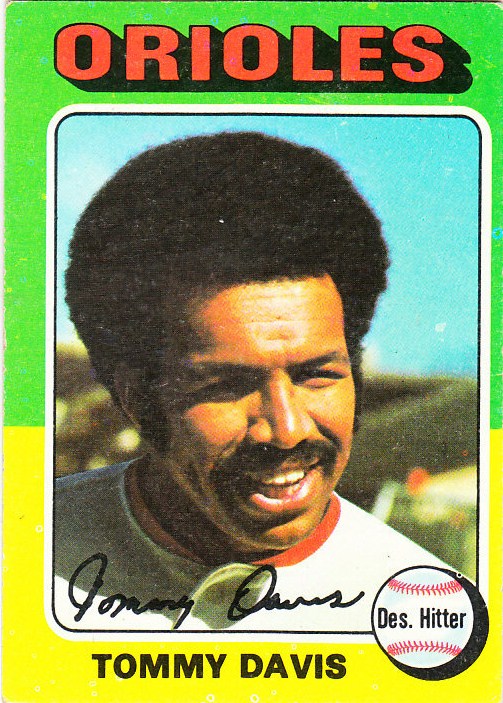
#564 - Tommy Davis
Card fact: There aren't a lot of capless players in this set -- thank goodness -- but Davis is not the first. Two other players have been featured without a cap -- if you don't include the Ralph Garr card, in which his helmet has fallen off his head in the photo.
What I thought about this card then: I had the mini card, and it is one of the first cards I think of when I think of my minis. It almost kind of came to represent the minis. The king of the minis. It's hard to argue with a guy in an Afro on a mini card.
What I think about this card now: I don't know why Davis is pictured without a cap. Many times Topps featured players without a cap because they had been traded recently or Topps believed a player was about to be traded (perhaps rumors of a trade were afoot). But Davis was in the midst of a four-year stay with the Orioles at this point.
Other stuff: Davis was a well-traveled player between 1959-76, competing for 10 teams in his major league career. But he didn't begin to bounce around until after suffering a broken ankle while sliding into second base during a game with the Dodgers in 1965.
Davis had been a two-time N.L. batting champion with standout seasons for the Dodgers in 1962 and 1963. His 153 RBIs in 1962 is still a Dodger record. He possessed both speed and power. But after the injury, his power diminished and he was dealt to the Mets after the 1966 season.
After one quality season with New York, he was shipped to the White Sox and then the Pilots and then the Astros, all within a three-year period. While with Houston, then Oakland, then the Chicago Cubs, he was more of a part-time player. It wasn't until he arrived in Baltimore and became the Orioles' full-time designated hitter, that Davis began to show what he exhibited back in the mid-1960s. He drove in over 80 runs in 1973 and 1974.
Davis finished his career with the Angels and Royals. He later became a coach for the Mariners (he is featured as a coach in the 1982 Donruss set).
(EDIT: Tommy Davis died April 3, 2022 at age 83).
Back facts: I'm not sure, but this might be the most jam-packed card in the set. We'll have to check out Frank Robinson and Hank Aaron before I know for certain.
Other blog stuff: R.I.P. to 1960s Tigers hero Jim Northrup, who died Wednesday at age 71:
This was the final Topps card of his career.
Sunday, May 15, 2011
#539 - Jesse Jefferson
Card fact: A couple of days after the pink-yellow border combination pulled even with the orange-brown border combo, orange-brown comes back with its first offering in 52 cards to regain the overall lead with 46 cards.
What I thought about this card then: I did not see it. The first card of Jesse Jefferson's I saw was his 1976 card when he's with the White Sox. Still rockin' the Afro, though. The nice thing about Jefferson's cards is he pitched from 1973-82, and he's featuring an Afro in every one of his cards.
What I think about this card now: It's good to see the tilted background again. A nice wide view of the ballfield falling off the shelf.
Other stuff: Jefferson pitched for nine seasons for the Orioles, White Sox, Blue Jays, Pirates and Angels. With the exception of his first two years in the majors, he had a losing record in every season, resulting in an unenviable 39-81 career won-loss record.
A lot of that came as a result of being on the expansion Blue Jays for the first four years of its existence.
Jefferson led the league in errors committed by a pitcher, twice (1977 and 1981).
Back facts: Have you ever tried to squat while flat-footed? You won't be squatting for long. I think the stance is more a matter of necessity than being "correct."
Other blog stuff: Still waiting for those erased comments to reappear, Blogger. The weekend is half over.
Thursday, April 21, 2011
#516 - Don Hood
Card fact: This is Don Hood's sophomore card. It looks a lot like the photo on his 1974 card, although obviously not taken in the same stadium.
What I thought about this card then: Never saw it. First card of his I saw was his '76 card when he was with the Indians.
What I think about this card now: It looks very similar to this card. I'm wondering how the Orioles kept their relievers straight. And, strangely, Hood looked more like Burt Reynolds than Bob Reynolds did.
Other stuff: Hood was a relief pitcher with the Orioles, Indians, Yankees, Cardinals and Royals, lasting 10 seasons through 1983. He received some starts while with Cleveland, but spent most of his time as a middle reliever.
Hood was acquired by the Yankees in a trade with Cleveland. New York reliever Rich Gossage hurt his hand in a clubhouse brawl with teammate Cliff Johnson in 1979. The Yankees responded by shipping Johnson to the Indians for relief help in Hood.
(EDIT: Don Hood died at age 73 on June 10, 2023).
Back facts: All right, this cartoon has me confused and I'm too lazy to figure out definitively whether it's wrong or not. The only Jake Gibbs to play major league baseball was a catcher for the Yankees in the 1960s and early 1970s. He never owned an NFL team, although he was a college football star and was headed for an NFL career as a quarterback before signing with the Yankees. But Jake Gibbs is the only Gibbs to ever play in the majors.
So, either there's some other guy named Jake Gibbs, who went by another first name besides Jake and another last name besides Gibbs, or the cartoon is totally screwed up. And as for that famous NFL Gibbs, Joe, he never played major league baseball.
Other blog stuff: On this date in 1898, Phillies pitcher Bill Duggelby hits a grand slam in his first major league at-bat. That feat would not be repeated for 107 years when Jeremy Hermida of the Marlins hits a slam in his first at-bat in August of 2005.
Saturday, March 26, 2011
#491 - Doyle Alexander
Card fact: I could be wrong, but I think this is Doyle Alexander's last card without him featuring his trademark mustache.
What I thought about this card then: I didn't see it. I feel robbed every time there's a '75 Topps card with an action shot that I didn't see as a kid.
What I think about this card now: Lots of people in the stands today.
Other stuff: Alexander compiled a 19-year career in which he displayed moments of greatness interspersed with periods of plain average pitching. He played for eight teams and produced some memorable seasons, like going 17-11 for the Rangers in 1977, back-to-back 17-win seasons for the Blue Jays in 1984 and 1985, and a 9-0 record to close out the 1987 season with the Tigers.
Alexander was also involved in some of the more notable trades in history. He went from the Dodgers to the Orioles in 1971 in the deal that sent Frank Robinson to L.A. He went from the Orioles to the Yankees in the deal that brought Tippy Martinez, Rick Dempsey, Scott McGregor and Rudy May to Baltimore. He's also been traded for John Montefusco, Duane Ward, and of course, John Smoltz. The Smoltz deal in 1987 is why most younger fans know the name Doyle Alexander. It's known as one of the most lopsided trades in history.
Alexander lost a major league high 18 games in his final season in 1989. He also led the league in home runs allowed with 28.
But I know him most for being airbrushed from head-to-toe into a Rangers uniform while on the mound in the middle of Yankee Stadium on his 1977 Topps card.
Back facts: This exact same cartoon question was asked on another '75 card. In fact, it was on Ron Reed's card. At least the cartoon is different on each card.
Other blog stuff: On this date in 1951, Mickey Mantle hits a home run estimated at between 654-660 feet during an exhibition game against UCLA at Bovard Field. The ball clears the field and the width of a football field before landing.
Sunday, February 20, 2011
#458 - Ross Grimsley
Card fact: Ross Grimsley is airbrushed into an Orioles cap on this card. He was traded from the Reds to the Orioles on Dec. 4, 1973 in a deal that sent Junior Kennedy and Merv Rettenmund to the Reds. The trade worked out pretty well for the Orioles.
What I thought about this card then: I remember think that there was something "off" about this card, but not being able to figure out exactly what it was. I knew nothing about airbrushing and usually airbrushed cards didn't register with me. But this one did.
What I think about this card now: Even though it's an obvious airbrush job, the Orioles bird doesn't look too bad.
Other stuff: Grimsley was another one of those eccentric pitchers of the 1970s. He was known both as "Scuz" and "Crazy Eyes," and wore a giant white man's Afro once he was able to get away from the Reds' strict grooming rules. During the '72 season, he reportedly corresponded with a self-described witch who was sending him good luck charms. Grimsley has some classic baseball cards (specifically 1978, 1980 and 1981 Topps).
Grimsley was a strong, young pitcher for Cincinnati and pitched in four games of the 1972 World Series against the A's. He won 18 games in his first year with Baltimore in '74. He signed as a free agent with Montreal in 1977 and proceeded to win 20 games for the only time in his career in 1978.
Grimsley's career ended quickly after that. He was traded to Cleveland in 1980, and ended his playing career back with Baltimore in 1982. He later became a coach in the minor leagues.
Back facts: Another Dodgers cartoon question.
Other blog stuff: This is the last player card for awhile. We begin another subset tomorrow as we relive the 1974 postseason.
Sunday, January 2, 2011
#410 - Mike Cuellar
Card fact: Mike Cuellar's name is misspelled "Cueller" on the front of the card. That is a major gaffe.
What I thought about this card then: I do remember my brother having this card. I probably traded it to him because it was an Oriole. I thought Cuellar looked very old. He was 37 at the time. Also, we never noticed the name misspelling.
What I think about this card now: That might be the tiniest signature in the entire set. I think they shrunk it down to fit it in the limited available space.
Other stuff: Cuellar was one of the best starting pitchers that you never hear about now. The Cuban native won 20 games four times within a six-year period. He won the 1969 Cy Young Award (in a tie with Denny McLain), and he could have won it a couple of other times.
Cuellar pitched in a number of big playoff games for the Orioles in the late 1960s and early 1970s. His performance in the 1969 World Series was stellar, despite Baltimore losing in five games to the New York Mets. He hit a grand slam in the ALCS against the Twins in 1970. In 1971, he was part of the only pitching staff to have four 20-game winners in the last 90 years.
Cuellar is now in the top five of several all-time statistical categories for the Orioles. He also pitched for the Reds, Cardinals, Astros and Angels.
Cuellar died from cancer at age 72 last April.
Back facts: It is nice for the cartoonist to apply a touch of realism to the drawing and give Mike Marshall a big ol' stache.
Other blog stuff: On this date in 1975, the No. 1 song in the country was "Angie Baby," by Helen Reddy. What the hell was wrong with people then?
Tuesday, November 30, 2010
#382 - Don Baylor
Card fact: Don Baylor's card looks very similar to teammate Paul Blair's card. It's a good way to get youngsters mixed up.
What I thought about this card then: I didn't see it.
What I think about this card now: Baylor has basically had the same look his entire baseball life. If I've seen him smile, I don't remember it. He always looks vaguely annoyed.
Other stuff: Baylor is one of the most successful designated hitters in history. He also may have remained with the Orioles his entire career if Baltimore wasn't so interested in getting Reggie Jackson. Baylor, along with Mike Torrez and Paul Mitchell, was shipped to Oakland for Jackson and Ken Holtzman.
Baylor lasted just a year with Oakland before signing with the Angels in California's big free agent splurge. He would go on to win the AL MVP award in 1979, then continue on with the Yankees, Red Sox, Twins and back to the A's. He made the postseason with six different teams between 1970-88, including three straight appearances between 1986-88 for three different teams.
After his playing career, he became a hitting coach, then was the Colorado Rockies' first manager. He later managed the Cubs, and is now hitting coach for the Diamondbacks.
(EDIT: Don Baylor died at age 68 on Aug. 7, 2017).
Back facts: This might be the most perfect cartoon in the entire set. The cartoon mentions Ron Hunt's feat of leading the league in getting hit by a pitch seven straight years on the back of the card of a player who would go on to surpass Hunt's career HBP total and become one of the all-time leaders in hit by pitches!
Baylor has 267 career HBPs, good for fourth place all-time. Hunt has 243, which is sixth all-time.
At the time of the cartoon, Baylor had 33 career HBPs, and had led the league in the category with 13 in 1973. But he was far from the single-season totals of 35 and 28 in the mid-1980s when he led the league in HBPs four straight years.
How did Topps know?
Other blog stuff: The No. 1 song in the country on this date in '75 was "Fly Robin Fly" by the Silver Connection. What a god-awful song.
Monday, November 1, 2010
#358 - Al Bumbry
Card fact: We are in the midst of a run of "red-orange" bordered cards. This is two straight for the "Burger King" color combo, and there are a few others coming up real soon.
What I thought about this card then: I pulled this card on a very hot day during the summer of 1975. Our family was on vacation and this card will always remind me of summertime as a kid.
What I think about this card now: The light tower on the side and the palm trees in the distance make Al Bumbry look like a giant, which he most certainly was not.
Other stuff: Bumbry was the American League Rookie of the Year in 1973. He was one of those players who always seemed on the verge of greatness, but would then suffer a setback, either because of an injury or simply a slightly disappointing season. I remember him hitting the crap out of the ball in 1977, then missing almost all of 1978. Then he became an All-Star in 1980 and hit .318 for the season. A year after winning the rookie of the year honor, he hit .233.
Bumbry was known for his speed and stole 254 bases in his career. He played almost his whole career for the Orioles, except for his final season in 1985 when he signed as a free agent with the Padres.
Bumbry's son, Steve, was selected by the Orioles in this year's amateur draft.
Back facts: The "military service" line intrigued me as a child, but not enough to find out what it meant. All I knew was Bumbry went away somewhere. Little did I know that "away" was Vietnam.
Other blog stuff: Here is the Bumbry card I pulled on the hot summer day:
Saturday, October 9, 2010
#335 - Jim Palmer
Card fact: You could tell me that the border colors were selected totally at random, but I would refuse to believe you when it comes to this card. I am saying that it is a FACT that Topps chose the orange-and-brown border for the Jim Palmer card because it would look so cool.
What I thought about this card then: I know I saw it, and I know I thought it was one of the greatest cards in the set, but I can't remember who had the card. I know it wasn't me.
What I think about this card now: Probably one of the top 10 cards in the set in terms of summing up the 1970s. You've got a close-up of a '70s matinee idol, displaying the cartoon Oriole front-and-center, with his face covered in shadow. It's '70s perfection.
Other stuff: The Hall of Fame pitcher was consistently the best pitcher in the American League throughout the 1970s. In fact, the 1974 season that immediately preceded this card was his only real down year. He suffered through elbow problems during the season, pitching just 178 innings and winning seven games.
Palmer didn't get a lot of respect from me during his career as I've documented before. I rooted against him a lot.
Late in his career he did some broadcasting and, of course, after his career he went into broadcasting full-time and is probably known to many younger fans as a broadcaster, not a Hall of Fame pitcher.
What? You expect me to document his 1966 World Series appearance against the Dodgers? Not here, man.
Card fact: I missed the anniversary of the achievement mentioned in the cartoon by one day.
I'm not sure what Topps means by "marvelous comeback." Going back through the records, it looks like Palmer disappeared from the Orioles' rotation between mid-June and mid-August in 1974 because of his elbow issues. When he came back, he did produce a few key victories, including a shutout of the Red Sox on Sept. 4 and another shutout of the Yankees on Sept. 17. He also pulled out a narrow 3-2 victory against the Royals on Aug. 31. But there were some losses mixed in there, too, going down the stretch.
Palmer's one postseason start in 1974 resulted in a 1-0 loss to the Oakland A's in Game 3 of the ALCS. He allowed just four hits, but Oakland's Vida Blue allowed just two.
Other blog stuff: It's official. the brown-orange color combo (not to be confused with this card's orange-brown combo) will be known as the "Reese's Peanut Butter Cup" combo. All 18 of the color combinations now have been named.
During one post in the future, I'll feature all the names again and see if any of them need to be renamed.
Sunday, September 5, 2010
#303 - Grant Jackson
Card fact: I'll go out on a limb and say this is the first card in the set to feature a player with the last names of two past presidents in his name.
What I thought about this card then: I didn't see it. But the 1976 Grant Jackson card was a favorite.
What I think about this card now: Great border color choice with this photo.
Other stuff: Grant Jackson was mostly a relief pitcher for several teams, gaining postseason appearances with the Orioles, Yankees and Pirates. He is probably most known for the part he played in the 1979 Pirates winning the World Series. He made 72 relief appearances that season, and appeared in four games in the World Series, in which he gave up just one hit and no runs.
Jackson started out with the Phillies in 1965 and played 18 seasons in the majors. He was selected by the Mariners in the 1976 expansion draft and was featured as a Mariner in the 1977 Topps set, but didn't play for the Mariners. He was traded to the Pirates a month after the draft.
(EDIT: Grant Jackson died at age 78 on Feb. 2, 2021).
Back facts: I find it interesting that Jackson's home is listed as Puerto Rico. You don't often see American-born players residing in Puerto Rico.
Other blog stuff: Current Dodger catcher Rod Barajas was born on this exact date in 1975. So he is 35 years old today, just like this set.
Sunday, August 8, 2010
#275 - Paul Blair
Card fact: This could be the best profile shot in the set. I'm not sure. There haven't been too many pure profile shots so far. Rick Monday is one. He'd have to be a contender. Perhaps I should start a poll.
What I thought about this card then: Not on my radar.
What I think about this card now: It has a hopeful feeling to it. Blair appears to be looking toward something with a touch of wonder or amusement or both. I like it.
Other stuff: When I was a kid there was one player who was known to play center field better than anybody else, and that person was Paul Blair. Most of Blair's career was before my time. I only knew him as a little-used Yankee. But I heard from others that Blair could not be topped in the fielding department.
Blair won eight straight Gold Gloves between 1969-75. He supplied some key offensive and defensive plays during the Orioles' 1966 World Series win over the Dodgers, and was a consistent figure in the strong Orioles teams of the late 1960s and early 1970s. During the end of his career, he was traded to the Yankees. His most famous moment as a Yankee was probably his fringe role in the on-air dugout confrontation between Billy Martin and Reggie Jackson during a game in 1977. The dust-up began when Martin sent Blair out to replace Jackson in the outfield after Jackson misplayed a ball hit by the Red Sox's Jim Rice.
After his career, Blair was a coach and instructor.
(EDIT: Blair died on Dec. 26, 2013).
Back facts: The "L D" middle name of Blair's is a complete mystery to me. ... So, too, is Johnny Bench's career as a professional bowler. I can find a couple of references to the fact that Bench "indeed was a pro bowler," but no other details. I'll have to do further research.
Other blog stuff: On this date in 2000, the Dodgers hit six home runs against the Cubs. Four of the home runs came in the fourth inning. The other two came from pitcher Darren Dreifort. Wow.
Monday, July 5, 2010
#247 - Enos Cabell
Card fact: This is Enos Cabell's first solo card. He appeared on one of those three-man rookie cards in the 1973 Topps set.
What I thought about this card then: Didn't see it. I remember when I acquired it as an adult that I thought he looked strange in an Orioles uniform. I had known Cabell mostly as an Astro.
What I think about this card now: I'm going to say that's old Memorial Stadium in the background. Having only seen the stadium from games on TV, I'm not sure. But I sure liked the look of the stadium from what I saw. Loved the row of homes beyond the outfield fence.
Other stuff: Cabell was a key part of the Houston Astros as the team grew into a contender in the National League West. He was the regular third baseman and delivered a lot of hits (the Astros gave him a lot of at-bats). He also played for the Tigers, Giants and finished his career with the Dodgers. Cabell was also among the players who confessed to drug use in the Pittsburgh drug trials.
But, for me, Cabell is the player at the center of the battle between "baseball people" and "sabermatricians." When I was a teenager, I started to read Bill James' annual publications that he put out in the early 1980s. I really looked forward to them each year. I found out that James didn't think much of Enos Cabell at all. This was around the time when the Tigers acquired Cabell and Sparky Anderson talked up Cabell's abilities. Well, James tore Sparky apart (he didn't like him either) and really bashed Cabell. He pointed out that Cabell didn't contribute a lot to the team when you looked at the stats. And when I look at Cabell's on-base percentage through the years, I can see that James was right. It's not good.
From that point on, I questioned what "baseball people" said about players and took a different look at stats and what was important to the success of a baseball team. I'm not a stat-head by any means, but it was the first time I realized that there was a different, and many times better, way of looking at a player's productivity.
Cabell is now an assistant to the general manager with the Astros.
Back facts: I wonder if more baseballs are required for games today. Some players seem to spend a half hour at the plate fouling off pitches.
Other blog stuff: Happy birthday to the Goose, Rich Gossage, who is 59 years old today.