Showing posts with label green-light green. Show all posts

Saturday, September 24, 2011

#658 - Vic Harris


Card fact: This is Vic Harris' last Topps card until the 1978 Topps set.

What I thought about this card then: Never saw it.

What I think about this card now: I know the Harris 1978 card well. He's with the Giants. It took me a long time to realize that this Harris and that Harris are the same person.

Other stuff: Harris was dealt to the Cubs along with Bill Madlock in the deal that sent Ferguson Jenkins to the Rangers. Harris was just coming off his best major league season when he played in 152 games as the Rangers' starting center fielder.

Harris was inserted at second base with Chicago, but he didn't hit well and was sent to the minors. When he returned in 1975, he was strictly a utility guy, first with the Cubs and then with the Cardinals, Giants and Brewers.

After 1980, he went to Japan and played for three years before retiring.


Back facts: "Has super-star potential." Ouch.

Other blog stuff: Jim Henson, the creator of that '70s classic, "The Muppet Show," was born on this date 75 years ago.

"Why do we always come here
I guess we'll never know
It's like a kind of torture
To have to watch this show"
-- Statler and Waldorf

Tuesday, September 13, 2011

#648 - Dave Pagan


Card fact: This is Dave Pagan's first solo card.

What I thought about this card then: I didn't see it.

What I think about this card now: He looks like a guy who we would have made fun of as kids.

Other stuff: Pagan was signed by the Yankees in 1970. After time in the minors, he reached the big leagues in 1973. From 1973 through 1975, he bounced between the majors and minors.

In 1976, he was involved in the big June trade between the Yankees and Orioles that included Ken Holtzman, Scott McGregor, Grant Jackson, Rick Dempsey, Doyle Alexander and Tippy Martinez, among others. He pitched ineffectively for Baltimore and was selected by the Mariners in the expansion draft. I know him from his Seattle days, thanks to this amusing card.

Pagan finished out his career with the Pirates in '77 and pitched in the minors through 1979.


Back facts: I missed posting on Pagan's birthday by two days.

Also, I think it's nice that the cartoon features a question about a Canadian ballplayer on the back of a card of someone from Saskatchewan. But that's an awfully open-ended question: "name one of the best all-time Canadian ballplayers?" Personally, I was going to say "Stubby Clapp." He was a Canadian ballplayer with an all-time great name, anyway.

Other blog stuff: Players in this set celebrating birthdays today are Rick Dempsey (age 62) and Rick Wise (age 65).

Thursday, September 8, 2011

#644 - Bill Fahey


Card fact: This card seems to illustrate to me, more than any other in the set for some reason, how difficult it is to be a catcher -- simply from the stance that the position requires. Personally, I try to avoid squatting as often as I can. And if I have to do so on some rare occasion, I'm instantly happy that I don't have to do that again. But catchers squat hundreds of times in a single game. Either I'm a wimp or they've got a really crummy job (that pays a lot, I realize).

What I thought about this card then: I didn't see it. The first card of Bill Fahey's I saw was his 1976 Topps card. We couldn't get over his awful .194 career batting average. Imagine how we would have reacted to his 1975 card when his career average was .168. (Or his 1974 card when it's .157).

What I think about this card now: I just documented it above.

Other stuff: Fahey was a backup catcher for the Senators/Rangers, who eventually found some offense later in his career. He played a little more often for the Padres in 1979 and 1980, then played three years for the Tigers.

Fahey coached for the Tigers in the minors after his career ended in 1983. He also was a coach for the Giants. He is the father of former Orioles utility player Brandon Fahey, who was with Baltimore between 2006-08.


Back facts: I think it's nice they put a cartoon about a catcher on the back of a card of a catcher.

Other blog stuff: Actress Michelle Johnson was born on this date in 1965. I don't bring this up because she once was married to former major league player Matt Williams. I bring it up because I saw "Blame It On Rio" in 1984. And she's never left my head.

Tuesday, August 30, 2011

#636 - Charlie Moore


Card fact: This is Charlie Moore's first solo card. He appeared on a four-player rookie card in the 1974 Topps set.

What I thought about this card then: No knowledge of it.

What I think about this card now: Moore is one of those guys that uses circles instead of dots for his "I"s. In fact, it's a rather stylish signature all around.

Other stuff: Moore played all but one of his 15 major league seasons for the Brewers. His last year was with the Blue Jays.

Moore split time behind the plate until the late '70s when he became the Brewers' principle catcher. But then in 1982, Moore was shifted to right field, and he played more during that period than he ever had. Moore had quite a bit of speed for a catcher, making him versatile enough to play other positions. From '82-84, his primary position was outfield. Then in 1985, he returned to catcher.

Moore hit .462 against the Angels in the 1982 ALCS, and he continued his hot hitting in the World Series that year, batting .346 against the Cardinals.

After his career, Moore returned to his native Alabama and worked in sales.

(EDIT: Charlie Moore died at age 72 on May 23, 2026).


Back facts: Topps slathered it on a little thick with the "one of the A.L.'s up and coming star receivers" line. Good player, sure, but he was no Fisk/Munson/Bench/Simmons.

Other blog stuff: On this date in 1979, the first hurricane I ever heard of -- Hurricane David -- hit the Caribbean and the eastern U.S. By the time it was gone, more than a thousand people had died. Can you imagine what the Weather Channel would have done with that hurricane?

Monday, July 18, 2011

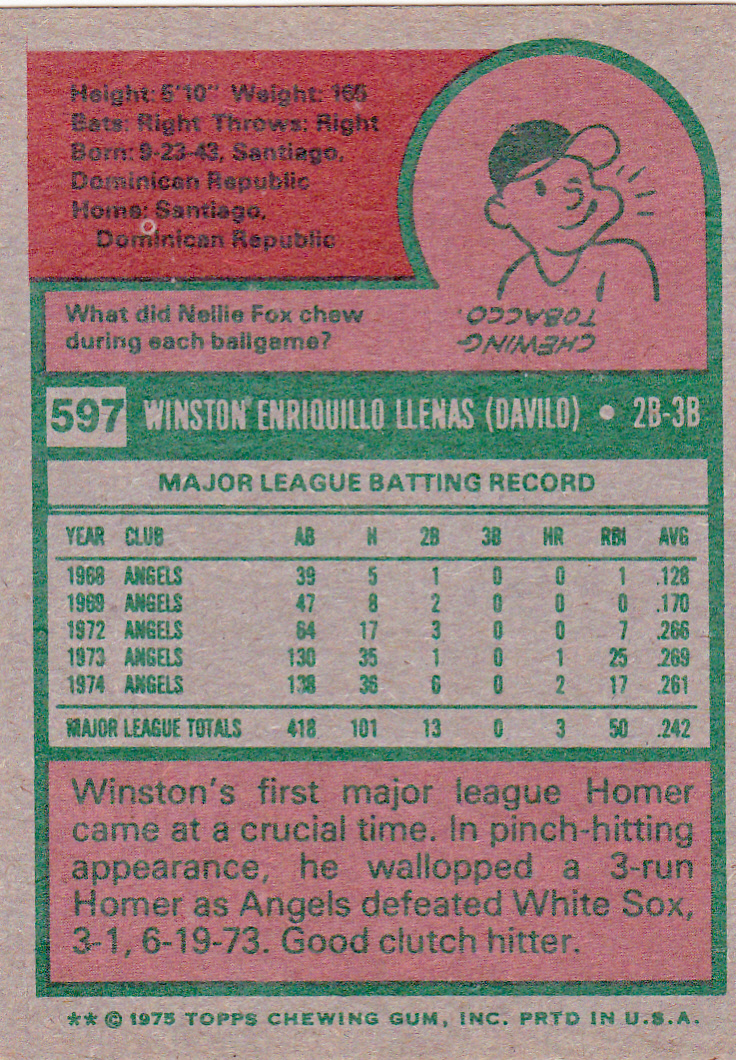
#597 - Winston Llenas


Card fact: This is Winston Llenas' final Topps card.

What I thought about this card then: I had the mini card, as I did with several of the Angels cards. I thought the bunting pose was cool.

What I think about this card now: Llenas is also shown bunting in his only other solo Topps card, in the 1974 set. He had seven sacrifice bunts for hits in his career. Is that enough to show him bunting in back-to-back sets?

Other stuff: Llenas started out in professional baseball when he signed as a teenager with the Kansas City A's back in 1961. He was released but a year later signed with the L.A. Angels. He played in the minors for the next six years before getting called up in 1968.

Llenas played with the Angels between 1968-69 and then 1972-75. He was used a lot as a pinch-hitter and led the American League in pinch-hits and pinch-hit at-bats in 1973. He finished his career batting .230.

His number is retired by Aguilas Cibaenas of the Dominican Winter League, where Llenas led the team to repeated success as a player, manager, GM, and team president.


Back facts: Well, we've finally got a player displaying a "chaw," but it's a cartoon Nellie Fox on the back of this card.

Other blog stuff: The green-light green border combo has moved back into sole possession of the overall lead with its 51st card.

Saturday, July 2, 2011

#585 - Chris Chambliss


Card fact: This is the first card of Chris Chambliss as a Yankee.

What I thought about this card then: No knowledge of it.

What I think about this card now: It's a very nice view of what was going on in the batting cage on that day. Good stuff.

Other stuff: I will always consider Chambliss a Yankee, as many also do. But Chambliss actually came up with the Indians and was named American League Rookie of the Year in 1971.

He played with the Indians through the early part of 1974, then was dealt to the Yankees in April of that year in the famed trade that also brought New York Dick Tidrow and Cecil Upshaw in exchange for Steve Kline, Tom Buskey, Fritz Peterson and Fred Beene.

It proved to be a terrific deal for New York, enhanced by the fact that Chambliss hit one of the most memorable home runs of the '70s, delivering the series-clinching blow off of the Royals' Mark Littell in the 1976 A.L. Championship Series. Who hasn't seen Chambliss knocking down jubilant Yankees fans on his way to home plate?

It was the first postseason series the Yankees had won since the 1962 World Series, and ushered in another semi-dynasty era for New York. Chambliss' best season for the Yankees was 1976, but he remained a reliable offensive and defensive first baseman for the team through the 1979 season. He was one of the few Yankees of that time that I did not despise.

Chambliss was traded by the Yankees to the Blue Jays after the '79 season. Toronto turned around and traded him to Atlanta a month later. Chambliss spent seven seasons with the Braves, so while I equate him with the Yankees, he was a Brave longer. He ended his career back with the Yankees, for one game in 1988.

He became a hitting coach and manager in both the majors and minors after his career. I saw him get thrown out of a game two years ago when he was managing the Charlotte Knights. He's now the hitting coach in Seattle.


Back facts: Carroll, huh? Guess it was good enough for Archie Bunker.

Other blog stuff: A historic moment. This is the 50th green-light green bordered card. And with this card, green-light green takes sole possession of first place in the overall border standings. Orange-brown has been in the lead for hundreds of cards, so this is BIG.

Also, the blog will be recognizing Independence Day by taking a few days off. See you after America's birthday.

Sunday, June 26, 2011

#579 - Skip Pitlock


Card fact: This is Skip Pitlock's second and final Topps card. His other card is in the 1971 set.

What I thought about this card then: No knowledge of it. I didn't have any knowledge of Pitlock either until I acquired this card while completing the set in 2004.

What I think about this card now: The slanted background returns. And those shadows in the bottom left corner look slightly ominous.

Other stuff: Pitlock would pitch to just one more major league batter after this card was issued. He faced Billy Williams of the A's in 1975, giving up a run-scoring single.

Pitlock came up with the Giants and was a starter in 1970, going 5-5. He spent the next three full seasons in the minors, two in the Giants organization and one in the White Sox organization. When he returned to the majors in 1974, he was a reliever, appearing in 41 games for Chicago.

Pitlock was traded to the A's in June of '75 in the deal that landed the White Sox Chet Lemon. Pitlock retired after the 1976 season.


Back facts: It seems to me that the trivia question in that cartoon would be tough to illustrate, which probably explains why you see what you see there.

Other stuff: The green-light green border combination reties the orange-brown combo for the overall lead with 49 cards each.

Monday, June 13, 2011

#568 - Dale Murray


Card fact: With this card, the green-light green border combination ties the orange-brown border combo for the overall lead with 48 cards apiece.

What I thought about this card then: This is one of the cards that I pulled out of the first three packs of baseball cards I ever bought, back in 1975. Everything about the card is ingrained in my brain. When I see it, I'm immediately transported to my bedroom on 6 Chadwick Road.

What I think about this card now: Is that a backstop way off in the distance? Look at how far away Dale Murray is from it! I'm surprised there is any room in front of Murray for a photographer to take a picture.

Other stuff: This is Murray's rookie card. He started off with a bang for the Expos, registering a 1.03 ERA in 32 games as a reliever.

Murray spent his entire 12-year career as a reliever, appearing as a starter in just one game out of 518. (While with the Reds, he lasted barely an inning in his only start in 1977). In 1975, Murray went 15-8 in 63 relief appearances. In 1976, Murray led the National League in appearances with 81.

Murray played for Montreal, Cincinnati, the New York Mets, Toronto, the New York Yankees and Texas. He was traded from Montreal to Cincinnati in the trade that sent Tony Perez to the Expos. Later, he went to the Yankees from the Blue Jays in a deal that gained Toronto Fred McGriff, Dave Collins and Mike Morgan.


Back fact: I know this cartoon as well as any cartoon in the set. Yet, it isn't until now that I have attempted to look up why there is a picture of a football player with a question about a Phillie winning a World Series game.

It turns out that this is another cartoon mix-up. Dean Look was a baseball player with a three-game career with the White Sox in 1961. He is better known as a collegiate football star and NFL player, who later became a longtime NFL referee.

The only pitcher to win a World Series game for the Phillies as of 1975 was Grover Cleveland Alexander who won Game 1 of the 1915 World Series against the Red Sox.

There are so many things as a kid that you just chalk up to "well, I don't understand that because I'm a kid." It turns out the cartoon would have confused anyone!

Other blog stuff: I still have that card of Murray that I pulled out of those first packs. A rookie card collector pulling a rookie card:

Sunday, June 12, 2011

#567 - Jim Sundberg


Card fact: This is Jim Sundberg's rookie card.

What I thought about this card then: I didn't see a Sundberg card until his 1977 Topps card.

What I think about this card now: Sundberg was one of those guys who seemed to look the same no matter what year it was or how long he had been in the majors. Unchangeable.

Other stuff: When I was a kid, I would only hear about Sundberg from TV broadcasters. The Rangers were never on TV, except when they played the Yankees. But during the Game of the Week and This Week in Baseball, I would hear about the catcher from Texas being one of the best catchers in the game. I'm sure Joe Garagiola, who always talked up catchers, mentioned him a lot.

Sundberg is known as one of the best defensive catchers to have played the game. He played from 1974 to 1989 and won six straight Gold Gloves between 1976-81. Sundberg was a fairly decent hitter, especially during the peak of his career. He tailed off offensively in the early '80s.

The Rangers dealt him to the Brewers after the '83 season. Then Sundberg was traded to the Royals ahead of the 1985 season. He was the primary catcher for Kansas City when they won the World Series. Sundberg later played for the Cubs and the Rangers again.

After his career, he was a TV broadcaster and now works as a VP of public relations for the Rangers.


Back facts: One of the longer write-ups that you'll see in the set. Topps was really tested by guys who had just a year or two in pro ball.

Other blog stuff: While looking up "on this date" items, I always come across airplane crashes. Plane crashes, I have noticed, don't happen nearly as often as they did when I was growing up. It used to be commonplace in the '70s and even '80s to read about large plane crashes maybe 7-8 times a year, many of which happened here in the U.S. I've done absolutely no research on this, but they don't seem to happen nearly as often anymore, which is terrific. I don't remember this being publicized -- I'm sure some airline has, though.

Sorry about that detour. Baseball-reference is acting loopy and that's the best that I could do.

Tuesday, May 31, 2011

#555 - Al Oliver


Card fact: I'm not 100 percent sure, but this photo could have come from the same shoot as his photo on the 1974 Topps card.

What I thought about this card then: I never saw it. I knew his 1976 Topps card very well though.

What I think about this card now: This is a prime example of a member of the subhelmet hat alliance. It looks a little goofy, but Al Oliver is taking it very seriously.

Other stuff: Oliver was a primary component of the 1970s pennant-winning Pirates teams. He would later become a key member of the lineup for the Rangers and Expos, but I will always think of him as a Pirate.

Oliver was your classic No. 3 hitter from the '70s. With Willie Stargell in the lineup, Oliver was the guy counted on to get on base and supply power, and Oliver could do both. He didn't have a ton of home run pop, but drove in more than 80 runs nine times and had a lifetime .303 average. He led the National League in hitting with a .331 average in 1982.

Oliver was also a solid fielder, known as "Scoop" in his later days when he played first base more than the outfield. After he was traded to Texas (in a four-team swap that landed the Pirates Bert Blyleven), he changed his uniform number from 16 to 0. I don't know why. I always thought it stood for "O," as in "Oliver," rather than the number zero, but I don't know that for certain.

Oliver is often mentioned as a Hall of Fame candidate. Oliver claimed that he was a victim of collusion by baseball owners in the late '80s, and he should have been able to extend his career past 1985, possibly obtaining 3,000 career hits.


Back facts: Oliver hit .321 in 1974 with nearly 200 hits and all Topps could think to write about was some mumbo-jumbo about him being difficult to face.

Other blog stuff: Brooke Shields was born on this date 46 years ago. I cannot think of 1980 without thinking of Brooke Shields and those Calvin Klein ads. She did a number on us 15-year-old boys.

Monday, May 30, 2011

#554 - Rich Gossage


Card fact: You might expect the card to say "Goose Gossage," but card companies didn't start identifying Gossage as "Goose" on the front of cards until the mid-1980s when Fleer and Donruss began doing so.

What I thought about this card then: It seems a little odd to see Gossage without his trademark Fu-Manchu, but not terribly so, as my brother had this card and we were acquainted with Gossage before he went all New York on everyone.

What I think about this card now: Always liked the red White Sox caps.

Other stuff: Gossage was one of the most imposing relief pitchers of his time, part of a new breed of reliever that included Al Hrabosky, Rollie Fingers, Bruce Sutter and Sparky Lyle. Except for one season when he went 9-17 for the 1976 White Sox, Gossage was a reliever exclusively. He led the league in saves three times, the first time in 1975.

His best seasons came with the Yankees. He was famously signed by New York after the 1977 season, even though the Yankees already had Lyle, who had just come off a Cy Young-winning season in '77. Gossage took over the closer role with a standout '78 and became the Yankees' primary reliever through the 1983 season.

Gossage later pitched for the Padres, Cubs, Giants, Rangers, A's and Mariners until 1994. He was voted into the Hall of Fame in 2008. He makes many public appearances and is active in his community in Colorado Springs, Colo., which is where he grew up.

Oh, and one more thing ... George Brett.


Back facts: That is some kind of season he had in 1971 at Appleton.

Other blog stuff: On this date in 1982, Cal Ripken Jr. began his consecutive games played streak by starting at third base against the Blue Jays.

Saturday, May 7, 2011

#532 - Gorman Thomas


Card fact: This is the last time Gorman Thomas wore the No. 44 in a baseball card photo. He handed over No. 44 to Hank Aaron in 1975 and took No. 3.

What I thought about this card then: Thomas was among those players that we poked fun at when we were kids. The combination of his first name and his .205 lifetime batting average at the time made him ripe for the picking. Little did we know that he would become badass.

What I think about this card now: It doesn't look like Thomas without the mustache and beard. By the 1976 card, he had the mustache, and by 1980, the beard was there.

Other stuff: Thomas was a big-time '70s slugger in the model of Dave Kingman. He hit a lot of home runs, his batting average was atrocious, and he struck out a bunch. But, unlike Kingman, Thomas managed to find himself a niche on a winning ballclub, as one of the primary hitters on the Brewers team of the early 1980s that eventually went to the World Series in 1982.

Thomas hit 45 home runs and drove in 123 in 1979 after struggling for six years to hang on with Milwaukee. He struck out 175 times that season and 170 the next, but between 1978-83, he put up power numbers that were among the best in baseball. He also played well in the outfield. I think young fans today would be surprised that he played center field.

Thomas was traded to Cleveland after the 1983 season and finished his career in 1986, partly with Seattle and partly back with Milwaukee. His lifetime batting average is .225. He remains popular with fans to this day and makes personal appearances for the Brewers.


Back facts: Well, all of us collectors certainly know Mickey Mantle's uniform number now, don't we? Also, I think that is in a tie for the shortest answer of any of the cartoons in the set.

Other blog stuff: On this date in 1940, the Brooklyn Dodgers become the first team to fly, on an airplane flight from Chicago to St. Louis.

Sunday, April 24, 2011

#519 - Jim Todd


Card fact: This is Jim Todd's rookie card.

What I thought about this card then: My brother had this card. He would joke that you could look up Todd's nostrils.

What I think about this card now: Let's play a game of "does he really have a ball in his glove?" I think he does.

Other stuff: Todd was a relief pitcher between 1974 and 1979. His best season was in 1975 when he appeared in 58 games for the Oakland A's, went 8-3, and saved 12 games with a 2.29 ERA. He appeared in all three games of the A's playoff series loss to Boston that fall.

Todd never enjoyed another season that strong and was shipped back to the Cubs for the 1977 season. He later pitched for the Mariners and then ended his career back with the A's. He pitched in the minors for the Giants in 1980 before retiring.

(EDIT: Jim Todd died at age 77 on Feb. 3, 2025).


Back facts: For a long time, I wondered whether a player would be out if a fielder caught his foul pop in the dugout. I would have saved myself a lot of wondering if I had only looked at the back of this card in 1975.

Other blog stuff: It's a holiday, so I'll take a break from research. Happy Easter.

Wednesday, April 20, 2011

#515 - Manny Sanguillen


Card fact: This photo appears to have been taken on the same day as this one. Must've been pretty chilly down there in Florida that day.

What I thought about this card then: I didn't see it. The first card of Manny Sanguillen's I saw was the electric fireball 1976 card.

What I think about this card now: Sanguillen has several classic cards, but this is not one of them. He looks a little perturbed by what he sees to his left.

Other stuff: Sanguillen was one of the best hitting catchers of the 1970s, part of a renaissance at the position, led by Johnny Bench and also including Carlton Fisk, Thurman Munson and Ted Simmons. In 12 seasons with the Pirates (and one with the A's), Sanguillen hit .296 for his career and was a three-time all-star.

Sanguillen was famed for his free swinging. Vladimir Guerrero reminds me a lot of what Sanguillen used to do. He used to swing at balls that seemed to be a foot over his head.

In 1971, he hit .379 in the World Series against the Orioles, supplying more hits than anyone besides Roberto Clemente. After Clemente's death, Sanguillen was tabbed to replace Clemente in right field, but the move didn't work and Sanguillen returned to catcher.

Sanguillen was famously dealt to the A's for manager Chuck Tanner, who ended up leading the Pirates to the 1979 World Series title. Sanguillen was back with the Pirates by then as Oakland returned him to Pittsburgh one year after acquiring him.

Sanguillen now operates a concession stand at PNC Park in Pittsburgh.


Back facts: Sanguillen recorded only 35 stolen bases in his career.

Other blog stuff: Today is Dodger manager Don Mattingly's 50th birthday! Win one for the birthday boy today, guys.

Wednesday, April 13, 2011

#508 - Bob Hansen


Card fact: This is Bob Hansen's one-and-only Topps card.

What I thought about this card then: Never saw it. Never heard of the man.

What I think about this card now: Hansen has a vaguely maniacal look about him even though a more rational person would pass it off as enthusiasm combined with a sweaty brow. It's quite a memorable card for your only card.

Other stuff: Hansen was a pinch-hitter and first baseman for the Brewers in 1974 and 1976. He was drafted by the Seattle Pilots in 1969. After spending several years in the minors, he finally came up with Milwaukee in '74 and contributed a .295 average in 88 at-bats.

Hansen never made it out of the minors in 1975. He was back with Milwaukee in '76 but hit just .164 in 24 games. That was the end of the majors for him.


Back facts: It looks like Don Zimmer slobbered some tobacco juice on the back of this card.

What an odd cartoon. Zimmer wasn't the only one who chewed tobacco in the majors. Granted, Zim usually looked like he had an excess amount in his mouth.

The bio reads like Topps is straining for words in order to fill space.

Other blog stuff: On this date in 1980, the Kansas City Royals fielded the first "Q" battery. Dan Quisenberry pitched and Jamie Quirk caught.

Tuesday, April 12, 2011

#507 - Tom Carroll


Card fact: This is Tom Carroll's rookie card. He was featured on just two cards by Topps, 1975 and 1976.

What I thought about this card then: I had the mini card. So, this is one of those cards that to this day  looks right only in mini form. The regular size looks too LARGE.

What I think about this card now: I never understood the collared look with the uniform jersey.

Other stuff: For a long time, I thought Tom Carroll was related to fellow Reds pitcher Clay Carroll, but he's not.

Carroll had a two-year major league career with the Reds. He pitched in 28 career games, going 8-4 in 125-plus innings. After two years with Cincinnati, he spent all of 1976 in the minors. He was then traded to the Pirates but didn't make the majors and retired soon afterward.

Carroll later became an analyst for some engineering/information technology corporation. I won't go deeper into it than that because his job profile makes my head hurt. It's safe to say he's a pretty smart dude.


Back fact: The cartoon might look a little familiar to you if you read my other blog. I used this cartoon -- altered, of course -- and placed it on the sidebar.

Here it is. All professional-like and everything:


Other blog stuff: I recently went to a card show and upgraded a handful of '75s. Some of the off-center cards look OK in person, but are glaring on the blog. I don't plan to scan these new cards in place of the ones I have on the blog already, so I'm not sure why I'm mentioning it here.

But I suppose if it has to do with '75s then it should be mentioned here. So here are the upgrades:


Collecting the 1975 set never ends.

Friday, April 8, 2011

#504 - Buddy Bradford


Card fact: This is the second and last card of a player named Buddy in this set. The other was Buddy Bell.

Actually, there is a third player named Buddy in the set. Buddy Solomon was a pitcher for the Dodgers that we'll see when the Rookie Prospects cards show up. But he is referred to by his given name "Eddie" in this set.

What I thought about this card then: I didn't see it. In fact, there was an African-American pitcher named Larry Bradford who pitched for the Braves in the late '70s. By the time I was aware of Buddy Bradford, I assumed they were the same person and Buddy decided to go by his given name of "Larry."

What I think about this card now: It is all kinds of miscut. I might have to search out a new copy at the card show coming up.

Other stuff: Bradford was a platoon-type player for several teams, mostly the White Sox, between 1966-76. He didn't hit for a high average (.226 for his career), but he had some power, which kept him attractive to some teams. The Indians, Reds, Cardinals and the White Sox, for a second time, all traded for him.

After his major league career ended in 1976, Bradford played for a year in Japan. He later became a successful businessman.


Back facts: OK, I am going to say this one time. The final pitch that Don Larsen threw to pinch-hitter Dale Mitchell that was called strike three by Babe Pinelli and clinched the only perfect game in World Series history was NOT A STRIKE. Too close to take? Maybe. But irksome just the same.

Other blog stuff: Today's date produced plenty of baseball breakthroughs. On this date in baseball:


  • The Cardinals debuted their "birds on a bat" uniforms in 1924.
  • Pete Rose made his first major league plate appearance in 1963 (he walked).
  • The Astros and Dodgers played the first MLB game on synthetic grass in 1966.
  • The Royals, Padres, Expos and Pilots all made their MLB debuts and each won in 1969.
  • Hank Aaron broke Babe Ruth's all-time home run record with No. 715 in 1974.
  • Frank Robinson made his debut as baseball's first African-American manager in 1975.
  • The Mariners registered their first major league victory in 1977.
  • Jim Abbott made his major league debut in 1989.
  • Chan Ho Park was the first Korean to play in an MLB game in 1994 (his team was no-hit by Kent Mercker)

Thursday, March 31, 2011

#496 - Pepe Frias


Card fact: This card achieves the hard-to-reach trifecta of batting helmet, batting cage and Coca-Cola ad in the background.

What I thought about this card then: I remember my brother and I ragging on poor Pepe relentlessly when we were kids. This was in the top five of ridiculed cards as a youngster. I think it was all based on his batting average and his name "Pepe."

As I got older, I wondered about his signature. It looked like it said "Chrysalis," which I knew from "Chrysalis Records," the label that signed Blondie, Pat Benatar, Huey Lewis and the News, and others. Leave it to me to associate new wave rock with a Latin American ballplayer.

What I think about this card now: Frias appears to be facing the wrong way if he wants to get a hit.

Other stuff: Frias was a utility infielder with the Expos after spending several years in the minors. He only played in at least 100 games once until he was sent to the Braves. Atlanta suddenly made him its starting shortstop in 1979 and he performed OK, hitting .259 in 140 games.

Frias finished out his career as a backup with the Rangers and the Dodgers. I remember being particularly embarrassed over having a 1981 Fleer card of Frias as a Dodger, considering how little regard we had for him back in 1975.


Back facts: Frias is actually not 5-foot-1. That is a typo. He is 5-10 or 5-11, depending on where you get your information.

Also, I have never heard of the term "cousin."

Other blog stuff: Here is the original '75 Frias that I pulled from a pack and that we kicked around so often:

Monday, March 21, 2011

#486 - Ray Fosse


Card fact: Well, it's not much of a fact, but I challenge you to find two back-to-back cards that feature more memorable mustaches than this one and the previous card.

What I thought about this card then: My brother had this card, and we thought it was amazing. Snidely Whiplash had his own card!

What I think about this card now: It's even more amazing. The A's green-and-gold uniforms were lost on us kids because everyone wore wacky uniforms in the '70s. But 35 years have passed and I now realize how fortunate we were to see ballplayers running around in those things.

Other stuff: Ray Fosse is most known for getting bowled over by Pete Rose on the final play of the 1970 All-Star Game. The play is blamed for ruining Fosse's career, but the fact is there was plenty of blame to go around throughout his career.

Fosse was injury prone and always seemed to find his way off the field. He was leveled by Jim Rice in another home plate collision late in his career. In 1974, he suffered a back injury trying to break up a fight between teammates Reggie Jackson and Bill North. But in between all the injuries he was known as a tremendous handler of pitchers. Before his '74 injury, he was the A's top catcher, helping pitchers like Vida Blue, Ken Holtzman and Catfish Hunter lead Oakland to a dynasty.

Fosse came to the A's in a trade with Cleveland that sent George Hendrick to the Indians. Fosse later returned to Cleveland, and also played for Milwaukee and Seattle before ending his career in 1979. After his playing days, he became a broadcast announcer for the A's, and still announces Oakland games.

(EDIT: Ray Fosse died on Oct. 13, 2021 after a long battle with cancer).


Back facts: Spider Jorgensen was the Brooklyn Dodgers' starting third baseman during his rookie year in 1947. The Dodgers won the pennant that year. But Jorgensen would never come close to playing that well again and was out of the majors by 1952.

Other blog stuff: On this date in 1968, Kansas City's new baseball franchise was named. The Royals were born. They're going to be good again. You just wait.

Tuesday, March 15, 2011

#480 - Carlos May


Card fact: Carlos May is one half of one of the brother combinations in this set. His brother, Lee May, was featured way back on card #25.

Other brothers with cards in this set are Phil and Joe Niekro, Gaylord and Jim Perry, Graig and Jim Nettles, Bob and Ken Forsch, and George and Ken Brett.

What I thought about this card then: I didn't see it.

What I think about this card now: I love how the player in the background practically GLOWS because of the White Sox's uniform. Please let it be Dick Allen, please let it be Dick Allen, please let it be Dick Allen.

Other stuff: May started off strong with the White Sox, despite getting most of his right thumb blown off during a mortar unit cleaning accident while in the Marine reserves. His incident was a mild childhood obsession of mine.

May was named the Sporting News rookie of the year in 1969, even though Lou Piniella won the actual MLB rookie of the year award that year. May continued to put up decent numbers for Chicago throughout the early 1970s. But by the mid-70s, he was expendable and acquired by the Yankees the day after his birthday in 1976.

May played in the World Series for the Yankees that season, but it was his last hurrah. He didn't play much in '77, and ended his career with the Angels that same year. He then played four years in Japan, and now works in community relations with the White Sox.

Oh, and he's the only guy to wear his birthdate, "May 17," on the back of his uniform. He switched his uniform number from 29 to 17 after his first season.


Back facts: I think Topps was being a little generous giving May a card number ending in zero. May took a downturn in 1974.

Other blog stuff: The No. 1 song in the country on this date in 1975 was "Black Water" by the Doobie Brothers. "And I ain't got no worries, cause I ain't in no hurry at all."

Sure would like to be that dude.