Saturday, September 3, 2011
#640 - Harmon Killebrew
Card fact: This is the final Topps card issued of Harmon Killebrew during his playing career. He had appeared in just about every Topps flagship set from 1955-75 (he's not in the 1957 set).
What I thought about this card then: I had the mini card. I thought he looked pretty old.
What I think about this card now: It's funny how little I noticed when I was a kid. It never dawned on me then that Killebrew is signing an autograph. And, of course, now I recognize that there is a partial tobacco advertisement in the photo. It's really one of the better photos in the set.
Other stuff: I always have trouble writing about the most well-known stars on this blog. What do I say?
I just wrote about Killebrew after his recent death. Killebrew was one of the greats, both as a player and a person. I was just getting to know baseball when Killebrew retired. I never saw him play. I would have been interested in seeing him in a Kansas City Royals uniform, which is where he spent his final season in 1975. But I really didn't actively watch baseball until 1976 or 1977.
It's easy for some to forget that Killebrew was among the top five home run hitters of all-time for quite awhile. Right up there with Aaron, Ruth, Mays and Frank Robinson.
I remember Killebrew mostly as a broadcaster.
Back facts: Rick Burleson (149 in 1980) and Roy Smalley (144 in 1979) have each surpassed Bobby Wine's double play record for shortstops.
Other blog stuff: This is probably the last opportunity on the blog to show the mini card next to the regular card, so here goes:
I may have a few more of these for you over on my other blog over the weekend. Stay tuned.
Monday, August 29, 2011
#635 - Chuck Dobson
Card fact: Chuck Dobson is wearing an airbrushed Angels cap and uniform. Dobson was acquired by the Angels in June of 1974. This is also Dobson's first Topps card since the 1972 set and the final Topps card issued during his career.
What I thought about this card then: Never saw it.
What I think about this card now: I like the stacked signature in the corner. It's a bit unusual.
Other stuff: Dobson pitched fairly successfully for the Kansas City and Oakland A's from 1966-71. Known as a strikeout pitcher, he won in double figures from 1967-71 and led the American League in starts with 40 and shutouts with five in 1971.
Arm and shoulder problems plagued him and eventually cost him the 1972 season and most of the 1973 season. He was property of the Mexican League Mexico City Tigers when purchased by the Angels. He pitched for the Angels in '74 and '75 and in the minors in 1976.
Dobson is known for two other things. One is being Reggie Jackson's roommate as the two were the first regular interracial roommates in baseball history. Also, Dobson appears in dramatic fashion on one of the best-known baseball cards, but it's not his card.
Back facts: Dobson gets a card number ending in "5" strictly based on his performance of at least three years prior to this card.
Other blog stuff: Since I made a statement that this card was the only one I had in regular, mini and OPC form, I have since acquired the Dobson card in all three forms. Why Chuck Dobson? Hey, you take what you can get with the '75 set.
Saturday, August 27, 2011
#633 - Paul Casanova
Card fact: This is the final Topps card issued of Paul Casanova during his playing career.
What I thought about this card then: I had the mini card. I didn't have any thoughts except I would always confuse him with long-ago Cubs all-star Phil Cavarretta. This can be attributed solely to the fact that both of them have the initials of P.C., because they are not alike in any way.
What I think about this card now: Casanova looks pretty happy in most of his cards. But in this one he seems like he has an idea that he's at the end of his career.
Other stuff: Casanova was a strong defensive catcher who spent most of his career with the Washington Senators. He played for them for seven seasons from 1965-71, winning an All-Star selection in 1967, his best season.
Casanova actually was signed by two other major league teams before the Senators -- the Indians twice, and the Cubs, but he didn't stick until playing for Washington. His hitting declined in the '70s and he was dealt to Atlanta, where he worked as a backup catcher through 1974.
Casanova's son, Raul, was a major league catcher from 1996-2008, most recently with the Mets (the transactions file on Raul Casanova is amazingly long).
(EDIT: Casanova died on Aug. 12, 2017).
Back facts: Niekro's no-hitter came against the Padres before a whopping 8,000 fans in Atlanta.
Other blog stuff: I'll show the mini next to the regular sized card:
Dueling Casanovas!
Sunday, August 21, 2011
#627 - Tom Walker
Card fact: Tom Walker is the father of current Pirates second baseman Neil Walker. That makes this the second straight card that featured a player whose son played in the majors also.
What I thought about this card then: Never saw it.
What I think about this card now: Walker seems to be strategically placed in front of the Coca-Cola sign that graces so many of the Expos' cards.
Other stuff: Walker pitched between 1972-77, mostly with Montreal. He was a reliever most of the time and was dealt to Detroit for Woodie Fryman after the 1974 season (Topps could only manage a blurb about the trade on the back of Walker's card).
Walker ended his career with stints with St. Louis, the Expos again, and the Angels.
(EDIT: Walker died Oct. 23, 2023 at age 74).
Back facts: OK, the cartoonist clearly is doing a lot more work than the biographer on this card.
The cartoonist draws a moose at the plate, which can't be easy to do.
The biographer? Well, it's obvious he had nothing to write about, so he stared at the stats for awhile and realized Walker never had a losing record and, viola, a write-up was born. Also, Walker was not exclusively a reliever. In fact, in 1974, he started eight games.
Other blog stuff: Kenny Rogers -- the singer, not the pitcher -- was born on this date in 1938.
Friday, August 19, 2011
#625 - Boog Powell
Card fact: This card really marks the homestretch for this set. With the exception of two cards, it is all players from here on out.
What I thought about this card then: Oh, my goodness, it was a laugh riot. It was the funniest card we ever saw at that young age.
What I think about this card now: The card was the very first Cardboard Appreciation subject on my other blog. It was the first one for all the reasons you can think of -- and for a few more that you can't think of because you're not 9 anymore.
Other stuff: Boog Powell made up the meat of the order for the Orioles' lineups through the 1960s and into the 1970s. He was at the tail end of his Orioles career at this point, as this is his final Topps card as an Oriole.
Powell won AL MVP honors in 1970 and finished second behind Harmon Killebrew in 1969. He hit six home runs in the postseason. He absolutely wore out the Twins in back-to-back ALCS.
Powell was traded to the Indians in February of 1975, so he was already with another team by the time this card came out. He finished his major league career in 1977 with the Dodgers. Powell is now known just as much for his barbecue as his playing career.
And just one more thing:
BOOOOOOOOOOOOOOOOOOOOOOOGGGG!!!!!!!!!!!!!!
Back facts: I missed posting on Powell's 70th birthday by two days.
Other blog stuff: The orange-brown border combination bounces back to join the pink-yellow combo at the top with its 53rd card.
Sunday, August 14, 2011
#620 - 1975 Rookie Catchers-Outfielders
Card fact: This is the first rookie card -- as rookie cards were known back in the '70s -- that I ever saw.
What I thought about this card then: I had the mini card, which was quite fortunate of me because it is Gary Carter's rookie card. But what I thought about the most was the fact that there were two Tigers on the bottom. That seemed unusual to me. It still does.
What I think about this card now: It's in semi-rough shape compared with most of the other cards I have from the set. I was probably trying to save cash by getting it on the cheap.
Also, Hill's cap is airbrushed.
Other stuff: Each player's first solo Topps card:
Gary Carter, Expos: 1976 Topps (with the rookie cup!)
Marc Hill, Giants: 1976 Topps
Danny Meyer, Tigers: 1976 Topps
Leon Roberts, Tigers: 1976 Topps
Most successful career: Carter is a Hall of Famer. (EDIT: He died on Feb. 16, 2012 at age 57. Marc Hill died August 2025 at age 73).
Most awesome middle name: Kauffman edges out Edmund.
Other blog stuff: It's been quite awhile since I've featured the mini card next to the regular card. This is as fine a time as any to resume that practice:
C'est bon!
Wednesday, August 3, 2011
#613 - Bill Parsons
Card fact: This is the final Topps card issued during Bill Parsons' career.
What I thought about this card then: Never saw it.
What I think about this card now: Parsons is airbushed into an A's cap. He was dealt from the Brewers to the A's in June of 1974. Topps didn't do a great job on the cap, but the uniform is pretty good. The gold jersey looks realistic.
Other stuff: Parsons was a 6-foot-6 right-hander who pitched for four seasons in the major leagues. He got off to a terrific start, winning 13 games for the Brewers in 1971 and finishing second to Chris Chambliss in the A.L. Rookie of the Year voting.
Parsons won 13 games again in 1972, even though the Brewers finished in last again. The following year wasn't so great as he stumbled to a 6.69 ERA in 20 games. Milwaukee traded him to Oakland for Deron Johnson. But he pitched in just four games for the A's, and that was the end of his major league career. In late '74, Parsons was acquired by the Cardinals, but didn't play in the majors for them.
Back facts: Another frustrating card for Topps, which went through the effort of airbrushing Parsons into an A's cap only to have him dealt to the Cardinals.
Also, the cartoon is quite random. Why not do a cartoon about every pitching coach in the majors in 1975?
Other blog stuff: We are about to embark on the final subset of the 1975 set. I'm going to handle this subset a little differently than I have the rest of the cards. But I hope it's still interesting.
Sunday, July 31, 2011
#610 - Ron Hunt
Card fact: This is the final Topps card of Ron Hunt during his playing career.
What I thought about this card then: No knowledge of it.
What I think about this card now: Topps isn't fooling me with that "Cardinals" cap. Hunt is airbrushed from his Expos get-up because he was obtained off waivers by the Cardinals in early September 1974 and Topps was out of luck getting a photo.
Other stuff: Hunt came up with Mets, who were in their sophomore season in 1963. He became the Mets' starting second baseman and finished second in the National League Rookie of the Year voting to Pete Rose that year.
Hunt played for the Mets for four years but was dealt to the Dodgers in the Tommy Davis deal. Then, after a season with L.A., he was shipped to the Giants in the first trade between the two teams since their moves out to the West Coast.
Hunt's reputation for getting hit by pitches really grew while he played for San Francisco. Beginning with his first season with the Giants in 1968, his HBP totals jumped and he led the league in HBP for seven straight seasons. His phenomenal 50 HBPs in 1971 while he was with the Expos is the most recorded in the modern era.
Hunt played with the Expos through 1974 and ended his career with the Cardinals. After his career, he eventually started a baseball camp, which he has operated for more than two decades.
(EDIT: Ron Hunt died at age 85 on July 15, 2026).
Back facts: The cartoon means to say: "Who stole home the most times in a career?" Although the Baseball Almanac site says Cobb stole home 54 times, not 35.
Other blog stuff: I'm really starting to believe my speculation on whether Topps waited to fill in the players who would represent the higher numbers in the set. If you look at the cards since No. 600, only Rod Carew and John Ellis are what you would have called "definites" for the set. Every other player has been either at the very end of his career, the very beginning, or was traded recently. Ellie Rodriguez doesn't fall into those categories, but he also didn't have a card the previous two years, so he wasn't a definite either.
I'll be tracking the rest of the cards.
Saturday, July 30, 2011
#609 - Ellie Hendricks
Card fact: Ellie Hendricks returns to the Topps set with this card. He did not appear in the 1973 and 1974 sets.
What I thought about this card then: I remember seeing a mangled mini version of the Hendricks card, but I couldn't tell you whether it was owned by me, my brother or a friend.
What I think about this card now: Hendricks gets progressively happier in his cards through the years (really, take a look). This is one of his final cards, and you can see he is quite happy.
Other stuff: Hendricks was an enormously popular Orioles player, who is credited as one of the keys to Baltimore's impressive pitching rotation of the late '60s and early '70s. He was known as a great handler of pitchers and was at his most active between 1969-71 when the Orioles went to the World Series each year. He was involved in a famous controversial play in the 1970 World Series in which he collided with the home plate umpire and Reds runner Bernie Carbo on a play at the plate.
Hendricks was dealt to the Cubs in 1972, but returned to the Orioles the following year, as more of a third-string catcher. He didn't hit much at all -- batting .220 for his career -- and was traded again to the Yankees in the huge nine player deal on June 15, 1976.
He returned again to the Orioles in the late '70s as a player-coach. He then moved on to be a bullpen coach for Baltimore for 28 seasons, and was the longest tenured active coach for a period.
Hendricks died of a heart attack just shy of his 65th birthday in December 2005.
Back facts: Hendricks hit a home run in Game 1 of the 1970 World Series, the same game in which he was involved in the controversial play.
Other blog stuff: The green-purple border combination ties the orange-brown combination for first place with its 52nd card.
Friday, July 29, 2011
#608 - Gene Michael
Card fact: This is the final Topps card of Gene Michael during his playing career.
What I thought about this card then: I had the mini card. Michael looked ancient to me.
What I think about this card now: It is way, way off-center and I need to fix it.
Other stuff: Michael is known for his career with the Yankees as a player, coach, manager and administrator. He had his most success as the general manager with the Yankees in the 1990s, helping build the team that won four World Series titles in five years.
As a player, Michael was signed by the Pirates, then traded to the Dodgers for Maury Wills in 1967. A year later, he was purchased by the Yankees and played for New York through the end of the 1974 season. He played for the Tigers in 1975.
Michael, nicknamed "Stick," was your typical good-field, no-hit middle infielder that thrived in the '70s. He batted .229 for his career, but knew the game, which really served him well in his front office jobs.
I remember Michael being a guest during a Yankees broadcast a few years ago. He was fascinating to listen to -- intelligent, revealing and full of stories. He should have been able to talk for the whole game.
(EDIT: Gene Michael died at age 79 on Sept. 7, 2017).
Back facts: Robert "Bobby" Mitchell was never an ace pitcher. He was more of a fill-in type guy. The first "full-time" left-handed pitcher was J. Lee Richmond, who also pitched baseball's first perfect game.
Other blog stuff: On this date in 1983, Steve Garvey's consecutive games played streak ended at 1,207 after he was unable to play in the second game of the Padres' doubleheader against the Braves. He dislocated his thumb in a collision at home plate in the first game.
Thursday, July 28, 2011
#607 - Jim Holt
Card fact: Jim Holt is looking way up in the sky because he doesn't want to show you that he is really wearing a Twins cap. Holt was traded from the Twins to the A's in August of 1974. He is painted into a green-and-gold jersey.
What I thought about this card then: Never saw it.
What I think about this card now: One of the more unsettling "looking up" cards in the set. Also, you might be interested to know that Holt's uniform number with the A's was 38. His uniform number with the Twins was 26. And you can see the number 26 on the bill of his cap. Can't fool me, Topps.
Other stuff: Holt played first base and the outfield for the Twins and A's between 1968-76. He was a part-timer for most of his career, although he hit .297 in 132 games for the Twins in 1973 when Harmon Killebrew was dealing with a knee ailment that sidelined him for a good chunk of the season.
The Twins traded Holt for Pat Bourque late in the season in '74 (Bourque was returned to the A's after the season). Holt's biggest moment with the A's was knocking in two runs as a pinch-hitter in the sixth inning of Game 4 of the '74 World Series against the Dodgers. Holt's single broke open a close game and a close series and gave the A's a 5-2 victory. Oakland would go on to win the Series in 5 games.
(EDIT: Holt died on March 29, 2019 at age 74).
Back facts: I don't know why "an accomplished big league hitter" is necessary. He's in the big leagues. He's a hitter. I think that makes him "accomplished."
Other blog stuff: The orange-brown border combination has moved back into first place with its 52nd card. It's apparently going to be a dogfight until the end.
Wednesday, July 27, 2011
#606 - Bruce Miller
Card fact: This is Bruce Miller's rookie card.
What I thought about this card then: I had the mini card. For some reason, I thought he was a pitcher, even though "2B-3B" was staring at me the whole time.
What I think about this card now: Miller looks quite friendly for someone with a bad-ass mustache.
Other stuff: Miller played four major league seasons for the Giants from 1973-76. He started with the White Sox, then was dealt to the Angels. The Giants acquired him for infielder Al Gallagher in 1973.
Miller was a part-time player. The only season he stayed out of the minors was 1975 when he .239 in 99 games for the Giants.
Miller became a teacher and school coach in his native Indiana after his playing career.
Back facts: I wonder if the cartoon, specifically the reference to Baltimore and the moving van drawing, gives any old Colts fans bad flashbacks?
Other blog stuff: '70 singer Maureen McGovern was born on this date 62 years ago. "The Morning After" is just a horrible '70s song. Of course, it won an Oscar.
Monday, July 25, 2011
#604 - Oscar Zamora
Card fact: This is Oscar Zamora's rookie card. Despite that, he is airbrushed into a Cubs cap. He was purchased by the Cubs from the Astros in June of 1974.
What I thought about this card then: I had the mini card. I don't recall thinking much of it. I do remember my brother being horrified by his 1978 Topps card (it's just a big head shot of Zamora airbrushed into an Astros cap, nothing to get worked up over).
What I think about this card now: I'm just realizing that the familiar barn-like baseball facility that appears on a lot of Astros cards in this set is in the background of the photo on this card. So Zamora was definitely an Astro in this photo.
Other stuff: Zamora may have appeared on his first card in '75, but he had been pitching professionally in the minors since 1965, with the Indians and Astros organizations. He finally broke through with the Cubs and didn't do too badly for a poor club.
Zamora's success declined in '75 and '76 and he returned to the minors. He was reaquired by the Astros for the 1978 season. After that he pitched in sporadically in the minor leagues.
Zamora was one of just four Cuban natives to appear in major league baseball during the 1970s.
Back facts: Zamora is the subject of the cartoon on the back of his own card. But Topps botches the honor by screwing up the year. Zamora led the Cubs in ERA in 1974. He was in the minors in '73.
Other blog stuff: I'll stay with the Chicago theme. On this date 57 years ago, "Sweetness" Walter Payton was born.
Saturday, July 23, 2011
#602 - John Vukovich
Card fact: John Vukovich is airbrushed into a Reds cap. He was traded from the Brewers to the Reds on Oct. 22, 1974.
What I thought about this card then: I never saw it. In fact, I didn't even know Vukovich existed until his final card, from 1981 Fleer. By then his career was a matter of at-bats from being over. Also, I thought he was Brewers pitcher Pete Vukovich's brother for a long time. They are not related.
What I think about this card now: The two Vukovichs don't look alike at all. I don't know what I was thinking.
Other stuff: Vukovich is associated mostly with the Phillies. He came up to the majors with Philadelphia and spent 1970, 1971 with the team. After two years with the Brewers and one with the Reds, he returned to the Phillies and stayed there the rest of his career.
Actually, he rarely played for Philadelphia the second time around. But the fans liked him.
After his career, he became a coach, mostly with the Phillies, even serving as interim manager for Philadelphia in the late '80s. His coaching career lasted almost two decades, despite being diagnosed with a brain tumor in 2001.
Vukovich remained a coach through 2004. Despite surgery back in '01, he became ill again in 2006 and died at age 59 in 2007.
Back facts: It is almost painful when I see high school exploits brought up in the card bios of major leaguers.
Other blog stuff: The orange-brown border color combination reties the green-light green border combo for the overall lead with its 51st card.
Monday, July 18, 2011
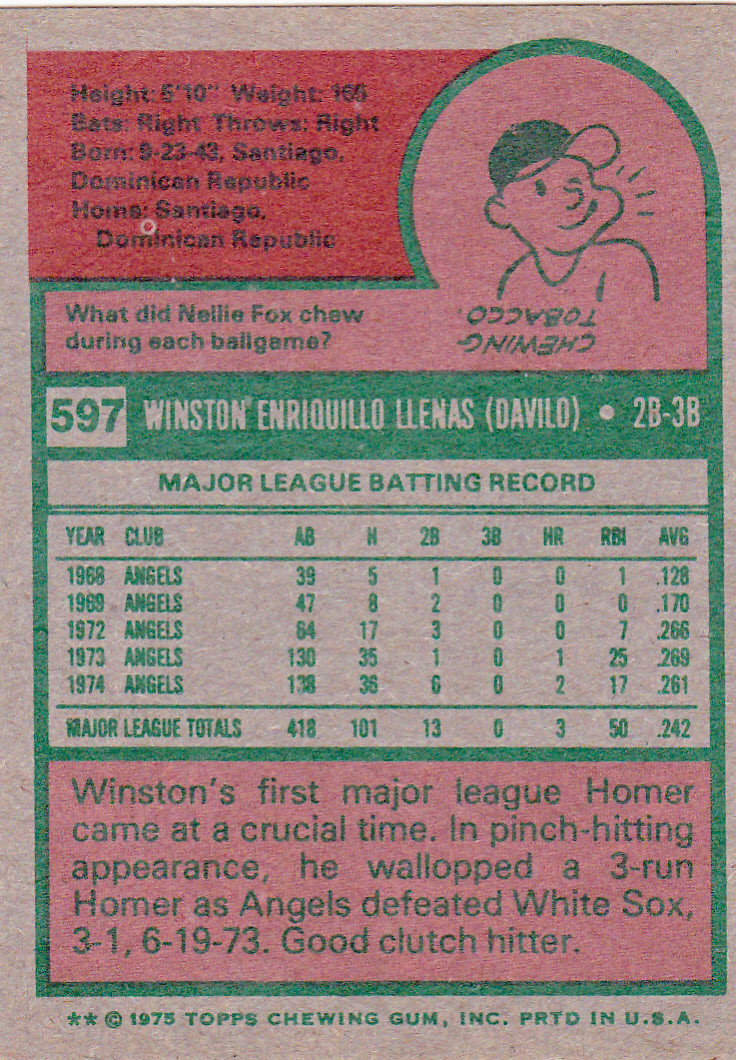
#597 - Winston Llenas
Card fact: This is Winston Llenas' final Topps card.
What I thought about this card then: I had the mini card, as I did with several of the Angels cards. I thought the bunting pose was cool.
What I think about this card now: Llenas is also shown bunting in his only other solo Topps card, in the 1974 set. He had seven sacrifice bunts for hits in his career. Is that enough to show him bunting in back-to-back sets?
Other stuff: Llenas started out in professional baseball when he signed as a teenager with the Kansas City A's back in 1961. He was released but a year later signed with the L.A. Angels. He played in the minors for the next six years before getting called up in 1968.
Llenas played with the Angels between 1968-69 and then 1972-75. He was used a lot as a pinch-hitter and led the American League in pinch-hits and pinch-hit at-bats in 1973. He finished his career batting .230.
His number is retired by Aguilas Cibaenas of the Dominican Winter League, where Llenas led the team to repeated success as a player, manager, GM, and team president.
Back facts: Well, we've finally got a player displaying a "chaw," but it's a cartoon Nellie Fox on the back of this card.
Other blog stuff: The green-light green border combo has moved back into sole possession of the overall lead with its 51st card.
Friday, June 24, 2011
#577 - John Morris
Card fact: This is the last card issued during John Morris' career. He had only three Topps cards and the one previous to this one is in the 1971 set.
What I thought about this card then: I had/have the mini card. I thought Morris was 48 years old. He was actually around 33.
What I think about this card now: He still looks a lot older than 33.
Other stuff: Morris, not to be confused with the outfielder who played for the Cardinals in the late '80s/early '90s, pitched for five teams between 1966-74. His best success came with the Pilots/Brewers between 1969-71. Morris was selected in the expansion draft of '68 from the Orioles.
(EDIT: John Morris died at age 84 on Oct. 20, 2025).
Back facts: The "green monster" is one of my favorite cartoons from this set. Also, the back of this card looks unusual without an orange crayon scribble across the monster drawing. My original mini of Morris (I've since upgraded) has the orange scribble, and it's become as much a feature of the card as the green-on-red type.
Other blog stuff: This is the third straight green-purple bordered card. Except for subsets, this is the first time the same color combination has been featured on three straight cards. The streak has pushed the green-purple combination within one of the overall lead.
Thursday, June 9, 2011
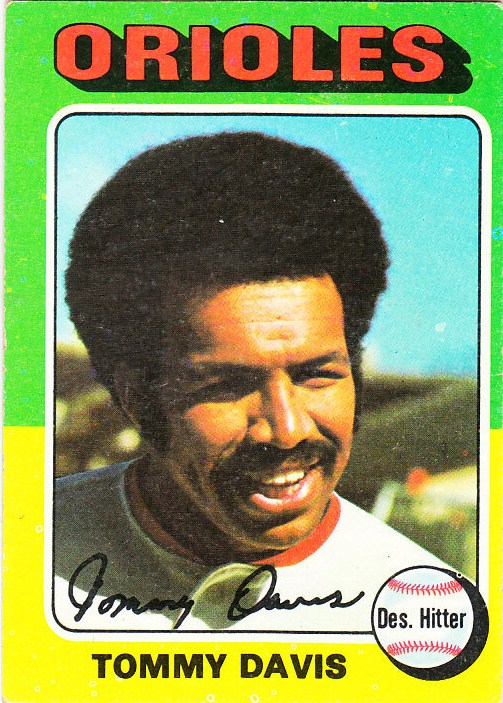
#564 - Tommy Davis
Card fact: There aren't a lot of capless players in this set -- thank goodness -- but Davis is not the first. Two other players have been featured without a cap -- if you don't include the Ralph Garr card, in which his helmet has fallen off his head in the photo.
What I thought about this card then: I had the mini card, and it is one of the first cards I think of when I think of my minis. It almost kind of came to represent the minis. The king of the minis. It's hard to argue with a guy in an Afro on a mini card.
What I think about this card now: I don't know why Davis is pictured without a cap. Many times Topps featured players without a cap because they had been traded recently or Topps believed a player was about to be traded (perhaps rumors of a trade were afoot). But Davis was in the midst of a four-year stay with the Orioles at this point.
Other stuff: Davis was a well-traveled player between 1959-76, competing for 10 teams in his major league career. But he didn't begin to bounce around until after suffering a broken ankle while sliding into second base during a game with the Dodgers in 1965.
Davis had been a two-time N.L. batting champion with standout seasons for the Dodgers in 1962 and 1963. His 153 RBIs in 1962 is still a Dodger record. He possessed both speed and power. But after the injury, his power diminished and he was dealt to the Mets after the 1966 season.
After one quality season with New York, he was shipped to the White Sox and then the Pilots and then the Astros, all within a three-year period. While with Houston, then Oakland, then the Chicago Cubs, he was more of a part-time player. It wasn't until he arrived in Baltimore and became the Orioles' full-time designated hitter, that Davis began to show what he exhibited back in the mid-1960s. He drove in over 80 runs in 1973 and 1974.
Davis finished his career with the Angels and Royals. He later became a coach for the Mariners (he is featured as a coach in the 1982 Donruss set).
(EDIT: Tommy Davis died April 3, 2022 at age 83).
Back facts: I'm not sure, but this might be the most jam-packed card in the set. We'll have to check out Frank Robinson and Hank Aaron before I know for certain.
Other blog stuff: R.I.P. to 1960s Tigers hero Jim Northrup, who died Wednesday at age 71:
This was the final Topps card of his career.
Wednesday, June 8, 2011
#563 - Wilbur Howard
Card fact: Wilbur Howard has already appeared on this blog once before.
What I thought about this card then: I have the mini card, but I believe it's one of the few that I have acquired after 1975. I don't remember thinking anything about this card as a kid.
What I think about this card now: Howard is airbrushed into an Astros cap. This is his first solo card, but he appeared in the 1974 Topps set on one of the four-player rookie cards and he is wearing a Brewers cap. Howard was traded from the Brewers to the Astros at the end of March 1974.
Other stuff: Howard was mostly a fourth outfielder for the Astros between 1974-78. He played in 121 games in 1975, finishing with 111 hits and ranking in the top 10 in the National League in stolen bases with 32.
Back facts: I have no idea why the number 15 is printed in giant block letters. It's a departure from the format used for all the other cartoon answers.
Other blog stuff: On this date in 1965, Rick Monday became the first player drafted in the inaugural major league player draft. The Arizona State sophomore was selected by the Kansas City A's.
Tuesday, June 7, 2011
#562 - Gary Nolan
Card fact: Gary Nolan received a card in the set even though he missed the entire 1974 season after shoulder surgery. He also barely pitched in 1973, appearing in just two games.
What I thought about this card then: I didn't see it. But Nolan was one of those inexplicable favorites of mine when I was a kid. Inexplicable because 1) he was a Red, and 2) I had no idea who he was.
What I think about this card now: It's a classic. But I'm wondering how old the photo is considering he hadn't had a full season since 1972.
Other stuff: Nolan was a hard-throwing phenom who appeared in the major leagues as a 19-year-old after being the Reds' number 1 pick in 1966. Nolan struck out 206 batters in 226 innings and went 14-8 in 1967, finishing third in the Rookie of the Year voting.
In what would become a recurring theme, Nolan dealt with arm and shoulder issues the next two years. He recovered to go 18-7 in 1970, starting Game 1 of the World Series against the Orioles. He helped the Reds to the World Series against in '72, but then disappeared from baseball for two seasons with shoulder issues.
By the time he returned in 1975, he was a control pitcher with admirable accuracy. He won 15 games in back-to-back seasons as the Reds won the World Series each year. But arm troubles occurred again, Nolan was traded to the Angels, and he retired in 1978.
Nolan became a casino dealer in Las Vegas after his playing career, and later a casino host at the Mirage. He recently patched up a falling out with the Reds and returns for Cincinnati hall ceremonies.
Back facts: I'm sure the cartoon would have thoroughly confused me if I saw it as a kid. Gene Autry's singing career was a dated reference even in 1975.
Other blog stuff: The 1975 Topps (it's far out, man) blog eclipsed 50,000 unique visitors in the last 24 hours. Thanks all, for viewing.
Friday, June 3, 2011
#558 - Dave Roberts
Card fact: The second Dave Roberts to be featured in this set. The first was the first of three Dave Roberts to play for the Padres.
What I thought about this card then: Well, first of all, dude looks like a lady. Secondly, I had the mini card, and it might have been my least favorite card in the set. It didn't fall into the camp of cards that we made fun of without mercy. I just kind of silently loathed it.
What I think about this card now: Dude looks more like a dooood, than a dudette.
Other stuff: Roberts was a utility infielder for the Padres, and later the Rangers, Astros and Phillies. Roberts actually enjoyed a productive 1973 season when he was San Diego's third baseman, and the Padres thought they had something special. But he fell off drastically in 1974, was sent down to Hawaii (oh, the misery, sent down to Hawaii), and never came close to performing like he did in '73.
Roberts later played all over the infield, even taking some turns at catcher, while staying in the majors until 1982.
Back facts: I did not like the pinky cartoon. The womanly fingers just added to the whole dude-lady perception in my 9-year-old mind. And hitting an inside-the-park home run against the Dodgers? Dude, that is so uncool.
Other blog stuff: Suzi Quatro was born on this date 61 years ago. Folks who know the '70s know who she is. I'll let everyone else stumble across it.