Tuesday, September 13, 2011
#648 - Dave Pagan
Card fact: This is Dave Pagan's first solo card.
What I thought about this card then: I didn't see it.
What I think about this card now: He looks like a guy who we would have made fun of as kids.
Other stuff: Pagan was signed by the Yankees in 1970. After time in the minors, he reached the big leagues in 1973. From 1973 through 1975, he bounced between the majors and minors.
In 1976, he was involved in the big June trade between the Yankees and Orioles that included Ken Holtzman, Scott McGregor, Grant Jackson, Rick Dempsey, Doyle Alexander and Tippy Martinez, among others. He pitched ineffectively for Baltimore and was selected by the Mariners in the expansion draft. I know him from his Seattle days, thanks to this amusing card.
Pagan finished out his career with the Pirates in '77 and pitched in the minors through 1979.
Back facts: I missed posting on Pagan's birthday by two days.
Also, I think it's nice that the cartoon features a question about a Canadian ballplayer on the back of a card of someone from Saskatchewan. But that's an awfully open-ended question: "name one of the best all-time Canadian ballplayers?" Personally, I was going to say "Stubby Clapp." He was a Canadian ballplayer with an all-time great name, anyway.
Other blog stuff: Players in this set celebrating birthdays today are Rick Dempsey (age 62) and Rick Wise (age 65).
Tuesday, August 16, 2011
#622 - 1975 Rookie Outfielders
Card fact: The Cincinnati Reds are abbreviated as the "Cinn. Reds" on this card. Apparently someone thought they were the "Cinnamon Reds."
What I thought about this card then: Didn't see it.
What I think about this card now: This was the toughest of the rookie cards for me to obtain and one of the toughest cards in the whole set to finally land. No one likes giving up their Fred Lynn rookies. That's why this one is off-center, miscut and there's a weird printing flaw next to Lynn's head.
The funny thing is I found another version of this card in a rummage sale a couple years ago. It's in similar shape -- maybe slightly better -- and I've replaced this card with the rummage sale one.
Other stuff: Each player's first solo Topps card:
Ed Armbrister, Reds: 1976 Topps
Fred Lynn, Red Sox: 1976 Topps (with the rookie cup!)
Tom Poquette, Royals: 1977 Topps (with the rookie cup!)
Terry Whitfield, Yankees: 1978 Topps
Most successful career: Lynn was a huge favorite in Boston, my brother's favorite player, an MVP his rookie year, and hit more than 300 career home runs.
Most awesome middle name: As intrigued as I am about what a land of Berts might look like, I have to go with "Rosanda." It sounds like something you'd get tattooed on your chest underneath a giant heart.
Other blog stuff: A happy 81st birthday to former Monday Night Football announcer Frank Gifford.
Friday, August 12, 2011
#618 - 1975 Rookie Pitchers
Card fact: Scott McGregor is featured as a Yankee on this card, but he never pitched in the majors for the Yankees. He was dealt to Baltimore before his big-league playing career began.
What I thought about this card then: No knowledge of it. It took me a long time to figure out that there were Dodgers on these 4-player rookie cards.
What I think about this card now: I think it'd be both cool and creepy if Topps arranged it so the players on these cards were staring directly at each other. You see that Easterly is attempting to do so, but Johnson will have none of it.
Also, both Easterly and Johnson were on future cards in which my brothers and I looked at the backs and said promptly, "holy crap, look at that ERA! He's not good!" Easterly, though pitched for 13 seasons.
Other stuff: Each player's first solo Topps card:
Jamie Easterly, Braves: 1976 Topps
Tom Johnson, Twins: 1976 Topps
Scott McGregor, Yankees: 1978 Topps
Rick Rhoden, Dodgers, 1976 Topps
Most successful player: A slight edge to Rhoden over McGregor as Rhoden has a slim advantage in most career stats and pitched a few more years. Throw in Rhoden's golfing career, and his success skyrockets.
Most awesome middle name: McGregor should have insisted on at least ending his career with the Astros.
Other blog stuff: I apologize for skipping out on you the last few days. Usually I try to give some warning, but vacation departure came a lot quicker than originally planned. I should be back for awhile now.
Monday, August 1, 2011
#611 - Yankees/Bill Virdon
Card fact: With this card, the orange-yellow border is officially the border color of choice for the team cards. Eight of the team cards have orange-yellow borders. The next closest is the tan-light blue combination with six cards, followed by brown-orange (five cards) and brown-tan (four cards). There is just one team card left.
What I thought about this card then: It's a team card. I had no thoughts.
What I think about this card now: This has to be the most disorganized team photo in the entire set. Look, I've circled the examples for you:
Most of the guys circled in red are not looking at the camera at all. They're all looking off to their right. Meanwhile, the guy circled in blue is in full guffaw after being told something funny by either Dick Tidrow or, um, some other guy in a mustache. And the guy circled in green -- who may or may not be Bobby Murcer -- has his head down and his hand on his cap like he doesn't want his photo taken.
Was the photographer that lousy or did he have a difficult time controlling the team and just said, "to hell with it."?
Other stuff: The Yankees finished in second place in 1974, which was their best finish in 10 years. But New York was barely above .500 two-thirds of the way through 1975 and that wasn't good enough for the new boss, George Steinbrenner. Virdon was dismissed and replaced by Billy Martin, and you know what happened after that.
Back facts: Scott McGregor is listed on the Yankees checklist and is featured on one of the upcoming 4-player rookie cards, but he never pitched a major league game for the Yankees. He was part of that huge trade with the Orioles in 1976.
Other blog stuff: Let's see how well Topps represented the 1974 Yankees in the set. New York sure made it difficult with a bunch of transactions.
The Yankees used 44 players in 1974, which is just one player short of the top number used by the Angels and Indians that season. Topps featured 31 of those N.Y. players in the '75 set, including several pictured with other teams -- Mike Hegan with the Brewers, Bobby Murcer with the Giants, and Steve Kline, Fred Beene, Fritz Peterson and Tom Buskey with the Indians. Topps also threw in McGregor and airbrushed Bobby Bonds into a Yankee cap.
The player with the most at-bats for the Yankees who wasn't featured on a card was infielder Fernando Gonzalez. He hit .215 in 121 at-bats in 1974, had a card in the '74 set and would play in the majors through 1979. But after '74, Gonzalez headed to the Mexican League and didn't return to the majors until 1978.
So, Topps featured just over 70 percent of the players who competed for the Yankees in '74, which puts New York in the middle of the pack:
1. Twins 81.25% of players featured
2. Tigers 78.37%
3. Orioles 78.13%
4. Braves 77.78%
5. Reds 77.14%
6. A's 75.0%
7. Dodgers 74.29%
7. Astros 74.29%
9. Giants 71.43%
10. Indians 71.11%
11. Royals 70.59%
12. Yankees 70.45%
13. Red Sox 70.27%
14. Angels 68.89%
15. Expos 68.29%
16. Brewers 66.67%
17. Rangers 65.79%
18. Cardinals 65.12%
19. White Sox 65.0%
20. Phillies 62.5%
21. Mets 62.16%
22. Pirates 61.5%
23. Padres 55.8%
Friday, July 29, 2011
#608 - Gene Michael
Card fact: This is the final Topps card of Gene Michael during his playing career.
What I thought about this card then: I had the mini card. Michael looked ancient to me.
What I think about this card now: It is way, way off-center and I need to fix it.
Other stuff: Michael is known for his career with the Yankees as a player, coach, manager and administrator. He had his most success as the general manager with the Yankees in the 1990s, helping build the team that won four World Series titles in five years.
As a player, Michael was signed by the Pirates, then traded to the Dodgers for Maury Wills in 1967. A year later, he was purchased by the Yankees and played for New York through the end of the 1974 season. He played for the Tigers in 1975.
Michael, nicknamed "Stick," was your typical good-field, no-hit middle infielder that thrived in the '70s. He batted .229 for his career, but knew the game, which really served him well in his front office jobs.
I remember Michael being a guest during a Yankees broadcast a few years ago. He was fascinating to listen to -- intelligent, revealing and full of stories. He should have been able to talk for the whole game.
(EDIT: Gene Michael died at age 79 on Sept. 7, 2017).
Back facts: Robert "Bobby" Mitchell was never an ace pitcher. He was more of a fill-in type guy. The first "full-time" left-handed pitcher was J. Lee Richmond, who also pitched baseball's first perfect game.
Other blog stuff: On this date in 1983, Steve Garvey's consecutive games played streak ended at 1,207 after he was unable to play in the second game of the Padres' doubleheader against the Braves. He dislocated his thumb in a collision at home plate in the first game.
Saturday, July 2, 2011
#585 - Chris Chambliss
Card fact: This is the first card of Chris Chambliss as a Yankee.
What I thought about this card then: No knowledge of it.
What I think about this card now: It's a very nice view of what was going on in the batting cage on that day. Good stuff.
Other stuff: I will always consider Chambliss a Yankee, as many also do. But Chambliss actually came up with the Indians and was named American League Rookie of the Year in 1971.
He played with the Indians through the early part of 1974, then was dealt to the Yankees in April of that year in the famed trade that also brought New York Dick Tidrow and Cecil Upshaw in exchange for Steve Kline, Tom Buskey, Fritz Peterson and Fred Beene.
It proved to be a terrific deal for New York, enhanced by the fact that Chambliss hit one of the most memorable home runs of the '70s, delivering the series-clinching blow off of the Royals' Mark Littell in the 1976 A.L. Championship Series. Who hasn't seen Chambliss knocking down jubilant Yankees fans on his way to home plate?
It was the first postseason series the Yankees had won since the 1962 World Series, and ushered in another semi-dynasty era for New York. Chambliss' best season for the Yankees was 1976, but he remained a reliable offensive and defensive first baseman for the team through the 1979 season. He was one of the few Yankees of that time that I did not despise.
Chambliss was traded by the Yankees to the Blue Jays after the '79 season. Toronto turned around and traded him to Atlanta a month later. Chambliss spent seven seasons with the Braves, so while I equate him with the Yankees, he was a Brave longer. He ended his career back with the Yankees, for one game in 1988.
He became a hitting coach and manager in both the majors and minors after his career. I saw him get thrown out of a game two years ago when he was managing the Charlotte Knights. He's now the hitting coach in Seattle.
Back facts: Carroll, huh? Guess it was good enough for Archie Bunker.
Other blog stuff: A historic moment. This is the 50th green-light green bordered card. And with this card, green-light green takes sole possession of first place in the overall border standings. Orange-brown has been in the lead for hundreds of cards, so this is BIG.
Also, the blog will be recognizing Independence Day by taking a few days off. See you after America's birthday.
Thursday, June 2, 2011
#557 - Larry Gura
Card fact: Larry Gura is likely wearing Cubs garb in this photo. He hadn't played for the Cubs since the 1973 season as he was traded in the offseason from the Cubs to the Rangers. He never played for the Rangers and was traded in May of 1974 to the Yankees. It appears Topps couldn't get a photo of Gura in a Yankee uniform and went with an older picture.
What I thought about this card then: I didn't see it.
What I think about this card now: That seems to me an unusual way to write an L.
Other stuff: Gura, who would go on to be one of the best pitchers the Royals ever had, was another one of my friend Jeff's favorites when I was kid. For Jeff, it was Amos Otis and Larry Gura all the time. But before Gura arrived with the Royals, he struggled to stay in the majors with the Cubs and the Yankees.
After the Yankees dealt Gura to the Royals in May of 1976, he found his stride. In 1978, he was 16-4 and a regular starter during the Royals pennant-winning teams of the late '70s. As luck would have it, Gura ended up facing his former team, the Yankees, in the playoffs in 1976, 77, 78 and '80. Gura famously ripped Yankees manager Billy Martin during the '76 playoffs for treating him harshly during his stay with the Yankees (Martin, it is said, didn't respect Gura's stuff or training habits). Martin would refuse to start him.
Gura eventually became known as a Yankee killer in his career, finishing 11-6 against them, including six straight wins between 1979-80. In 1980 and '82, he won 18 games for Kansas City, and was an All-Star in 1980.
Gura pitched until 1985, finishing his career back with the Cubs, where he started.
Back facts: The write-up reads like a Topps apology for not getting Gura in a Yankees uniform:
"You see, Larry started 1974 in Spokane, and THEN he came to the Yankees in a trade and spent time at SYRACUSE. Then he joined the Yankees LATE in the season.'
Other blog stuff: I recently received a generous package of 1975 Topps upgrades from wobs of the terrifically informative 1974 Topps - Pennant Fever blog.
Great stuff:
Nolan Ryan! FTW!
Thanks, wobs!
Monday, May 9, 2011
#534 - Alex Johnson
Card fact: Alex Johnson is wearing an airbrushed Yankees cap, as if you couldn't tell. Whoever was given the task of airbrushing players into Yankees caps for the '75 set, had a difficult time.
What I thought about this card then: Never saw it. One of those cards that I saw for the first time when I was completing the set 7 years ago.
What I think about this card now: Is that a scoreboard in the background? I can't tell.
Other stuff: Johnson was one of the most confounding baseball players of the '60s and '70s. A player with enormous talent and a powerful build, Johnson was dealt from team to team because managers and teammates couldn't get along with him.
Johnson played for the Phillies, Cardinals, Reds, Angels, Indians, Rangers, Yankees and Tigers. His best seasons were with the Reds in 1968 and 1969 and with the Angels in 1970 when he won the A.L. batting title.
But Johnson, who was widely considered as a pleasant and amiable fellow off the field, infuriated his teammates with his on-field play, refusing to hustle on the bases or run down plays in the outfield (his fielding ability was sporadic, especially early in his career). While with the Angels, he was fined and suspended repeatedly. It got so tense that Johnson wouldn't speak to his fellow teammates (he was in reported scrapes with teammates while with the Reds, too). He started shouting obscenities at teammates and the media. After being suspended indefinitely, his cause was taken up by Marvin Miller and the players union. The union's argument was that Johnson was emotionally unstable and the team should have recognized that.
Johnson later finished his career with the Indians, Rangers, Yankees and Tigers. His lackadaisical habits in the field continued to be a problem, and he was out of the majors at age 32. He played a year in Mexico and then took over his father's trucking service.
(EDIT: Alex Johnson died on Feb. 28, 2015).
Back facts: Johnson's brother was a halfback for the New York Giants.
Other blog stuff: The green-yellow border combination continues to be the recent domain of the airbrushed photo. Four of the last five green-yellow bordered cards feature airbrushed subjects. Johnson was airbrushed since he was purchased by the Yankees in early September of 1974.
Thursday, April 7, 2011
#503 - Fred Stanley
Card fact: I'll be darned if I go through all of the cards in the set right now, but I'm about 70 percent sure that this is the only card in which the player's position is defined solely as "infield." If you want to prove me wrong, you know what to do.
What I thought about this card then: Never saw it.
What I think about this card now: My knowledge of Yankee Stadium comes post-renovation, 1976 onward. This photo doesn't remind me much of Yankee Stadium. If the Anacin ad wasn't there (and Stanley wasn't in his home pinstripes), I'd think it was a different park.
Other stuff: Fred "Chicken" Stanley was my hero back in the late '70s when it seemed like every player on the Yankees could hit. Stanley was used as a defensive replacement for New York between 1973-80, mostly at shortstop. He had a very weak bat, hitting .216 for his career. It was a delight to see him in the Yankees' lineup.
Yankees announcer Phil Rizzuto loved Stanley because he knew how to play shortstop well. If I remember correctly, Stanley could bunt, too, which also won Rizzuto's blessing.
Stanley also played for the Seattle Pilots (he was the last Pilot active in the majors), Brewers, Indians and Padres before playing for New York. He finished up with Oakland in 1981 and '82. After his playing career, he worked for years as a coach and manager in the minors. He was also the Brewers' assistant general manager. He has been the Giants' director of player development for the last four years.
Back facts: I doubt Stanley received any kind of sense of vengeance from hitting his grand slam against the Brewers. He played for them three years before the grand slam, and as you can see by the stats, didn't get a single at-bat (yes, I do know the Brewers were the former Pilots).
Other blog stuff: Actor James Garner was born on this date in 1928. He's acted on many shows and in many movies, but I remember him from "The Rockford Files" because it was one of my dad's favorite shows.
Sunday, March 20, 2011
#485 - Sparky Lyle
Card fact: This was the second-to-last Yankee card I needed for the set. The last was Graig Nettles. Why do I specifically remember the Yankees? Because they're so blasted difficult to land where I live.
What I thought about this card then: I never saw it.
What I think about this card now: There is an "8" hanging from the fence in the background. I'm wondering if that is an "8" for the retired number of Yogi Berra and Bill Dickey. Or maybe it's just a distance marker.
Other stuff: Sparky Lyle was one of the greatest relief pitchers of his time. He was so good in 1977 that he won the Cy Young Award, which rarely happened at the time. But that didn't stop the Yankees from acquiring Rich Gossage to be the Yankees' new closer, eventually pushing Lyle out the door.
Lyle became famous outside of baseball for writing "The Bronx Zoo" in 1979, a tell-all book about his Yankees teammates during their 1977 and '78 championship seasons. It was the first book of its kind that I ever read -- I read it when I was 13 or 14 -- and a real eye-opener into what happened behind the scenes on baseball teams. Especially that part about sitting on birthday cakes.
Before he came to New York, Lyle was a successful closer for the Red Sox. He was dealt to the Yankees for Danny Cater prior to the 1972 season, which proved to be a terrific deal for New York.
After Lyle's Yankee days ended in '78, he went to the Rangers, Phillies and White Sox but didn't have the kind of success he had with New York.
After his career, he made plenty of appearances around the country and managed for a little bit. He even showed up in our town to pitch in a charity event before a minor league game. A guy I worked with hit a double off of him. I believe it was the only hit Lyle gave up in three innings of work.
Back facts: Lyle's entrance song was indeed Pomp and Circumstance, which I know as the graduation march. It seems like an odd thing to play when a reliever enters the game, but that's what they played.
Other blog stuff: On this date in 1931, Hal Linden was born. Barney Miller was my all-time favorite show at one point. I miss sitcoms.
Sunday, February 13, 2011
#451 - Rick Dempsey
Card fact: This is the second straight card of a player who competed in four different decades. Rick Dempsey barely qualifies as he played in five games in 1969.
What I thought about this card then: I didn't see a Dempsey card until he was with the Orioles.
What I think about this card now: Well, for one, the upper left corner is bent. Secondly, Dempsey isn't in a full catcher's crouch, which makes me think that he's either illustrating when a catcher signals to a pitcher that he wants the ball thrown high, or the ground is wet.
Other stuff: Dempsey is known as one of the better defensive catchers of the last 40 years. He lasted as long as he did not because he could hit -- he couldn't -- but because of his ability to handle pitching staffs. His best success came with the Orioles when he won a starting role even with his limited hitting ability. He contributed to two Orioles World Series appearances and found his hitting stroke in the 1983 Series against the Phillies, winning Most Valuable Player honors.
Dempsey later played for the Indians, and then the Dodgers, where he was a backup catcher on the 1988 Series-winning team. He finished out his career with the Brewers and then back with the Orioles in the early '90s.
Dempsey got on my nerves as I was growing up, as most Orioles did. He was kind of a clown and when he first did that rain-delay act in which he impersonated Babe Ruth and slid on the wet tarp (I think it's appropriate that there is a tarp in the background of the photo on this card), I didn't think it was all that funny. But the TV stations did, and they played it over and over and over again. I think it was on "This Week in Baseball" for two months straight.
Dempsey since has worked as a color man on Orioles broadcasts (big surprise), and coached in the O's organization. He's been thought of as manager material for quite awhile.
Back facts: The write-up grudgingly credits Dempsey for a fine showing with the bat, but there is no evidence in the stats.
Other blog stuff: On this date in 1995, the Dodgers signed Japanese pitching star Hideo Nomo, and a million card collections were born.
Tuesday, January 18, 2011
#426 - George Medich
Card fact: George Medich was known as Doc Medich for just about his whole career, but he was never referred to as "Doc" on the front of a Topps card.
What I thought about this card then: I vaguely remember owning this card early in 1975. A Yankee fan probably demanded that I trade it to him. And I didn't have it anymore.
What I think about this card now: Medich is the original "Doc" to me. Before Gooden, before Halladay. But after some other folks, like Edwards and Cramer.
Other stuff: Medich came up with the Yankees and was pretty successful from the start, winning in double figures in each of his first three seasons. That enabled the Yankees to coax Willie Randolph and Dock Ellis from the Pirates in a trade after the 1976 season.
Medich pitched for the Pirates for a year, then went through the most tumultuous period of his career, traveling from the Pirates to the A's to the Mariners to the Mets to the Rangers in an eight-month period of 1977. He pitched for Texas for six years, then ended his career with Milwaukee in 1982.
After 10 years without a postseason appearance, he finally reached a World Series in his last season, throwing two forgettable innings for Milwaukee in a 13-1 loss to St. Louis in Game 6. Medich gave up six runs and five hits in two innings of relief.
Medich received his nickname because he was a medical student in college and then received his medical degree. He became an orthopedic surgeon after his baseball career ended. Sadly, he was plagued by drug addiction and pleaded guilty to illegal possession of a controlled substance in 2001. He was sentenced to probation and his medical license was suspended.
Back facts: The cartoon recounts the greatest feat in the history of time.
Also, the notation of a dash for a player's ERA confused me as a kid. I didn't know why it was there. Later, I found out it was there because Medich had no definable ERA in 1972. He gave up two runs without retiring a batter in one game. His ERA was infinity. I think it would be cool if Topps wrote "infinity" instead of the dash, but maybe they thought that was cruel.
Other blog stuff: A member of the 1975 Topps set, Billy Grabarkewitz, was born on this date. The man with the last name that's fun to say is 65 today.
Monday, December 20, 2010
#401 - Mike Wallace
Card fact: This is Mike Wallace's first solo card. Wallace is featured on just two Topps cards by himself (he's on one of those 4-rookie cards in the '74 set). In both of them, he is airbrushed into the cap of his new team. He is airbrushed into a Rangers cap in the 1977 set.
What I thought about this card then: I was deprived as a child. I never saw it. For the longest time, I only knew Mike Wallace as the guy on 60 Minutes.
What I think about this card now: One of the more obvious and terrible airbrushing attempts in the set. The cap is barely on Wallace's head and the N.Y. logo is much, much too big. Wallace's long hair isn't helping matters.
Other stuff: Mike Wallace played five seasons in the majors. He came up with the Phillies in 1973. In his first game, the second part of a doubleheader against the Mets, he threw a complete game, allowing one run, walking none and getting the victory. He worked almost exclusively as a reliever during his career, starting just four games.
In 1974, he was traded to the Yankees and went 6-0 for New York. He remembers teaming with another pitcher on a combined shutout against Jim Palmer and the Orioles during September of that year. After that, he pitched with the Yankees in '75, then with St. Louis and Texas before his major league career ended in 1977.
Back facts: The write-up says Wallace "joined the Yankees last June." The trade between the Yankes and Phillies was May 3, which means Topps is saying Wallace joined the Yankees from the minor leagues. He began his New York career with Syracuse, the Triple A team of the Yankees then.
Other blog stuff: Both Cecil Cooper and Oscar Gamble were born on this date in 1949. They're both 61 today.
Friday, November 19, 2010
#375 - Roy White
Card fact: This was one of four 1975 cards that were the first cards I purchased from a mail-order catalog, which happened on two separate occasions. The first two were George Brett's rookie card and Barry Foote. The second two were Roy White and Ralph Garr.
What I thought about this card then: Out of the four cards that I ordered, this was the only one that I had not seen. But White was one of my favorite players, and I knew I had to have the card. When I received it, the mustache surprised me. I didn't know that White had a mustache, as he had shaved it off by the late 1970s.
What I think about this card now: There's a lot to like about this card, Yankeeness aside. The puffy clouds in the background. White's tremendous signature. The batting cage. The batting helmet.
Other stuff: One of the drawbacks of having two blog is that if I write about the player already on one blog, I don't feel like writing about him again on the other blog. I did a post about White recently on Night Owl Cards.
So, the abbreviated version of that post is White was a lifetime Yankee, yet he was one of my favorites as a kid, and I nicknamed myself "Roy" when I played baseball in the backyard (although I selected the name long before I had heard of Roy White). Later, White stood out as one of the quiet, non-brash Yankees that I appreciated.
A switch-hitter, White played 15 seasons for the Yankees. He was an All-Star in 1969 and 1970, knew how to take a walk, and hit a very quiet 160 home runs in his career. After the majors, he played in Japan. Later he was a coach for the Yankees and A's.
Back facts: Mike Schmidt's hit in the Astrodome came on June 10, 1974. The ball actually hit a speaker 117 feet above the playing surface and 329 feet away. The ball then fell to the field. According to Astrodome ground rules, it was a live ball. Schmidt had thought it was a home run and was in his home run trot. So the Astros held him to a single.
Other blog stuff: Actress Jodie Foster was born on this date in 1962. What does she have to do with 1975? Well, until very recently, I thought she played one of the main characters in the '75 Disney movie "Escape to Witch Mountain," which was one of the first non-cartoon movies I ever saw. But it turns out Foster never acted in the movie. The part was intended for her, but she had a conflict, and Kim Richards took the role.
Another childhood memory debunked.
Thursday, September 23, 2010
#321 - Rudy May
Card fact: This quite possibly could be the most hilarious card in the entire set.
What I thought about this card then: Sadly, I never saw it.
What I think about this card now: Well ... I am very amused by the difficulties that the New York logo gave Topps' airbrushers. They had a horrible time with the logo in the 1974 set. And they didn't show any improvement in the '75 set. That logo looks like it should be graffiti on a brick wall. To top it off, Rudy May seems absolutely crest-fallen over what he must wear. It's like he knew ahead of time how foolish he'd look on his card, even though I'm sure at the time this photo was taken that he didn't have an idea he would end up playing for the Yankees.
By the way, this isn't May's only strange card. His 1983 Fleer card freaks me out. However, his 1971 Topps card is very cool.
Other stuff: May pitched for 16 seasons in the majors, with the Angels, Yankees, Orioles and Expos. Even though he pitched mostly with the Angels and the Yankees, I identify him completely with the Orioles. It's probably because of his 1978 Topps card, which is the first card of May's that I saw.
May was purchased by the Yankees from the Angels in June of 1974, which wasn't enough time for Topps to get a photo of May as a Yankee. He later was traded to the Orioles in 1976 in a massive deal that also sent Scott McGregor, Rick Dempsey and Tippy Martinez and others to Baltimore in exchange for Ken Holtzman, Eldrod Hendricks, Grant Jackson and others.
May enjoyed an 18-win season for Baltimore in 1977, but was immediately traded to the Expos for Don Stanhouse and Gary Roenicke. May became a free agent in 1979 and rejoined the Yankees. He pitched in the postseason in 1980 and 1981, throwing in the World Series against the Dodgers in '81.
(EDIT: Rudy May died on Oct. 23, 2024 at age 80).
Back facts: The Dodgers are credited with the first batting helmets, but they were more like liners worn inside their regular caps. Pee Wee Reese and Ducky Medwick were victims of beanings the previous year, so the "helmets" were developed for their use. The first team to wear batting helmets as we know them are the 1952 Pittsburgh Pirates.
Re: the writeup. There are some people who dispute a pitcher's ability to "get stronger" as a game progresses, saying it's physically impossible.
Other blog stuff: Bruce Springsteen was born on this date in 1949. He came out with an album in 1975. You may have heard of it. Something about being born to run.
Tuesday, August 24, 2010
#291 - Bill Sudakis
Card fact: This is the final Topps card issued during Bill Sudakis' career.
What I thought about this card then: Never saw it. If I did, it would be a favorite.
What I think about this card now: It's a rather stately pose by Mr. Sudakis. I don't know if he is looking for a sign or if someone is getting on his nerves. Perhaps it's Rick Dempsey (see below).
Other stuff: Sudakis was mostly a utility player during his career, but he began his career with the Dodgers and played 132 games at third base in 1969, hitting 14 home runs and batting (*gulp*) .234. He hit a home run in his first major league game, on Sept. 3, 1968 against the Phillies.
The Dodgers attempted to put him at catcher in the early 1970s, but Sudakis had chronic knee problems and L.A. ended up waiving him. After a brief stop with the Mets and a fairly successful year as a DH with the Rangers, Sudakis played for the Yankees, where he's known for getting into a brawl with fellow catcher Rick Dempsey at the end of the 1974 season in a hotel in Milwaukee. He later played briefly with the Angels and Indians, ending his career in 1976.
Sudakis made news in the '80s for being charged with attempting to sell cocaine to an undercover officer. But he apparently overcame that bit of nastiness and was a coach in California in the 1990s.
(EDIT: Sudakis died on Sept. 15, 2021 at age 75).
Back facts: I'm not sure if the timing of the trivia question is quite accurate. The late 1960s Dodgers squad was indeed known as "The Mod Squad," named after the popular TV show at the time. But "The Mod Squad" did not debut until the end of September 1968. Since the season was wrapping up at that time (and the Dodgers didn't play in the postseason in '68), it's unlikely they were called The Mod Squad in 1968. Nice pants, though.
Also, note the "traded to California Angels 12/3/74" in the write-up. Nice of Topps to squeeze that in there. Sudakis was traded to the Angels for Skip Lockwood, whose card we'll see later in the set (a card that also has issues). I wonder what was written in that spot before Sudakis got traded?
Other blog stuff: The No. 1 song in the country on this date was "Fallin' in Love," by Hamilton, Joe Frank and Reynolds. I always thought that was four people, but apparently I had an extra comma between Joe and Frank and it was only three.
Monday, July 26, 2010
#266 - Sandy Alomar
Card fact: This is the second card in the last nine to feature a player who fathered not one, but two major league players. First it was Dave LaRoche. Now, it's Sandy Alomar, father to Sandy Alomar Jr. and Roberto Alomar.
What I thought about this card then: Didn't see it. But Alomar's 1968 Topps card was the first '68 card I ever saw.
What I think about this card now: They really had to squash down that signature to fit it into that tight head shot, didn't they?
Also, Alomar's cap is obviously airbrushed. He was purchased from the Angels by the Yankees in July of 1974, not enough time for Topps to get a photo of Alomar in a Yankee uniform during those days.
Other stuff: Alomar played for 15 seasons with the Braves, Mets, White Sox, Angels, Yankees and Rangers. His most successful seasons were with the Angels in the early 1970s. He wasn't much of a hitter, but he could steal a base and the Angels put him at the top of the lineup A LOT in 1970 and 1971. He led the league in plate appearances each year with 735 and 739, respectively.
Alomar was a solid defensive player, although he struggled with throwing. Both of his sons were known as very strong defensive players with hardly a weakness. And, of course, Roberto hit a lot better than dad.
Alomar was the Mets' bench coach under Jerry Manuel before being dismissed after last season.
(EDIT: Sandy Alomar died at age 81 on Oct. 13, 2025).
Back facts: Herb Washington's card will show up on this blog in a few months.
Other blog stuff: Mick Jagger was born on this date in 1943. He is really getting up there.
Tuesday, June 29, 2010
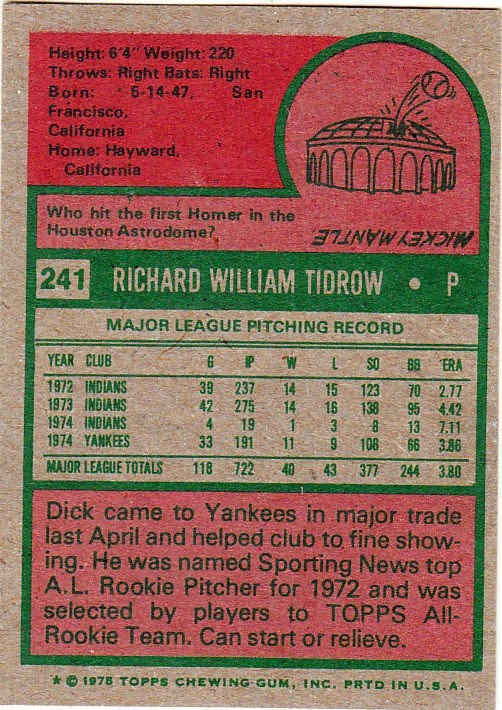
#241 - Dick Tidrow
Wednesday, June 2, 2010
#217 - Lou Piniella
Wednesday, April 28, 2010
#183 - Mel Stottlemyre
What I thought about this card then: This was the first Yankee that I ever saw from this set. I know I had the card, but I lost it rather early on in 1975. I probably traded it to some greedy, grubby Yankee fan. I always liked the card. It seemed to have a classic look to it, and its the first Yankee card I think of when I think of this set.
What I think about this card now: It occurs to me that I have never known what Stottlemyre looked like as a young man. By the time I knew who he was, he was at the end of his career. After that, I only knew him as someone who walked out to the mound to talk to pitchers or sat in the dugout.
Other stuff: Stottlemyre made an immediate impact with the Yankees in 1964, pitching in three games in the World Series against the Cardinals that year, his rookie season. He won 20 games the following year, and won 20 games two other times. He was one of the most consistent players on a Yankee team that was not very good between 1965-75.
Stottlemyre pitched his entire career for the Yankees, then made his name as a pitching coach, particularly with the Mets and the Yankees. He was Davey Johnson's pitching coach during the 1986 World Series, and Joe Torre's pitching coach during the Yankees' run from 1996-2005.
Stottlemyre also is the father of former major leaguers Todd and Mel Jr. Todd always seemed very hyper to me.
(EDIT: Mel Stottlemyre died at age 77 on Jan. 13, 2019).
Back facts: I just noticed that a lot of the cartoons appear to be about Pirates. I should go back through and see which team is mentioned the most.
Also, there's a typo in Stottlemyre's ERA for 1967. It looks like he had a 296 ERA that year.
Other blog stuff: The No. 1 song in the country on this date in 1975 was "Another Somebody Done Somebody Wrong Song" by B.J. Thomas. Now that's just being wordy for the sake of being wordy.