Tuesday, August 16, 2011
#622 - 1975 Rookie Outfielders
Card fact: The Cincinnati Reds are abbreviated as the "Cinn. Reds" on this card. Apparently someone thought they were the "Cinnamon Reds."
What I thought about this card then: Didn't see it.
What I think about this card now: This was the toughest of the rookie cards for me to obtain and one of the toughest cards in the whole set to finally land. No one likes giving up their Fred Lynn rookies. That's why this one is off-center, miscut and there's a weird printing flaw next to Lynn's head.
The funny thing is I found another version of this card in a rummage sale a couple years ago. It's in similar shape -- maybe slightly better -- and I've replaced this card with the rummage sale one.
Other stuff: Each player's first solo Topps card:
Ed Armbrister, Reds: 1976 Topps
Fred Lynn, Red Sox: 1976 Topps (with the rookie cup!)
Tom Poquette, Royals: 1977 Topps (with the rookie cup!)
Terry Whitfield, Yankees: 1978 Topps
Most successful career: Lynn was a huge favorite in Boston, my brother's favorite player, an MVP his rookie year, and hit more than 300 career home runs.
Most awesome middle name: As intrigued as I am about what a land of Berts might look like, I have to go with "Rosanda." It sounds like something you'd get tattooed on your chest underneath a giant heart.
Other blog stuff: A happy 81st birthday to former Monday Night Football announcer Frank Gifford.
Monday, August 15, 2011
#621 - 1975 Rookie Pitchers
Card fact: This is the first of the rookie cards to feature a player who never made the majors. Juan Veintidos was featured here on the strength of his 14-5 record in the minors in 1974, but he never got the call in 10 minor league seasons.
What I thought about this card then: If it's an orange-yellow bordered rookie card then I never saw it.
What I think about this card now: Veintidos appears to be the happiest of the four, yet he didn't enjoy the success of the others. I guess you had to be cold and ruthless to succeed as a major league pitcher in 1975.
Other stuff: Each player's first solo Topps card:
John Denny, Cardinals: 1976 Topps
Rawly Eastwick, Reds: 1976 Topps
Jim Kern, Indians: 1977 Topps
Juan Veintidos, Twins: no solo card
Most successful career: Both Eastwick and Kern got off to quick success as relief pitchers, Eastwick becoming a force for the Big Red Machine in the '75 World Series, and Kern wowing Cleveland fans with his arm and quirky behavior. But each faded almost as quickly. I'm going with starter John Denny, who pitched 13 fairly consistent seasons and won the Cy Young for the National League champion Phillies in 1983.
Most awesome middle name: Jackson is not as awesome as Rawlins, but there's not much to go on here.
Other blog stuff: For those of you who spend all of your time in vintage cards and vintage only, I would be remiss if I didn't mention that there is a new set out this month that pays tribute to the 1975 Topps minis. Current and past players are featured on mini cards that are similar in size and look to the '75 minis. They are inserted randomly into packs of 2011 Topps Lineage.
Unfortunately, the backs do not feature the '75 backs we all know and love. And the cards are made from that same slick crap that has plagued the Topps base set for the last decade. But I appreciate the thought by Topps and am trying to collect as many as I can. I owe it to my 9-year-old self.
Sunday, August 7, 2011
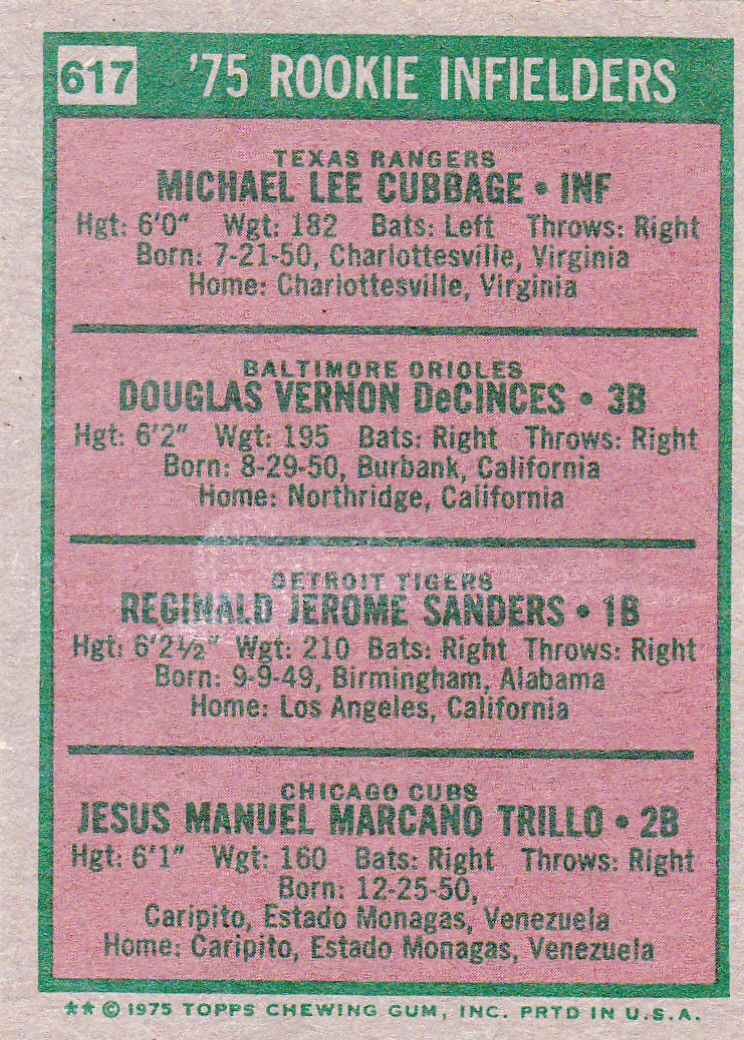
#617 - 1975 Rookie Infielders
Card fact: You never knew Reggie Sanders played for the Tigers, did you? But it's not that Reggie Sanders.
What I thought about this card then: Did not see it.
What I think about this card now: Manny Trillo is not wearing a live Cubs hat. It is most likely an airbrushed A's cap.
Other stuff: Each player's first solo Topps card:
Mike Cubbage, Rangers: 1976 Topps
Doug DeCinces, Orioles: 1976 Topps
Reggie Sanders, Tigers: no solo card. His career lasted 26 games in 1974. He died in 2002.
Manny Trillo, Cubs: 1976 Topps
Most successful player: Toss-up between Doug DeCinces and Manny Trillo. DeCinces played 19 seasons in the majors and hit 237 home runs. Trillo played 17 seasons, was an All-Star for the Cubs and Phillies and had a great 1980 NLCS.
DeCinces was just in the news last week for a bit of ugliness.
Most awesome middle name: U.S.-born players are so boring. Have to go with Manuel Marcano.
Other blog stuff: On this date in 1975, actress Charlize Theron was born. The world would never be the same.
Friday, August 5, 2011
#615 - 1975 Rookie Pitchers
Card fact: We've got back-to-back "rookie pitchers" cards here. Unlike the previous one, I believe everyone is wearing a non-airbrushed cap.
What I thought about this card then: Never saw it.
What I think about this card now: Hank Webb looks like he's just spotted the team mascot that has always freaked him out.
Other stuff: Each player's first solo card:
Pat Darcy, Reds: 1976 Topps
Dennis Leonard, Royals: 1976 Topps
Tom Underwood, Phillies: 1976 Topps (with a rookie cup!)
Hank Webb, Mets: 1976 Topps (his only solo Topps card)
Most successful player: Dennis Leonard was a three-time 20-game winner who won three postseason games. Tom Underwood, who died in November 2010, pitched for 11 seasons.
Most awesome middle name: Gaylon Matthew proves that more is better. Also, how cool is it that two players on this card have "Patrick Leonard" in their name?
Other blog stuff: On this date in 1975, the first seven Phillies who come to bat in a game against the Cubs get a hit against starter Bill Bonham to set a major league record. Mike Schmidt hit a home run to make it 5-0 and send Bonham to the showers. The next batter, Johnny Oates, proceeds to single for the eight straight hit. Pitcher Dick Ruthven's sacrifice bunt is the first out.
Thursday, August 4, 2011
#614 - 1975 Rookie Pitchers
Card fact: Welcome to the rookie portion of the '75 Topps retrospective. Sometimes called "rookie stars," sometimes "rookie prospects," Topps took the understated route in 1975 and merely described the players by their respective position.
This was the period when Topps featured four rookies on one card, which is the format that I know and love best. Topps went with this format from 1974-1978. After (and before), Topps featured three or even two rookies per card.
What I thought about this card then: I never saw it. Topps used the orange-yellow border combination and the pink-yellow border combination for its rookie cards. But I only saw the pink-yellow combination when I was collecting in 1975.
What I think about this card now: That is a lineup of mediocrity right there.
Other stuff: For the rookie cards, I thought it'd be interesting to note what each player's first solo card was -- if they ever had a first solo card.
Jack Kucek, White Sox: 1977 Topps (his only solo card).
Dyar Miller, Orioles: 1976 Topps
Vern Ruhle, Tigers: 1976 Topps
Paul Siebert, Astros: no solo card, unless you want to include the late '80s Pacific Senior League set.
Most successful player: Vern Ruhle, who had cards every year from 1975 through 1987 and was later a longtime pitching coach. Unfortunately, he's also the only deceased player of the four.
Most awesome middle name: Dyar Miller has a "K," baseball scorekeeping shorthand for a strikeout, as his middle name, and he was a pitcher. That is fantastic.
Other blog stuff: As you can see, I'm mixing it up a little bit for the rookie cards. I'm not going into detail about the players, because that's really too much work. Hope you like it.
Monday, August 1, 2011
#611 - Yankees/Bill Virdon
Card fact: With this card, the orange-yellow border is officially the border color of choice for the team cards. Eight of the team cards have orange-yellow borders. The next closest is the tan-light blue combination with six cards, followed by brown-orange (five cards) and brown-tan (four cards). There is just one team card left.
What I thought about this card then: It's a team card. I had no thoughts.
What I think about this card now: This has to be the most disorganized team photo in the entire set. Look, I've circled the examples for you:
Most of the guys circled in red are not looking at the camera at all. They're all looking off to their right. Meanwhile, the guy circled in blue is in full guffaw after being told something funny by either Dick Tidrow or, um, some other guy in a mustache. And the guy circled in green -- who may or may not be Bobby Murcer -- has his head down and his hand on his cap like he doesn't want his photo taken.
Was the photographer that lousy or did he have a difficult time controlling the team and just said, "to hell with it."?
Other stuff: The Yankees finished in second place in 1974, which was their best finish in 10 years. But New York was barely above .500 two-thirds of the way through 1975 and that wasn't good enough for the new boss, George Steinbrenner. Virdon was dismissed and replaced by Billy Martin, and you know what happened after that.
Back facts: Scott McGregor is listed on the Yankees checklist and is featured on one of the upcoming 4-player rookie cards, but he never pitched a major league game for the Yankees. He was part of that huge trade with the Orioles in 1976.
Other blog stuff: Let's see how well Topps represented the 1974 Yankees in the set. New York sure made it difficult with a bunch of transactions.
The Yankees used 44 players in 1974, which is just one player short of the top number used by the Angels and Indians that season. Topps featured 31 of those N.Y. players in the '75 set, including several pictured with other teams -- Mike Hegan with the Brewers, Bobby Murcer with the Giants, and Steve Kline, Fred Beene, Fritz Peterson and Tom Buskey with the Indians. Topps also threw in McGregor and airbrushed Bobby Bonds into a Yankee cap.
The player with the most at-bats for the Yankees who wasn't featured on a card was infielder Fernando Gonzalez. He hit .215 in 121 at-bats in 1974, had a card in the '74 set and would play in the majors through 1979. But after '74, Gonzalez headed to the Mexican League and didn't return to the majors until 1978.
So, Topps featured just over 70 percent of the players who competed for the Yankees in '74, which puts New York in the middle of the pack:
1. Twins 81.25% of players featured
2. Tigers 78.37%
3. Orioles 78.13%
4. Braves 77.78%
5. Reds 77.14%
6. A's 75.0%
7. Dodgers 74.29%
7. Astros 74.29%
9. Giants 71.43%
10. Indians 71.11%
11. Royals 70.59%
12. Yankees 70.45%
13. Red Sox 70.27%
14. Angels 68.89%
15. Expos 68.29%
16. Brewers 66.67%
17. Rangers 65.79%
18. Cardinals 65.12%
19. White Sox 65.0%
20. Phillies 62.5%
21. Mets 62.16%
22. Pirates 61.5%
23. Padres 55.8%
Sunday, July 31, 2011
#610 - Ron Hunt
Card fact: This is the final Topps card of Ron Hunt during his playing career.
What I thought about this card then: No knowledge of it.
What I think about this card now: Topps isn't fooling me with that "Cardinals" cap. Hunt is airbrushed from his Expos get-up because he was obtained off waivers by the Cardinals in early September 1974 and Topps was out of luck getting a photo.
Other stuff: Hunt came up with Mets, who were in their sophomore season in 1963. He became the Mets' starting second baseman and finished second in the National League Rookie of the Year voting to Pete Rose that year.
Hunt played for the Mets for four years but was dealt to the Dodgers in the Tommy Davis deal. Then, after a season with L.A., he was shipped to the Giants in the first trade between the two teams since their moves out to the West Coast.
Hunt's reputation for getting hit by pitches really grew while he played for San Francisco. Beginning with his first season with the Giants in 1968, his HBP totals jumped and he led the league in HBP for seven straight seasons. His phenomenal 50 HBPs in 1971 while he was with the Expos is the most recorded in the modern era.
Hunt played with the Expos through 1974 and ended his career with the Cardinals. After his career, he eventually started a baseball camp, which he has operated for more than two decades.
(EDIT: Ron Hunt died at age 85 on July 15, 2026).
Back facts: The cartoon means to say: "Who stole home the most times in a career?" Although the Baseball Almanac site says Cobb stole home 54 times, not 35.
Other blog stuff: I'm really starting to believe my speculation on whether Topps waited to fill in the players who would represent the higher numbers in the set. If you look at the cards since No. 600, only Rod Carew and John Ellis are what you would have called "definites" for the set. Every other player has been either at the very end of his career, the very beginning, or was traded recently. Ellie Rodriguez doesn't fall into those categories, but he also didn't have a card the previous two years, so he wasn't a definite either.
I'll be tracking the rest of the cards.
Saturday, July 9, 2011
#589 - Braves/Clyde King
Card fact: This is Clyde King's first-and-only appearance on a card with the Braves. He was hired to replace Eddie Mathews in the middle of the 1974 season.
What I thought about this card then: I associate it with that sheet of flimsy '75 team cards that we ordered from Topps. Perhaps the Braves card was positioned first (I don't remember if they were in alphabetical order).
What I think about this card now: Well aside from this being probably one of the last examples of someone wearing black-framed glasses until Joe Maddon came along, somebody, please, PLEASE tell me what the story is with the little dude in the three-piece suit just above King's head. That is some team card craziness.
Other stuff: The Braves finished 88-74 and in third place in the National League West. But King lasted only into the middle of the 1975 season before he was let go. It was the '70s and the Braves were about to get really awful. King was replaced by someone named Connie Ryan to finish out the '75 season. Dave Bristol took over for 1976.
Back facts: The checklist doesn't look right without Hank Aaron's name at the beginning. But Topps was on the ball after the offseason trade of Aaron to the Brewers. New acquisition Dave May's name is listed in the middle of the second column without any signs of distress.
Other blog stuff: Let's see if the '74 Braves were represented properly by Topps.
The Braves used 36 players in 1974. Topps featured 28 of those players, including Danny Frisella, who is listed as a Padre in the set, and, of course, Hank Aaron, who is listed as a Brewer.
Of the players not featured, there isn't much of note. Pitcher Jack Aker appeared in 17 games for the Braves, but didn't even finish the season with them, getting purchased by the Mets in June. Utility player Ivan Murrell had 133 at-bats for the Braves, but it was the last season of his career.
The Braves fair quite well in terms of the percentage of '74 roster players featured in the '75 set:
1. Twins 81.25% of players featured
2. Tigers 78.37%
3. Orioles 78.13%
4. Braves 77.78%
5. Reds 77.14%
6. A's 75.0%
7. Dodgers 74.29%
7. Astros 74.29%
9. Giants 71.43%
10. Indians 71.11%
11. Royals 70.59%
12. Red Sox 70.27%
13. Angels 68.89%
14. Expos 68.29%
15. Brewers 66.67%
16. Rangers 65.79%
17. Cardinals 65.12%
18. White Sox 65.0%
19. Phillies 62.5%
20. Mets 62.16%
21. Pirates 61.5%
22. Padres 55.8%
Wednesday, July 6, 2011
#586 - Tim McCarver
Card fact: Tim McCarver is airbrushed into a Red Sox cap in this photo. He played for St. Louis most of the 1974 season, but was purchased by Boston in September of 1974 and spent the rest of '74 and the early part of '75 with Boston.
What I thought about this card then: I never saw it.
What I think about this card now: This was one of the final cards I needed to finish off the set. Players who become famous broadcasters are often difficult to track down.
Other stuff: McCarver is so well-known as a broadcaster that it overshadows the fact that he played in the major leagues for 21 seasons and was a four-decade player. He spent most of his career catching for St. Louis and Philadelphia, but also played for Montreal and Boston.
Some of McCarver's notable moments as a player was hitting the game-winning home run in the 10th inning of Game 5 of the 1964 World Series for St. Louis and scoring the winning run for the National League in the 10th inning of the 1966 All-Star Game. He finished second in the National League in MVP voting in 1967.
McCarver was noted for fostering successful relationships with pitchers Bob Gibson and Steve Carlton. McCarver became Carlton's personal catcher during the latter years of McCarver's career.
After his playing career, McCarver worked as a broadcaster for local Philadelphia and New York television, then branched out to national television. As a young fan, I remember him broadcasting on WOR in New York (or was it Secaucus, N.J?), and I enjoyed his broadcasts.
Now, of course, he is reviled by many fans for his work on Fox's weekly broadcast. McCarver isn't the same broadcaster as he was back when I was young. He does make a lot of mistakes and does overexplain things, but he never bothered me as much as Joe Morgan.
(EDIT: McCarver died at age 81 on Feb. 16, 2023).
Back facts: I think that every aspect of Hank Aaron's year in '74 was addressed in cartoons in the 1975 set. Aaron was traded from the Braves to the Brewers on Nov. 2, 1974. Milwaukee also sent a minor leaguer, Roger Alexander, to Atlanta a month later to complete the deal.
Other blog stuff: On this date in 1932, Cubs shortstop Billy Jurges is shot twice in his hotel room by a former girlfriend, showgirl Violet Valli. Jurges, shot in the shoulder and hand, doesn't prosecute and Valli is signed to sing in nightclubs based on her fame. Jurges recovered from his injuries and helped the Cubs win the 1932 National League title.
Saturday, June 18, 2011
#573 - Orlando Pena
Card fact: This is the final Topps card of Orlando Pena issued during his career.
What I thought about this card then: I didn't see it.
What I think about this card now: I believe Pena is wearing a Cardinals uniform in this photo as he was traded by the Cardinals to the Angels in September of 1974.
Other stuff: Pena was known as a junk-ball pitcher, but used his variety of pitches to compete in the majors from 1958 to 1975. His first baseball card was in the 1959 Topps set. From that point, his appearance in the major leagues was sporadic. He was used as a reliever with the Reds at the start of his career, but when he went to the Kansas City A's, he became a starter. He lost a league-high 20 games in 1963.
Pena returned to a relief role for the A's and the Tigers, appearing in 50 games a season regularly. But by the late '60s, he was back in the minor leagues. Pena lacks a baseball card from 1969-73 as he bounced between the minors, the Indians, Pirates and Orioles.
He found a spot with the Cardinals in 1974, and enjoyed a renaissance at age 38, appearing in 46 games and registering a 2.21 ERA. He had one more season with the Angels in '75. After his career, he became a scout for the Tigers. Even at age 77, he's still listed as a scout.
Back facts: Hank Aaron might be on more '75 cartoons than any other player. The phrasing of the question is kind of odd.
Other blog stuff: The blog is taking a breather for a couple of days. It will be back with a new entry soon though.
Friday, May 6, 2011
#531 - Reds/Sparky Anderson
Card fact: This is the sixth orange-yellow bordered team card. That ties it with the tan-light blue border combination as the color combo on the most team cards.
What I thought about this card then: Team card, shmeem card.
What I think about this card now: This is the one card in the entire set that I had the most trouble obtaining in respectable shape. For a long time, my complete collection featured a Reds team card with fully rounded corners because it was all I could find. Repeated trips to card shows and shops failed to yield anything any better. Fortunately, I now have one that is up to my not-so-exacting standards.
Other stuff: In 1974, Sparky Anderson and the Big Red Machine suffered through the one black mark in their five-year reign in the National League West. The Reds won the N.L. West in 1972, 73, 75 and 76, but finished second to the upstart Dodgers in '74.
Back facts: John Vukovich, listed last on the checklist, is the only player on that list who did not play for the Reds in 1974. He played for the Brewers and is airbrushed into a Reds cap on his card.
Other blog stuff: The Reds were a well-known team in 1974, so I doubt Topps left anyone notable off the team, but let's take a look.
Cincinnati used 35 players in 1974. Topps featured cards of 27 of them, plus one of airbrushed Vukovich, in the 1975 set. It also produced a card of Reds pitcher Roger Nelson, who is airbrushed into a Cardinals cap on his '75 card. So, 27 out of 35 is a 77.14 percentage, which is one of the higher ones yet.
All of the top players are present and accounted for. Utility player Andy Kosco (37 at-bats) and relief pitcher Dick Baney (22 games) had the most appearances among players without cards. Both were at the end of their careers (although Baney was only 27 at the time).
So, here is where the Reds rank with the other teams featured so far:
1. Twins 81.25% of players featured
2. Tigers 78.37%
3. Orioles 78.13%
4. Reds 77.14%
5. Dodgers 74.29%
5. Astros 74.29%
7. Giants 71.43%
8. Indians 71.11%
9. Royals 70.59%
10. Red Sox 70.27%
11. Angels 68.89%
12. Expos 68.29%
13. Brewers 66.67%
14. Rangers 65.79%
15. Cardinals 65.12%
16. White Sox 65.0%
17. Phillies 62.5%
18. Mets 62.16%
19. Pirates 61.5%
20. Padres 55.8%
Only four more chances for the Padres to get out of the basement.
Wednesday, April 27, 2011
#522 - Gary Sutherland
Card fact: This is Gary Sutherland's debut card as a Detroit Tiger. He skipped around a lot, but he had his best success with the Tigers.
What I thought about this card then: Didn't see it. I had no idea who Sutherland was for decades. He's another guy who was at the tail end of his career as I began to be interested in baseball.
What I think about this card now: Now THAT is a batting cage shot. It's like Sutherland is in a batting cage theme park.
Other stuff: Sutherland was a utility infielder for most of his career except on two occasions. The first was in 1969 during the first year of the Expos. Sutherland was selected from the Phillies in the expansion draft and became the Expos' starting second baseman in 1969. He scored the first run in Montreal history.
Sutherland didn't last long as the starter, platooning the following year, and then losing his job altogether and getting demoted to the minors. After some time in Houston's minor league organization, he was acquired by the Tigers and inserted as their starting second baseman.
Sutherland started at second for the 1974 and 1975 season. His 149 games played with the Tigers in '74 was a career high. He was not great at getting on base -- despite hitting lead off -- but Detroit was pretty much the worst team in baseball in '74 and '75, so they took what they had.
Sutherland ended his career with bits of seasons with Milwaukee, San Diego and St. Louis. He later worked as a scout in the Padres organization and is now in the Angels' front office.
(EDIT: Gary Sutherland died at age 80 on Dec. 16, 2024).
Back facts: Mentioning a minor league feat that occurred seven years into a major league career is not cool, Topps. Not cool.
Other blog stuff: American Top 40 radio host Casey Kasem was born on this date 79 years ago. I spent many a pre-teen Saturday night listening to American Top 40. I am going on record as saying I hated the long distance dedications.
Saturday, April 16, 2011
#511 - Rangers/Billy Martin
Card fact: Let's see if I can convince myself that Billy Martin is wearing Rangers garb in the inset photo. He is airbrushed into a Rangers cap in the 1974 set. This cap looks more realistic, but the jersey almost looks like a road Twins jersey. Martin was manager of the Twins in 1969, but I don't believe he had facial hair at the time. And why would Topps drag out a five-year-old photo of Martin, especially when he managed the Tigers from 1971-73? So I'm saying Martin is definitely wearing a Rangers get-up.
What I thought about this card then: Just like the last team card featured, the Astros, I had this card in mini form. No thoughts other than it was itty-bitty.
What I think about this card now: The Lone Star scoreboard rules. Also, I believe Jim Bibby and Fergie Jenkins are book-ending the back row. They always grow pitchers bigger.
Other stuff: The Rangers had their first real encounter with contention in 1974, thanks to Martin's first full season with the team. Texas finished second in the A.L. West after being dead last in 1972 and 73. The Rangers were third in 1975, but Martin didn't make it to the end of the season. He was fired when the Rangers got off to a 44-51 start.
Back facts: There is not one thing out of place on this checklist. No misspellings, players out of order, unlisted players. Nothing. Probably not the first one in the set, but there's probably only been 5 or 6.
Other blog stuff: Here is where we see how well Topps represented the 1974 Texas Rangers.
The Rangers used 38 players to get out of the basement in 1974. Topps featured cards of 25 of those players. That includes Alex Johnson, who is airbrushed into a Yankees cap in the 1975 set. Nobody significant from the team was overlooked. Catcher Duke Sims, at the end of his career, had the most at-bats of players not featured with 118. There were an awful lot of fringe players on the team, though.
So that puts Texas at 65.8 percent, which is in the bottom third of the list so far:
1. Twins 81.25% of players featured
2. Tigers 78.37%
3. Orioles 78.13%
4. Dodgers 74.29%
4. Astros 74.29%
6. Giants 71.43%
7. Indians 71.11%
8. Royals 70.59%
9. Red Sox 70.27%
10. Angels 68.89%
11. Expos 68.29%
12. Brewers 66.67%
13. Rangers 65.79%
14. Cardinals 65.12%
15. White Sox 65.0%
16. Phillies 62.5%
17. Mets 62.16%
18. Pirates 61.5%
19. Padres 55.8%
Saturday, February 5, 2011
#443 - Twins/Frank Quilici
Card fact: This is the third orange-yellow bordered team card in the set. The first two -- the Phillies and Angels -- were way back in the early days of the blog.
What I thought about this card then: Nada. It was a team card.
What I think about this card now: I often wonder why team photos back then could feature bat boys, such as this one did, but now Topps has to put a fence up to obscure the bat boys. Is everyone that litigious today?
Other stuff: Frank Quilici was in the middle of a three-year term with the Twins. A former player with Minnesota who stopped playing in the majors after the 1970 season, Quilici briefly boosted a team that was slowly sliding out of its success of the 1960s and early '70s. But it didn't last. After the 1975 season, Quilici was replaced by Gene Mauch.
Back facts: There is a typo with the last card. Juan Veintidos is not card No. 521. That belongs to Expos pitcher Dennis Blair. Veintidos was on rookie card No. 621.
Other blog stuff: Where do the Twins rank in terms of how successful Topps was in reflecting the '74 team in its 1975 set?
They rank very well.
The Twins used 32 players in 1974. That is tied -- so far -- with the Orioles for the lowest amount used by a team in 1974.
Topps featured cards of 26 of those players. That includes pitcher Bill Hands and infielder Joe Lis, airbrushed into Rangers and Indians uniforms, respectively. It also includes Jim Holt, who is disguised as an Athletic in this set. And it includes Pat Bourque, who is shown as an Athletic -- not airbrushed -- even though he played most recently for the Twins in 1974 (more on that in card #502).
The most "overlooked" player was utility infielder Luis Gomez, who had 168 at-bats for the Twins in his first major league year and batted .208. Topps would give him later cards, though.
So here is where the Twins stand with the other teams in terms of percentage of players represented:
1. Twins 81.25% of players featured
2. Tigers 78.37%
3. Orioles 78.13%
4. Dodgers 74.29%
5. Giants 71.43%
6. Indians 71.11%
7. Royals 70.59%
8. Red Sox 70.27%
9. Angels 68.89%
10. Expos 68.29%
11. Brewers 66.67%
12. Cardinals 65.12%
13. White Sox 65.0%
14. Phillies 62.5%
15. Mets 62.16%
16. Pirates 61.5%
17. Padres 55.8%
Yup. There is a new leader. The Tigers have led since the very first team card, but no more.
Wednesday, December 15, 2010
#397 - Bill Freehan
Card fact: This is the only Topps card in Bill Freehan's career in which he is not listed exclusively as a catcher. The 1974 season was the only one in which Freehan played more games at a position other than catcher. He played 65 at first base and 63 beind the plate.
What I thought about this card then: Me no see. The first card of his I saw was his 1976 Topps card.
What I think about this card now: I have never known how to pronounce Freehan's name. I've always pronounced it "Free-HAN," which I suspect is wrong.
Other stuff: Freehan was born in Detroit, played his whole career with the Tigers, and was both a solid hitter and a record-setting fielder. All of those ingredients made him a hero among Tigers fans. He has but two transactions in his entire 15-year career. He signed with the Tigers in 1961 and was released by the Tigers in 1976.
Freehan was an 11-time all-star. His best seasons came in 1967 and 1968, when he was third and second, respectively, in A.L. MVP voting. He set a number of records for fielding, and caught more games than any other player in Tigers history. He ended his career ninth all-time in MLB history in total games caught.
After his career, Freehan did some broadcasting, then became the University of Michigan baseball coach in the 1990s.
(EDIT: Freehan died at age 79 on Aug. 26, 2021 after a long battle with Alzheimer's disease. He was in hospice care for more than two years).
Back facts: I learned about the term "hitting with your foot in the bucket" by reading a story as a young teenager about Al Simmons and the Philadelphia A's famous 1929 World Series comeback against the Cubs. It's been a long time since I ever heard any one mention a major leaguer as hitting with their foot in the bucket. I'm sure the coaches clean that right up these days.
Other blog stuff: On this date in 1975, "Young Frankenstein" was released. "Roll, roll, roll in ze hay!"
Saturday, December 11, 2010
#393 - Gary Gentry
Card fact: This is the final Topps card issued of Gary Gentry during his career.
What I thought about this card then: I remember this card came to me in a big trade with a friend. I recall being quite fascinated with it. I don't know why. Probably the mustache.
What I think about this card now: I like how there are many of the elements of a stadium in the background. Bleachers, backstop, press box. Cool.
Other stuff: Gentry's claim to fame came during his rookie season with the New York Mets in 1969. Gentry pitched the division-clinching victory in September, pitched the league championship-clinching win against the Braves, and won Game 3 of the World Series, adding a two-run home run. He was truly an amazing part of the Amazing Mets.
Gentry pitched well for the Mets the next few years, then was traded to Atlanta with Danny Frisella in exchange for Felix Millan and George Stone. Gentry suffered an elbow injury soon after the trade, and it led to the end of his career. He was finished not even two months into the 1975 season.
Back facts: You can see that Gentry barely played in 1974. He pitched three games. It makes me wonder why Topps produced a card of him for the '75 set. I have a suspicion he was a late fill-in for an unknown player who may have retired. That suspicion has to do with the card that will be featured in the next post. (Ah, suspense!)
Other blog stuff: The last three orange-yellow bordered cards all have had Mets connections. There is Gentry, and before that was Tom Seaver, preceded by Ray Sadecki.
Saturday, November 13, 2010
#370 - Tom Seaver
Card fact: The first sideways signature in the set. But it's not a terribly uncommon occurrence.
What I thought about this card then: I don't think I actually saw this card in person. I probably saw it in a magazine or other publication. I know it was a desirable-yet-unattainable card for me.
I've mentioned this before, but the first baseball glove I ever owned was a Tom Seaver model in 1976. I changed my favorite team to the Mets and my favorite player to Tom Seaver for one day, the day I received the glove. I quickly realized that was foolhardy and changed my favorite team back to the Dodgers. But for a long time after that, I hoped that Seaver would get traded to the Dodgers. It wasn't an unrealistic expectation, as there were rumors all the time in the '70s that Seaver would be traded to L.A. (he was originally drafted by the Dodgers).
What I think about this card now: The Mets have a lot of cool "hanging out by the batting cages" cards in this set. Unfortunately, the shadows detract a bit from the photo, although at the time I thought it added to the mystery and coolness of Seaver.
Other stuff: I often wonder what it was like to be a baseball fan during Seaver's breakout seasons in the late 1960s. By the time I knew who he was, in the mid-70s, he was an established star and the Mets were slowly sinking to the basement of the NL East. Still, it was major news when he was traded to the Reds in 1977. Dubbed the "Midnight Massacre" in New York, I still remember reading about it in the newspaper while seated on the floor of our living room.
As the years go on, Seaver's later years grow hazy. I barely remember his time with the White Sox, although I do recall being very happy that his 300th win came against the Yankees. I just had to look up the reason why Seaver didn't pitch in the postseason for the Red Sox in 1986, his final year. I forgot about the knee injury.
Seaver has worked off-and-on as a broadcaster, both for the Mets, Yankees and network television. Although he seemed capable, I wasn't a fan of his most recent stints with the Mets. He seemed to make every excuse to bash current players. He and Keith Hernandez would have a field day.
(EDIT: Tom Seaver died at age 75 on Aug. 31, 2020)
Back facts: I believe Tom Niedenfuer "blew up" in the 1985 NLCS against the Cardinals.
Seaver leads the National League in most seasons of 200-plus strikeouts with 10. Roger Clemens leads the American League with 11. Nolan Ryan is the overall leader with 15.
Other blog stuff: On this date in 1974, Steve Garvey won the National League MVP award. Say what you want about Garvey, but there are a lot more Dodger fans out there because of him. (Yes, yes, he probably fathered some of them). And, yup, that is a good thing.
Saturday, October 23, 2010
#349 - Ray Sadecki
Card fact: Ray Sadecki is airbrushed into a Cardinals cap and uniform as he was traded from the Mets on Oct. 13, 1974, which was too late for Topps to get a photo of Sadecki as a Cardinal (unless they wanted to go back to when he pitched for the Cardinals between 1960-66).
What I thought about this card then: Didn't see it. Sadecki is another one of those guys who retired right as I was getting into baseball, so it was decades before I knew who he was. He did have one final card in the 1977 Topps set, as a Brewer, but since he didn't pop up in another set after that, he meant nothing to me.
What I think about this card now: One of the poorer photos in the entire set. Just lousy.
Other stuff: Sadecki was traded for some heavyweights in his career. In 1966, he went to the Giants in exchange for Orlando Cepeda, who ended up helping the Cardinals to a World Series and winning MVP honors. In 1974, Sadecki was sent from the Mets back to the Cardinals for Joe Torre, who ended managing the Mets.
Sadecki started out with St. Louis, and was a 20-game winner for the 1964 pennant-winning Cardinals, who defeated the Yankees in the World Series. In 1968, while with the Giants, he had one of his better seasons, striking out a career high 206 and recording a 2.91 ERA. But he led the league in losses with 18.
He returned to the World Series with the Mets in 1973. He was a swingman during his time with New York, relieving and spot starting. He gained a save in the World Series against the A's.
After getting traded back to the Cardinals in 1974, he didn't stay there long. He was traded again in May of 1975, this time to the Braves. He bounced around to the Royals, Brewers and then back to the Mets before closing his career in 1977.
(EDIT: Ray Sadecki died on Nov. 17, 2014)
Back facts: Harry "Peanuts" Lowery, an outfielder with the Cubs and Cardinals mostly, got his nickname from his small stature as a kid, not because he liked peanuts.
Other blog stuff: Since everyone is enjoying the Yankees' defeat so much, I'll mention a Yankee loss that I enjoyed a lot. On this date in 1981, the Dodgers beat the Yankees 5-4 in Game 3 of the 1981 World Series. This is one of the more memorable games that I have ever watched. My favorite player, Ron Cey, hit a 3-run home run against Dave Righetti in the bottom of the first. Dodgers starter Fernando Valenzuela worked in and out of trouble. Cey then scored the eventual winning run on a double play grounder. Then in the eighth, Cey halted a Yankee rally, by diving to catch Bobby Murcer's foul bunt and doubling the runner off of first.
The Dodgers were down 0-2 in the Series at the start of the game, but would go on to win the rest of the Series. My favorite player was the catalyst. I'll never forget it.
Thursday, October 21, 2010
#347 - Mike Caldwell
Card fact: This is the first time that Mike Caldwell makes an appearance on a card with his familiar mustache and longish '70s hair. On his 1974 card, he is wearing an airbrushed Giants cap and is clean-shaven.
What I thought about this card then: Didn't see it. The first card of his I saw was his 1977 Topps card in which he is airbrushed into a Cardinals cap. That's notable because Caldwell was traded from the Cardinals to the Reds in March of 1977, probably before many collectors obtained their card of Caldwell as an airbrushed Cardinal.
What I think about this card now: If pitchers really looked in that intently for the catcher's signal, I think batters would be hesitant to get in the batter's box.
Other stuff: Caldwell began his career with the Padres, then was traded to the Giants in the deal that sent Willie McCovey to San Diego. A couple of years later he was on the move again, to the Cardinals, and then to the Reds. Cincinnati held on to Caldwell for just a couple of months before trading him to the Brewers for a couple of minor leaguers.
That trade was a steal for Milwaukee. The next year, 1978, Caldwell went 22-9 with a 2.36 ERA for the Brewers. He threw an astounding 23 complete games and was second to Ron Guidry in the A.L. Cy Young Award voting. From that point, he became a steady starter for the Brewers for seven years.
As a starter for the 1982 World Series team, Caldwell started Game 1 and Game 5 against the Cardinals and won both games. But St. Louis won the series. Caldwell pitched for the Brewers through 1985 before getting released. He's now a pitching coach in the Giants' organization.
Back facts: The "Shoe Polish" incident, also known as the "Shoeshine Incident," was during Game 4 of the 1957 World Series between the Milwaukee Braves and New York Yankees. Jones, who played for Milwaukee, led off the 10th inning as a pinch-hitter. He jumped away from a low pitch that was called a ball. Jones argued that the ball hit him in the foot, pointed out shoe polish on the ball, and was awarded first base. The Braves went on to score three runs in the inning, win the game, tie the Series at 2 games apiece, and eventually win the Series.
As for the stats, 1974 was Caldwell's first decent year. You can see for his won-loss total from 1973 and 1974, he swapped the wins and losses. Now that's a turnaround season.
Other blog stuff: Former Dodgers shortstop and manager Bill Russell was born on this date. He is 62.
Sunday, September 26, 2010
#324 - Ed Kranepool
Card fact: With this card, 12 of the 13 Mets cards shown so far feature colors that match with the Mets' colors. Either a border color, or the team lettering color, or both, is blue or orange. You can't say that about the other teams.
I think it's a plot. Topps always seemed to show favortism toward the New York teams. Usually, it's the Yankees. But in 1975, the Mets ruled New York.
What I thought about this card then: Ed Kranepool was my grandfather's favorite player. He would watch the Mets games, and on Sundays my family would come to visit and I'd plop down on the floor and watch Ralph Kiner, Lindsey Nelson and Bob Murphy broadcast the games. My grandfather didn't say much, so it was hard to tell who he liked and who he didn't. But I know he liked Kranepool.
I didn't have this card, but one of my Mets-loving friends had it. As with all Mets cards then, it was cool.
What I think about this card now: You have to be doing something right to wear the No. 7.
Other stuff: Growing up, it was just understood that Kranepool was "the man" among the Mets. He was the first notable player to come out of the Mets' organization. Even though he rarely held a starting role, he played with the Mets longer than anyone (18 seasons). He never played with another team. He still holds the team record for career games played.
Later in his career, his role was reduced to mostly that of a pinch-hitter. But he was still considered the heart of the Mets and always popular with Mets fans. It helped that he was born in the Bronx.
(EDIT: Kranepool died at age 79 on Sept. 8, 2024).
Back facts: "Emil," huh? I didn't know that.
Other blog stuff: Olivia Newton-John, who sang the No. 1 song "Have You Never Been Mellow" in 1975, was born on this date. She is 62. That's right. Miss "Let Me Hear Your Body Talk" is 62.