Showing posts with label Cubs. Show all posts

Saturday, September 24, 2011

#658 - Vic Harris


Card fact: This is Vic Harris' last Topps card until the 1978 Topps set.

What I thought about this card then: Never saw it.

What I think about this card now: I know the Harris 1978 card well. He's with the Giants. It took me a long time to realize that this Harris and that Harris are the same person.

Other stuff: Harris was dealt to the Cubs along with Bill Madlock in the deal that sent Ferguson Jenkins to the Rangers. Harris was just coming off his best major league season when he played in 152 games as the Rangers' starting center fielder.

Harris was inserted at second base with Chicago, but he didn't hit well and was sent to the minors. When he returned in 1975, he was strictly a utility guy, first with the Cubs and then with the Cardinals, Giants and Brewers.

After 1980, he went to Japan and played for three years before retiring.


Back facts: "Has super-star potential." Ouch.

Other blog stuff: Jim Henson, the creator of that '70s classic, "The Muppet Show," was born on this date 75 years ago.

"Why do we always come here
I guess we'll never know
It's like a kind of torture
To have to watch this show"
-- Statler and Waldorf

Thursday, September 1, 2011

#638 - Cubs/Jim Marshall


Card fact: This is the final team card in the set. I'll commemorate it by noting which color combinations were used with each team:

1. Orange-yellow (8): Yankees, Braves, Reds, Rangers, Twins, Angels, Royals, Phillies
2. Brown-orange (6): Cubs, A's, Astros, Dodgers, Giants, Orioles
3. Tan-light blue (6): Mets, Pirates, White Sox, Cardinals, Red Sox, Padres
4. Brown-tan (4): Brewers, Indians, Expos, Tigers

What I thought about this card then: Zzzzzzzzzzz. Team card.

What I think about this card now: Well, first, it's probably the most out-of-focus, far-away team photo in the whole set, which might explain why the Cubs stuck with floating head team cards for most of the '70s and early '80s.

Secondly, I still don't know why the Cubs went with the team pose and the White Sox the floating heads in '75 when it was flip-flopped all the other years.

Other stuff: The Cubs finished dead last in 1974, their first last-place finish since 1966. Jim Marshall replaced Whitey Lockman as manager in the middle of the season. Marshall would last two more sub-.500 seasons before Herman Franks took over for the 1977 season.

(EDIT: Jim Marshall died Sept. 7, 2025 at age 95).


Back facts: Darold Knowles, Bob Locker and Manny Trillo are all listed on the Cubs checklist although none played for the team in '74. All are airbrushed into Cubs caps.

Other blog stuff: One last opportunity to see how well Topps represented a team from the 1974 season. Let's see how many Cubs from '74 were in the Topps set.

The Cubs used 38 players in 1974, including a bunch of guys I never knew (Herb Hutson? Ron Dunn?). Topps featured 26 of those players, including Billy Williams as an airbrushed Athletic, and Horacio Pina as an airbrushed Angel.

My quest to see if Topps left out anyone significant is rather pointless with the Cubs, because it's the Cubs! Come on! The guy with the most at-bats who didn't get a card is Dave Rosello. He hit .203 in 148 at-bats. Rob Sperring also didn't get a card. He hit .206 in 107 at-bats.

So Topps kindly represented 68.42% of the '74 Cubs in the '75 set.

This is where they rank with the other teams:

1. Twins 81.25% of players featured
2. Tigers 78.37%
3. Orioles 78.13%
4. Braves 77.78%
5. Reds 77.14%
6. A's 75.0%
7. Dodgers 74.29%
7. Astros 74.29%
9. Giants 71.43%
10. Indians 71.11%
11. Royals 70.59%
12. Yankees 70.45%
13. Red Sox 70.27%
14. Angels 68.89%

15. Cubs 68.42%
16. Expos 68.29%
17. Brewers 66.67%
18. Rangers 65.79%
19. Cardinals 65.12%
20. White Sox 65.0%
21. Phillies 62.5%
22. Mets 62.16%
23. Pirates 61.5%

24. Padres 55.8%

That's all of them! The Twins are better represented in the set than any other team. How about that?

And my real mission was to see if anyone major was left out of the set as has been the case in some other Topps sets. I wasn't able to find anyone significant, though, in the '75 set.

Sunday, August 7, 2011

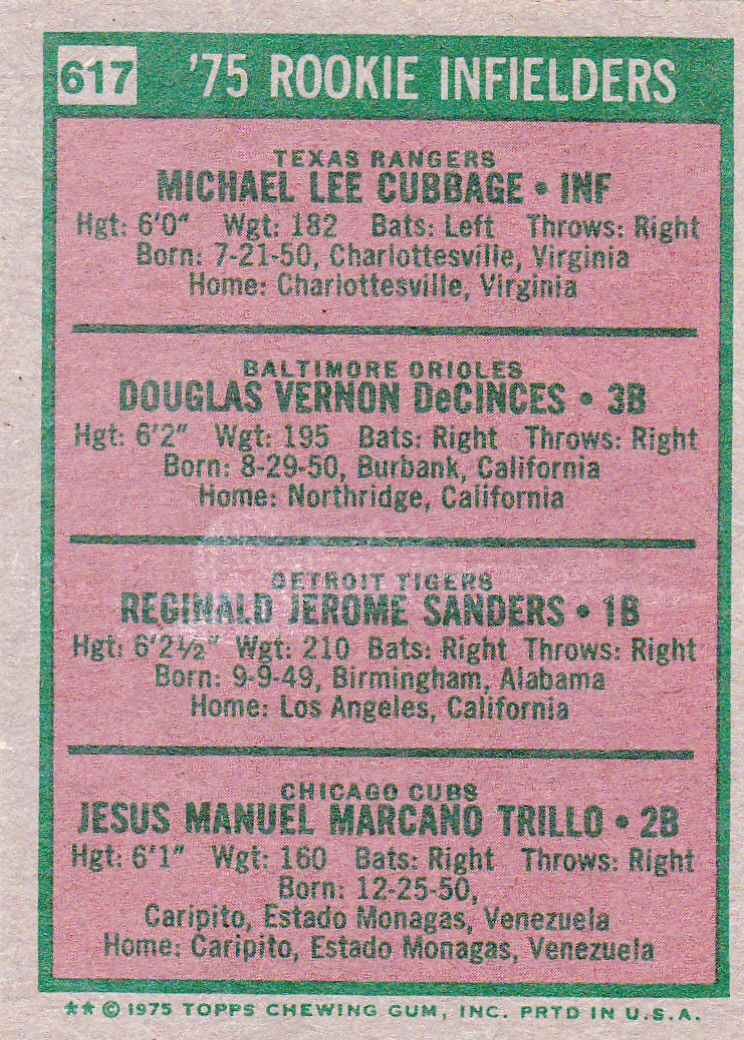
#617 - 1975 Rookie Infielders


Card fact: You never knew Reggie Sanders played for the Tigers, did you? But it's not that Reggie Sanders.

What I thought about this card then: Did not see it.

What I think about this card now: Manny Trillo is not wearing a live Cubs hat. It is most likely an airbrushed A's cap.

Other stuff: Each player's first solo Topps card:

Mike Cubbage, Rangers: 1976 Topps
Doug DeCinces, Orioles: 1976 Topps
Reggie Sanders, Tigers: no solo card. His career lasted 26 games in 1974. He died in 2002.
Manny Trillo, Cubs: 1976 Topps

Most successful player: Toss-up between Doug DeCinces and Manny Trillo. DeCinces played 19 seasons in the majors and hit 237 home runs. Trillo played 17 seasons, was an All-Star for the Cubs and Phillies and had a great 1980 NLCS.

DeCinces was just in the news last week for a bit of ugliness.


Most awesome middle name: U.S.-born players are so boring. Have to go with Manuel Marcano.

Other blog stuff: On this date in 1975, actress Charlize Theron was born. The world would never be the same.

Monday, July 25, 2011

#604 - Oscar Zamora


Card fact: This is Oscar Zamora's rookie card. Despite that, he is airbrushed into a Cubs cap. He was purchased by the Cubs from the Astros in June of 1974.

What I thought about this card then: I had the mini card. I don't recall thinking much of it. I do remember my brother being horrified by his 1978 Topps card (it's just a big head shot of Zamora airbrushed into an Astros cap, nothing to get worked up over).

What I think about this card now: I'm just realizing that the familiar barn-like baseball facility that appears on a lot of Astros cards in this set is in the background of the photo on this card. So Zamora was definitely an Astro in this photo.

Other stuff: Zamora may have appeared on his first card in '75, but he had been pitching professionally in the minors since 1965, with the Indians and Astros organizations. He finally broke through with the Cubs and didn't do too badly for a poor club.

Zamora's success declined in '75 and '76 and he returned to the minors. He was reaquired by the Astros for the 1978 season. After that he pitched in sporadically in the minor leagues.

Zamora was one of just four Cuban natives to appear in major league baseball during the 1970s.


Back facts: Zamora is the subject of the cartoon on the back of his own card. But Topps botches the honor by screwing up the year. Zamora led the Cubs in ERA in 1974. He was in the minors in '73.

Other blog stuff: I'll stay with the Chicago theme. On this date 57 years ago, "Sweetness" Walter Payton was born.

Thursday, July 7, 2011

#587 - Chris Ward


Card fact: This is the first and only solo Topps card of Chris Ward.

What I thought about this card then: I didn't know it existed. In fact, it is yet another Cubs card from this set that features a player I knew nothing about until I tracked down the card while completing the set in 2004. The Cubs sure had a lot of players in '74 that made little impact.

What I think about this card now: The cap he's wearing looks like some sort of denim trucker's cap.

Other stuff: Except for a single at-bat in 1972, Ward's entire major league career occurred in 1974 when he played 92 games for the Cubs. He finished with 28 hits in 137 at-bats, hitting a mere .204.

Ward would return to the minors for the 1976 and 1977 seasons, playing in the Chicago, Cleveland and San Diego organizations.


Back facts: Wilmer "Vinegar Bend" Mizell was a U.S. congressman in North Carolina. In fact, his tour as a congressman ended just before this card came out as he did not win a fourth term in 1974. But Mizell went on to serve in the Ford, Reagan and Bush administrations.

Other blog stuff: On this date in 2005, the sports of baseball and softball are dropped from the Olympic Summer Games. Summer without baseball. This makes no sense.

Saturday, June 11, 2011

#566 - Ray Burris


Card fact: Ray Burris' full name of "Bertram Ray Burris" appears in his signature on all of his cards in which a facsimile autograph is featured. Because it is so long, it makes for some interesting cards. His 1982 Topps card shows the signature sideways from the bottom of the card to the top.

What I thought about this card then: I didn't see a Burris card until the 1977 Topps set.

What I think about this card now: It is probably the most miscut card in the entire set, and I need to upgrade.

Other stuff: Burris was a starting pitcher for 15 seasons in the majors from 1973-87. He pitched for some poor teams, specifically the 1970s Cubs and the late-to-early 1980s Mets. But when he landed with Montreal  in 1980, he was part of solid team that came very close to the World Series in 1981.

Burris was the starting pitcher in that fateful Game 5 of the NLCS against the Dodgers. He allowed just one run in eight innings and left the game with it tied 1-1. Of course, the Dodgers would go on to win the game and the series on Rick Monday's home run off of Steve Rogers.

Burris later pitched for Oakland, St. Louis and Milwaukee. After taking a job as a pitching coach in Milwaukee, he actually returned to the mound for the Brewers in 1987. When his playing career was officially done, he became a coach and worked in the front office. Most recently, he's been a pitching coach in the Tigers organization for Double A Erie.


Back facts: Burris spent most of his career as a starter, but one of the seasons when he was mostly a reliever was in 1974. He started just five of 40 games (Burris also relieved quite a bit in 1982-83 for the Expos).

Other blog stuff: 1970s bad-ass second baseman Dave Cash was born on this date in 1948.

Sunday, April 24, 2011

#519 - Jim Todd


Card fact: This is Jim Todd's rookie card.

What I thought about this card then: My brother had this card. He would joke that you could look up Todd's nostrils.

What I think about this card now: Let's play a game of "does he really have a ball in his glove?" I think he does.

Other stuff: Todd was a relief pitcher between 1974 and 1979. His best season was in 1975 when he appeared in 58 games for the Oakland A's, went 8-3, and saved 12 games with a 2.29 ERA. He appeared in all three games of the A's playoff series loss to Boston that fall.

Todd never enjoyed another season that strong and was shipped back to the Cubs for the 1977 season. He later pitched for the Mariners and then ended his career back with the A's. He pitched in the minors for the Giants in 1980 before retiring.

(EDIT: Jim Todd died at age 77 on Feb. 3, 2025).


Back facts: For a long time, I wondered whether a player would be out if a fielder caught his foul pop in the dugout. I would have saved myself a lot of wondering if I had only looked at the back of this card in 1975.

Other blog stuff: It's a holiday, so I'll take a break from research. Happy Easter.

Tuesday, March 29, 2011

#494 - Pete LaCock


Card fact: This is Pete LaCock's rookie card. I think it's safe to say the world was never the same after this.

What I thought about this card then: I vaguely remember seeing it. Perhaps a friend of mine had it. I remember it as one of those goofy-faced players that we relentlessly mocked. I also remember being amused by his name, but having no idea why.

What I think about this card now: That sure is a majestic shot for a guy who was hitting .204 on the back of this card.

Other stuff: LaCock is a legend on the sophomoric humor circuit. In fact, LaCock and a future '75 Topps subject, Dick Pole, have starred in front of standing room-only crowds for years. The mere presence of their cards throw collectors into giddy fits of hysteria.

Aside from that, LaCock was a part-time player for the Cubs and Royals between 1972-1980. He actually worked his way into a starting role at the end of his career with the Royals. In fact, LaCock has the honor of hitting a home run in the first major league game I ever saw in person on July 15, 1978 against the Yankees. Yes, the first home run I ever saw in person was hit by LaCock. It was all downhill from there.

LaCock later played in Japan, and has worked as a coach in the minors and in independent leagues, most recently in 2009 for the Tucson Toros.

LaCock is the subject of a famous quote by Bob Gibson. On the occasion of his retirement, Gibson said, "When I gave up a grand slam to Pete LaCock, I knew it was time to quit."


Back facts: LaCock's father was the longtime host of "Hollywood Squares." Peter Marshall's given name was also Ralph Pierre LaCock. I often wondered why LaCock didn't go by Pete Marshall, too.

Then again, I suppose he wouldn't be the legend he is now if his name was Marshall. Dad knew what he was doing.

Other blog stuff: The pink-yellow border combo has crossed the 40 threshold with this card. It's the third combination to do so, and could have a real shot of taking over first place by the time this blog is done.

Thursday, March 3, 2011

#469 - Tom Dettore


Card fact: This is Tom Dettore's rookie card. Woo-hoo!

What I thought about this card then: Never saw it.

What I think about this card now: I can't get over how many Cubs there are in this set that I had never heard of before. Tom Dettore, Ken Frailing, Carmen Fanzone, Rick Stelmaszek. All of these players I knew nothing about until I was trying to complete this set 30 years after they played.

Other stuff: Dettore started out with the Pirates as a hitter. He switched to pitching and toiled for a few years in the minors before reaching Pittsburgh in 1973. The Pirates promptly traded him to the Cubs on April 1, 1974 (apparently too late for Topps to get Dettore in a Cubs uniform since his cap is airbrushed).

Dettore pitched three years with the Cubs, with 1975 being his most successful season. He was out of the majors by 1977 and done playing by 1978. He later became a coach for the Pirates and Mariners in the minor leagues and continues to coach in the minors at age 63.


Back facts: Pants Rowland was the White Sox's manager from 1915-18 and later became a huge figure in minor league baseball for decades. Another account of his nickname says that he received the moniker when he was a kid, playing baseball in his father's overalls.

Other blog stuff: On this date in 1988, Kirk Gibson walked out of Dodgers training camp after teammate Jesse Orosco places eyeblack in Gibson's cap as a practical joke. L.A. knew there and then that Gibson, who returned the next day, meant business, as he would later show in the World Series that year.

Friday, January 28, 2011

#436 - Ken Frailing


Card fact: This is the first and last solo Topps card of Ken Frailing issued during his career.

What I thought about this card then: No knowledge of it.

What I think about this card now: When I was trying to complete the set back in 2004, this was one of the few players I came across who I had never heard of prior to seeing his card.

Other stuff: Frailing was a relief pitcher for the White Sox and Cubs between 1972-76. He was dealt to the Cubs in the trade that sent Ron Santo to the White Sox. Frailing's career was shortened by an arm injury.

(EDIT: Ken Frailing died at age 74 on Aug. 25, 2022).


Back facts: The 55 appearances that Frailing made during the 1974 were just shy of half of all the major league appearances he had during his career.

Other blog stuff: On this date in 1901, the American League officially becomes a major league alongside the National League. Only a minor league prior, the major league AL's teams are Cleveland, Boston, Baltimore, Washington, Chicago, Milwaukee, Detroit and Philadelphia. Buffalo, Indianapolis and Minneapolis are dropped.

Wednesday, January 26, 2011

#434 - Bob Locker


Card fact: This is the final card of Bob Locker issued during his career.

What I thought about this card then: Never saw it. But upon my return to collecting, starting out by trying to complete this set, this was one of the first cards that I picked up. I was at a collectibles shop and one of the dealers had this huge box of nothing but '75 cards. I would go there around noon each week and try to nab as many '75s as I needed.

What I think about this card now: It's off-center and I should upgrade.

Other stuff: Locker's claim to fame is he pitched 10 seasons in the major leagues, appearing in 576 games, and did not start a single game. That was very unusual in the 1960s and '70s. After five years with the White Sox, he was traded to the Seattle Pilots. He pitched for Seattle and then Milwaukee before being purchased by Oakland.

Locker had his best success with the A's, settling into a set-up role for relief pitcher Rollie Fingers during the 1972 World Series championship season. But he was dealt to the Cubs after the season. Locker enjoyed another strong season with Chicago, but apparently told Chicago management that he would play only one season with the Cubs, because he wanted to return to Oakland where his family was.

The A's reacquired Locker for 1974, but Locker underwent arm surgery and didn't play the entire year. After the season, he was sent back to the Cubs in the deal for Billy Williams. He pitched in 22 games that final season in '75.

(Edit: Bob Locker died Aug. 15, 2022 at age 84).


Back facts: You can see Locker's lost '74 season in the statistics. Topps must have loved the transaction of Oakland trading Locker back to the Cubs in October of 1974. Normally, that would require Topps to pull out the airbrushing equipment and paint Locker into a Cubs uniform. But since Locker had played for the Cubs already in 1973, Topps just pulled out an old photo of Locker. Problem solved.

Oh, by the way, what are the chances of the cartoon guy running the bases surviving after getting drilled in the back of the head by a line drive?

Other blog stuff: Former Blue Jays and Cardinals pitcher Tom Bruno was born on this date in 1953. I interviewed Bruno once. He was a pro angler at the time. One of the best interviews with a former major leaguer I ever had.

Monday, January 3, 2011

#411 - George Mitterwald


Card fact: Another dugout shot! This is the first card of George Mitterwald as a Cub (I refuse to count that traded thing in 1974). It also might be the only card of a player rubbing his eye, or inserting a contact, or whatever he's doing.

What I thought about this card: Didn't see it.

What I think about this card now: I'm fairly certain that is the Cub logo on Mitterwald's left sleeve. For a minute, I thought Topps was trying to disguise the fact that Mitterwald was wearing a Twins uniform, but the Twins didn't wear pinstripes in the mid-1970s.

Other stuff: Mitterwald, nicknamed "Baron von Mitterwald," was a middling catcher for the Twins and the Cubs. He played most of the games behind the plate for Minnesota in 1970, 71 and 73. When he was traded to the Cubs for Randy Hundley in the offseason, his playing time declined, even though he began his Chicago days with a bang.

In April of 1974, Mitterwald hit three home runs, including a grand slam in an 18-9 victory over the Pirates. He drove in eight runs. According to this report, he did it with a hangover.

Mitterwald didn't hit much after that and his career was done after the 1977 season. He became a manager in the minor leagues and was manager of the Duluth-Superior Dukes when Ila Borders became the first female professional pitcher with the team in 1997.


Back facts: I've never heard of a banjo hit. The fielder looks absolutely freaked out.

Other blog stuff: On this date in 2003, it was announced that the Baseball Hall of Fame game between major league teams would take place on a different weekend than the Hall of Fame induction ceremonies for the first time in history. The reason was because of a conflict in the major league schedule. It marked the beginning of the end of the Hall of Fame game, which eventually became a casualty of MLB's schedule-tinkering and  teams' unwillingness to play an exhibition in midseason. Too bad.

Monday, December 6, 2010

#388 - Steve Stone


Card fact: This is the first card featuring Steve Stone wearing a mustache. He'd appear in a mustache on each Topps card until his transformation on the 1981 card in which he was clean-shaven, had shorter hair and was fresh off a 25-win season.

What I thought about this card then: My brother and I thought he was an odd-looking fellow. Looking at it now, Stone looks like a friend of mine when I was a kid -- minus the mustache, of course.

What I think about this card now: Well, first, nice coordination of the glove color with the team color. Secondly, there aren't a lot of photos in this set in which the photographer shot up at the subject. I'm not sure why they chose Stone for that treatment. He wasn't exactly a dominant pitcher at this time.

Other stuff: Stone was your typical 1970s pitcher. He was his own kind of guy and he wasn't going to follow the ballplayer traditions of the previous 80 years without thinking about it first. Other 1970s pitchers -- the Carltons, the Marshalls, the Lyles, the Lees, etc. -- were the same way, a new breed. Stone was well-read and did things like visiting a psychic in a bid to improve his pitching.

Stone came over to the Cubs from the White Sox in the famous trade that sent Ron Santo to the White Sox. Stone returned to the White Sox in 1977, then signed with the Orioles as a free agent before the 1979 season. In 1980, Stone started 37 games, pitched 250 innings and won 25 games against 7 losses. He captured the Cy Young Award in a vote that many feel robbed Mike Norris of the award.

But Stone's reliance on the curve ball that season led to arm issues. He had only one more major league season and was retired by 1982.

Stone is now known more for his broadcasting than his career. He began broadcasting in 1983 and paired up with Harry Caray in Chicago for nearly 15 years. He was quite popular. He later teamed with Chip Caray, but became involved in controversy with Cubs players, who complained he was too critical of them on the air (why am I not surprised that Moises Alou was one of the complainers? I do not like anything I hear about that guy).

Stone left the Cubs after that 2004 flap and after a few years landed with the White Sox. He is now partnered with Ken Harrelson.


Back facts: Arbitrary capitalization of "shutout" in the write-up.

Other blog stuff: I have no more words. Make something up on your own.

Saturday, November 6, 2010

#363 - Carmen Fanzone


Card fact: This is the last Topps card of Carmen Fanzone issued during his career. He had only three.

What I thought about this card then: Never saw it. This was one of those players who was absolutely not in my consciousness until I returned to the hobby and started to collect the entire 1975 set in 2004.

What I think about this card now: Well, you've got to start with the mustache. ... and you've got to end with the mustache.

Also, I'm wondering how you pronounce his name. Is it "Fan-ZONE" like "the ESPN fan zone" or is it a more ethnic pronunciation? Please tell me it has nothing to do with ESPN.

Other stuff: Fanzone was a utility player, mostly for the Cubs, for five seasons. He was rather popular, which strikes me as a strictly Cub-fan thing. They seem to gravitate toward the mediocre players. But Fanzone was very good at playing a variety of positions, and did have one semi-decent year in 1973.

His popularity seemed to come from his ability to play the horn. He played the National Anthem before Cubs games and went into the jazz music profession after his career ended. He is married to a Grammy-winning jazz vocalist.


Back facts: That cartoon is ... uh ... different.

Also, I enjoy write-ups like this in which the writer is desperately trying to avoid mentioning the player's drawbacks. Fanzone is "ready and able to jump into any spot and do the job." That is, as long as you don't ask him to hit more than .224 for his career.

Other blog stuff: On this date in 1974, Mike Marshall became the first relief pitcher to receive the Cy Young Award.

Tuesday, October 26, 2010

#352 - Darold Knowles


Card fact: Back on this post, I mentioned that the first card I ever pulled from a pack of cards that I bought was either the Hal McRae card or another card. This is the other card. If I was forced to make a decision between the two, I'd say this is the card that I pulled first. But I really can't recall.

What I thought about this card then: Well, no doubt, I thought it was cool if it was the first card I ever pulled. I do know that I had no idea that Darold Knowles was airbrushed into a Cubs cap (while in the Oakland A's stadium).

What I think about this card now: I can't believe I had this card for so long before realizing his cap was airbrushed, especially since the look on Knowles face seems to indicate that he's pulled a fast one. "I wonder if they'll be able to tell that I'm wearing a fake Cubs cap," he seems to be saying.

Other stuff: Knowles was a much-traveled relief pitcher who found his niche with the Oakland A's dynasty of the early 1970s. After playing for the Orioles, Phillies and Senators, he was traded to Oakland in the middle of the 1971 season. He became a key part of the bullpen, used mostly to set-up reliever Rollie Fingers.

Knowles pitched for the A's championship teams in 1972, 1973 and 1974. He famously pitched in all seven games of Oakland's World Series against the Mets in 1973. Interestingly, he didn't pitch in either the '72 or '74 Series (he was injured in 1972).

Knowles' effectiveness declined a little in 1974, and after the season he was sent to the Cubs in a package deal to acquire Billy Williams. A couple years later, he was sent to the Rangers. He played for the Expos and Cardinals to close out his career. He later worked as a coach for the Cardinals and Phillies.


Back facts: The cartoon question doesn't specify why Pete Gray played with one arm, but the cartoon certainly illustrates it. I remember finding this cartoon kind of shocking when I was a youngster.

Other blog stuff: Here it is: Maybe, possibly, the first card I ever pulled from a pack of cards:


Neat, huh?

(EDIT: I have since become completely certain that this is the first card I pulled out of a pack that I bought).

Tuesday, October 12, 2010

#338 - Rick Stelmaszek


Card fact: This is the last Topps card issued during Rick Stelmaszek's playing career. He didn't play in the majors past 1974.

What I thought about this card then: I never saw it. In fact, I was totally unaware of this player until I was completing the set a few years ago. I'm kind of proud of my knowledge of ballplayers from the mid-1970s. Thanks to collecting baseball cards back then, I got to know just about all of them. But when completing the set, I came across a handful that were completely new to me, and threw me for a loop -- "how did I miss this guy?" Stelmaszek was one of the ones I missed.

What I think about this card now: Stelmaszek is majorly airbrushed into a Cubs cap. It appears he's wearing an Angels uniform, which is funny, because on his 1974 Topps card, he is airbrushed into an Angels cap. Stelmaszek appeared on a couple of those three-rookie cards in the early '70s, but the '74 and '75 cards are his only solo cards, and he's airbrushed into his new team on both of them!

Other stuff: Stelmaszek was a career backup catcher for the Senators, Rangers, Angels and Cubs between 1971-74. He didn't have more than 44 at-bats in any one season, and he hit .170 for his career. I'm actually surprised that he made the set this year. He must've been one of the last players to make the cut.

After the Cubs, Stelmaszek kicked around in the minors with teams like the Yankees and Expos until taking up a coaching career. He has been a coach with the Minnesota Twins for the last 30 years.

For all things Stelmaszek, you need to visit Johngy's Beat. The blog's author was a neighbor of Stelmaszek and his blog is filled with stories about him. He also sponsors Stelmaszek's baseball-reference.com page. I may not have heard of Stelmaszek a few years ago, but I sure know about him now.

(EDIT: Rick Stelmaszek died at age 69 on Nov. 6, 2017)


Back facts: Stelmaszek's father's last name was "Stelmack"? Perhaps dad altered the family name? Or maybe a bloop by Topps?

Also, I just missed publishing this card on Stelmaszek's birthday, which was Friday.

Other blog stuff: On this date 60 years ago, Susan Anton was born. If you remember Susan Anton, then you really are a child of the '70s. I don't think I've thought of her in 30 years.

Friday, September 17, 2010

#315 - Don Kessinger


Card fact: This is the last Topps card of Don Kessinger in a Cubs uniform. He's airbrushed into a Cardinals uniform in the 1976 set.

Also, if I was right in this post, then this is the second card in the set of player using a batting donut.

What I thought about this card then: Never saw it.

What I think of this card now: It's quite cool. You don't see enough cards of players in the on-deck circle. Even though Kessinger's drastically off-center on this card, I like it.

Other stuff: Don Kessinger was the everyday shortstop for the Cubs during one of their better eras -- the late 1960s/early 1970s. He started for them from 1965 to 1975. He was a Gold Glove fielder and a productive hitter, although not necessarily by today's standards. Kessinger had over 600 at-bats in a season five times and was an All-Star five straight seasons.

Interestingly, Kessinger ended up completing his career with two teams considered the Cubs' mortal enemies -- the Cardinals and the White Sox. He was traded to St. Louis in 1975 for pitcher Mike Garman. The Cardinals traded Kessinger to the White Sox in 1977. Kessinger then ended up managing the White Sox as a player-manager in 1979.

Kessinger later coached in college and now works in real estate. He had a son, Keith, who played in 11 games for the Reds in 1993. I never knew he had a son in the majors until researching this post.


Back facts: I guess Topps didn't dare put a bench-warmer cartoon on the back of a card of a bench-warmer. They played it safe and picked a guy averaging 600 at-bats a year.

Also, in the June 17th game, Kessinger also scored the winning run in the 10th inning on a single by Ron Santo. The Cubs beat the Cardinals 7-6.

Other blog stuff: Actor John Ritter was born on this date. If you don't know why that's significant, then you weren't 13 years old in the late 1970s. The guy was my hero.

Sunday, August 15, 2010

#282 - Jerry Morales


Card fact: One of the things that I have not mentioned about this set yet is the position designation, which is displayed on a baseball graphic. The type in the baseball is often not centered, as on this card.

What I thought about this card then: This is one of a group of cards that I received in a trade with a friend. Because of that, I still associate the card with my friend, as if the card is still his, as if he first discovered the card. Funny how the brain works.

What I think about this card now: It's kind of a cool photo. Jerry Morales posing in front of the distant grandstand, while looking off to the side. Very nice.

Other stuff: Morales began for the fledgling Padres, but was traded to the Cubs, who were undergoing a youth movement at the time. They got rid of Fergie Jenkins and also traded Glenn Beckert to the Padres for Morales.

Morales enjoyed some decent seasons for the Cubs. He hit fairly well and had a good glove. He was later traded to the Cardinals and then bounced around between St. Louis, Detroit and the New York Mets, before returning to the Cubs as a role player.

Morales has spent much of his post playing career as a coach, both in the major and minor leagues and in his native Puerto Rico.


Back facts: Union Grounds in Brooklyn was a ballpark bordered by three streets and a fence, allowing the teams that played there to charge admission. It was the home of the Brooklyn Eckfords of the National Association of Base Ball Players, among other teams.

Other blog stuff: Here is the card that I received from my friend in that trade:


It was in much better shape when I traded for it. Still, it doesn't look too bad!

Sunday, July 18, 2010

#258 - Dave LaRoche


Card fact: I've got nothing, so let's start a tally on which teams come immediately after a checklist card. This time, it's a Cub. The last time, it was a Twin. More useless information, courtesy of the 1975 Topps blog.

What I thought about this card then: Well, we have a "dude looks like a lady" entry. We thought that long hair looked awfully girly, completely discounting the chest hair and the hint of a mustache.

What I think about this card now: Tough one. Not much to think about. And since I'm just staring at the screen, I'll move on.

Other stuff: Dave LaRoche was almost exclusively a relief pitcher for five teams during 14 years in the major leagues. His best seasons probably came with the Angels in the late 1970s.

In a famous story, which is on his wikipedia page, LaRoche was known as a complainer. One time, teammate Rod Carew got so fed up at LaRoche's whining that he challenged him to a fight. The two had it out in a broom closet in the clubhouse.

LaRoche also threw an eephus-style pitch, called "La Lob" during his career. He finished up with the Yankees and appeared in the World Series in 1981. He is now a pitching coach for the Blue Jays in the minor leagues.

LaRoche is probably most known now as being the father of two current major leaguers, Adam and Andy LaRoche. Andy used to play with the Dodgers, but now, because they've been traded so often and because they both share four-letter first names that begin with "A," I have a hell of a time keeping track of where they are or even who they are. This is why parents need to select names for their children that are distinct from their siblings.


Back facts: I like the complete transaction details in the write-up at the bottom. Also, Lynwood is not a good name. I can see why he went by "Schoolboy."

Other blog stuff: On the other blog, I noted that I may have to change the color-combination attributed to the Dave Lopes card. It appears that the actual color combination on the card is "brown-orange" not "brown-tan." I apparently have a copy in which the orange color is faded. So I have changed the Lopes label to "brown-orange," so that the color combination standings are accurate.

I'm sure you're all relieved.

Friday, June 18, 2010

#233 - Billy Grabarkewitz


Card fact: This is the last card issued of Billy Grabarkewitz during his career.

What I thought about this card then: I thought it was pretty cool for a reason that I can't explain now. I don't think I noticed the atrocious airbrush job on the cap at all.

What I think about this card now: I am wondering which team's uniform Grabarkewitz is wearing. He played for a series of teams in a short period of time before this card -- the Dodgers, Angels, Phillies -- it could be any one of them.

Other stuff: Grabarkewitz played in the majors from 1969-75, but he's known as being a one-year wonder. In 1970, starting at third base for the Dodgers, he recorded 153 hits in 529 at-bats in 156 games. His .399/.454/.852 line helped L.A. overlook the fact that he struck out a franchise record 149 times.

But Grabarkewitz would never play in more than 87 games in a season again and he hit above .247 only one other season in his career. After the 1972 season, Grabarkewitz was in the trade that sent Frank Robinson, Bill Singer and Bobby Valentine from the Dodgers to the Angels in exchange for Andy Messersmith.


Back facts: How much do you think Bobo Holloman's rookie card would be worth if he pitched a no-hitter in his first major league start in 2010?

Other blog stuff: All right, this color combo still doesn't have a name. I'm going to take care of it by naming it the "Lymon/Sprite" combo, as I threatened to do a little while ago. If someone, including me, comes up with something better, I'll change it. But "green-yellow" is now the Lymon/Sprite combo on the sidebar.

One more color combo left to name.