Showing posts with label Padres. Show all posts

Wednesday, September 7, 2011

#643 - Brent Strom


Card fact: Brent Strom is wearing an airbrushed Padres cap (a not very accurate one, too). He was likely wearing an Indians cap, or less likely, one from a minor league team.

What I thought about this card then: Ladies and gentlemen, as kids we may have made fun of other players' cards more, but there was only one card of a player we made fun of first. And that card was the '75 Topps Brent Strom card. I specifically remember my brother and I mocking his name -- overemphasizing the sound it made when you pronounced the first name and last name together. It didn't help that he was wearing that weird painted cap and that his career ERA on the back was 5.06 or his career record was 2-13.

What I think about this card now: It's really not so bad. Except for that airbrushing job.

Other stuff: Strom was a star pitcher for national champion USC in college. He eventually signed with the Mets as the third pick overall in 1970. After three years in the minors, he came up with New York in 1972 and went 0-3. The Mets dealt him to the Indians after the season.

Strom didn't fair much better with the Indians, going 2-10 in 1973. He didn't play in the majors in 1974, but was sent to the Padres as a player-to-be-named that year. Strom pitched three seasons for San Diego, starting 33 games in 1976 and going 12-16.

Elbow injuries got in the way and Strom was released. He pitched in the minors through 1981, including a final year in the Dodgers organization (I remember seeing him the minors in Albuquerque and recalling our childish mocking with chagrin). He later became a pitching coach for several minor and major league teams, and is now a pitching instructor for the Cardinals.


Back facts: I'm a little curious as to why Strom got a card in this set. He didn't play in the majors at all in 1974. We noticed this as kids, spotting the Oklahoma City and Hawaii team names.

Other blog stuff: On this date in 1975, the Reds clinched the division -- the earliest clinching in history. And people complain that there are no pennant races in today's game.

Saturday, August 13, 2011

#619 - 1975 Rookie Outfielders


Card fact: I'm quite certain that is an airbrushed White Sox cap atop Nyls Nyman's head. Tommy Smith's cap may or may not be airbrushed, too.

What I thought about this card then: No knowledge of it.

What I think about this card now: No future stars there, eh? Also, Topps must have struggled to find a shot of Jerry Turner. You don't see the absolute profile shot too often.

Other stuff: Each player's first solo Topps card:

Benny Ayala, Mets: Not until 1980 Topps, with the Orioles.
Nyls Nyman, White Sox: 1976 Topps. His only one.
Tommy Smith, Indians: 1977 Topps. As an airbrushed Mariner. Also his only solo Topps card.
Jerry Turner, Padres: 1977 Topps

Most successful player: Turner and Ayala both played 10 seasons, with Turner playing in more than 300 more games than Ayala. Turner also has slightly better stats. Even though Ayala got into a few postseason games with the Orioles as one of Earl Weaver's platoon favorites, I'll give the edge to Turner.


Most awesome middle name: Nyls Nyman already has the best first name. Throw in Rex and Wallace as your middle names and it's no contest. Also, where did John Webber Turner get "Jerry"?

Other blog stuff: The pink-yellow border combination becomes the third border combo with 50 cards. It is just two off the overall lead with a few more rookie cards to go.

Saturday, August 6, 2011

#616 - 1975 Rookie Outfielders


Card fact: The first pink-yellow rookie card also is one of the more coveted rookie cards in the entire 1975 set, as it's Jim Rice's rookie card.

What I thought about this card then: I vaguely recall seeing it. But not because of Jim Rice. I only recall the two guys on the top, Dave Augustine and Pepe Mangual.

What I think about this card now: This card wasn't terribly difficult to obtain. There is another rookie card coming up that was more of a chore finding.

Other stuff: Each player's first solo Topps card:

Dave Augustine, Pirates: Never had one.
Pepe Mangual, Expos: 1976 Topps
Jim Rice, Red Sox: 1976 Topps (with a rookie cup)
John Scott, Padres: 1978 Topps (his only one, as a member of the Blue Jays)

Most successful player: Rice is in the Hall of Fame.


Most awesome middle name: Jose "Pepe" Manuel Mangual seems like a mouthful. I'll go with that one.

Other blog stuff: Former Mets pitcher Victor Zambrano was born on this date in 1975. Remember him?

Saturday, June 25, 2011

#578 - Dave Tomlin


Card fact: This is Dave Tomlin's first solo card.

What I thought about this card: I didn't see it.

What I think about this card now: Tomlin is definitely airbrushed into a Padres cap and jersey (and doesn't look pleased). But with him not having a previous card (I want to say he was on one of those multi-player rookie cards, but I can't find an example right now), I'm wondering if he's actually wearing a minor league uniform or a Reds uniform, which is the team he was with before the Padres. I'm assuming it's a Reds uniform.

Other stuff: Tomlin was a career-long relief pitcher for mostly the Reds and the Padres from 1972-86. Even though he played 13 seasons in the majors, he had relatively few cards. They spanned from 1975-80.

This is mostly because after 1980, he appeared in only 14 more games with the Expos and Pirates. Before that, Tomlin appeared in 67 games in '75 and 76 games in '77 for San Diego. He was then traded to Texas straight up for Gaylord Perry. Perry went on to win the Cy Young Award for San Diego, while Tomlin was released in spring training and picked up by the Reds.

With Cincinnati in 1978, he went 9-1 but had a 5.78 ERA. Such was life with the Big Red Machine. Tomlin performed better in '79 and appeared in three postseason games for the Reds.

After his playing career, he became a pitching coach in the Expos and Braves organizations. Since 1996, he's been a coach and manager in the minors for the Red Sox.


Back facts: "Dave had 2 saves for Padres in 1974." The Padres were a bad team in '74.

Other blog stuff: Two more key celebrities of the '70s were born on this date. Singer Carly Simon is 66. Comedian Jimmie "Dy-no-mite" Walker is 62.

Friday, June 3, 2011

#558 - Dave Roberts


Card fact: The second Dave Roberts to be featured in this set. The first was the first of three Dave Roberts to play for the Padres.

What I thought about this card then: Well, first of all, dude looks like a lady. Secondly, I had the mini card, and it might have been my least favorite card in the set. It didn't fall into the camp of cards that we made fun of without mercy. I just kind of silently loathed it.

What I think about this card now: Dude looks more like a dooood, than a dudette.

Other stuff: Roberts was a utility infielder for the Padres, and later the Rangers, Astros and Phillies. Roberts actually enjoyed a productive 1973 season when he was San Diego's third baseman, and the Padres thought they had something special. But he fell off drastically in 1974, was sent down to Hawaii (oh, the misery, sent down to Hawaii), and never came close to performing like he did in '73.

Roberts later played all over the infield, even taking some turns at catcher, while staying in the majors until 1982.


Back facts: I did not like the pinky cartoon. The womanly fingers just added to the whole dude-lady perception in my 9-year-old mind. And hitting an inside-the-park home run against the Dodgers? Dude, that is so uncool.

Other blog stuff: Suzi Quatro was born on this date 61 years ago. Folks who know the '70s know who she is. I'll let everyone else stumble across it.

Thursday, April 14, 2011

#509 - Dave Hilton


Card fact: This is the second straight card of a player wearing a batting helmet. I suppose you're wondering if that's the first time that's happened. Nope. It happened once before. Card #375, Roy White, and Card #376, Steve Yeager.

I look so you don't have to.

What I thought about this card then: I had the mini card. I had a lot of mini cards of Padres for some reason. They were a mini kind of team.

What I think about this card now: It's a card I've had some difficulty finding well-centered. The previous Hilton card I had was WAY off.

Other stuff: Dave Hilton's career spanned just 1972-75, but he's featured on two notable cards. The first is his rookie card in the 1973 Topps set (he is referred to as "John Hilton." He shares it with Mike Schmidt, so it's better known as Mike Schmidt's rookie card. Also, I prefer to call it "Ron Cey's second-year card," because my favorite player, Cey, is the third player on that card.

The other notable Hilton card is his 1977 Topps card in which he's airbrushed into a Blue Jays uniform as expansion Toronto acquired him in October of 1976 from the Padres. But Hilton never played in the majors for the Blue Jays. In fact, his final major league season was 1975, two full years before his 1977 Topps card came out. Oops.

Hilton played his entire major league career with San Diego, never playing in more than 74 games in a season and hitting .213 for his career. He played in Japan in the late '70s, then return to the U.S. for a couple more minor league seasons. He later worked as a coach with the Brewers and managed in the minors.

(EDIT: Hilton died at age 67 on Sept. 17, 2017)


Back facts: Hugh "One Arm" Daily lost his left hand in a gun accident. He was a standout pitcher in the 1880s and a fan favorite. But he was a hot-headed, cranky son-of-a-gun who switched teams often because he was uncontrollable.

Other blog stuff: Pete Rose is 70 years old today. Can you believe it?

Saturday, March 19, 2011

#484 - Glenn Beckert


Card fact: This is the final Topps card of Glenn Beckert issued during his career.

What I thought about this card then: This is another card that I remember pulling during a family vacation in Western New York. I remember being struck by how tiny Beckert was (although it was only because the photographer took the shot from so far away) and also by how tiny Beckert's bat was.

What I think about this card now: I like the shadow underneath Beckert's signature. It's cool.

Other stuff: Beckert started out with the Red Sox, but came up to the majors with the Cubs. He teamed with Don Kessinger to form the Cubs' middle infield combination during the 1960s and early '70s (I still confuse the two).

Beckert was a four-time all-star, a good fielder, and seldom struck out. He finished third in the National League in batting average in 1971, and really piled up the hits during his career. If it had lasted more than 10 years, he could've been among the all-time hits leaders at the rate he was going.

After that '71 season, his output declined and he was traded to the Padres in 1973. Beckert was merely a backup for San Diego, and he retired in 1975. After his career, he worked as a commodities trader.

(EDIT: Beckert died at age 79 on April 12, 2020).


Back facts: My, what a violent cartoon.

Other blog stuff: On this date in 1975, the movie "Tommy" debuted. This is another one of those movies from that time that weirded me out when I was a kid.

Saturday, February 12, 2011

#450 - Willie McCovey


Card fact: This is the first Topps card of Willie McCovey in an actual Padres uniform. He is airbrushed into a Padres cap in the 1974 Topps set.

What I thought about this card then: I don't remember which brother had this card, but I do know it was around. The thing is that I knew McCovey only as a Padre for a couple of years. The first time I saw him was on this card, and I identified him as a Padre. Little did I know that McCovey's Padre years were the worst part of his career.

What I think about this card now: Don't just stand there, do something!

Other stuff: Willie McCovey was one of the greatest power hitters of all-time, spending most of his career with the Giants. He was a four-decade player, starting in 1959 and ending in 1980. He went 4-for-4 in his major league debut (against Robin Roberts) and won the N.L. Rookie of the Year Award in '59 despite playing in just 52 games.

McCovey's most famous moment came in Game 7 of the 1962 World Series. McCovey came to bat with two outs in the bottom of the ninth, runners on second and third and the Giants trailing the Yankees 1-0. McCovey scalded a line drive that Bobby Richardson leapt to snare for the third out. I admit I am conflicted by this moment -- both bummed that the Yankees won another World Series and thrilled that the Giants lost in the most painful way possible.

McCovey continued to hammer N.L. pitching through the '60s and won the NL MVP award in 1969. But his performance trailed off in the early '70s, and he was traded to San Diego for Mike Caldwell after the '73 season. McCovey started OK with San Diego, but ended up hitting abysmally for both the Padres and during his brief stay with the A's.

He was reacquired by the Giants, and I remember his triumphant 1977 season when he re-emerged for one last solid season and won Comeback Player of the Year honors.

"Stretch," who has had his share of health issues the last few years, is an advisor to the Giants.

(EDIT: McCovey died at age 80 on Oct. 31, 2018).


Back facts: This might be the most confusing cartoon in the whole set. I do not know what it means and it's too late to go on a fact-finding mission. The question asks "Who was The Hat?" which I would assume to be a nickname. But then the answer comes back with "Jerry Lynch with 18." With 18? With 18 what? 18 hats?

I know Jerry Lynch was one of the best pinch-hitters of all-time. I have a card of his from the '56 set. I should check it and see if he's referred to as The Hat and how that connects with the No. 18. Anyone with more free time than I, please take a crack at enlightening me.

Other blog stuff: On this date in 1999, the Padres signed country singer Garth Brooks and invited him to spring training as a non-roster invitee. How'd that work out, San Diego?

Tuesday, December 21, 2010

#402 - Bob Tolan


Card fact: Here is another name that does not match the signature on the card. I remember Tolan being called "Bobby," but Topps always referred to him as "Bob" on his cards.

What I thought about this card then: I didn't see it. But no doubt I would have thought it was cool.

What I think about this card now: I can't figure out what that yellow tuft is behind Tolan's hair at the back of his head.

Other stuff: Tolan began  his career with the Cardinals, but blossomed into a full-time outfielder with the early Big Red Machine teams in Cincinnati in the early 1970s. Tolan led the league in stolen bases in 1970 and later was a key figure for the Reds in their NLCS victory over the Pirates, scoring all three runs in a Game 2 victory.

Tolan ruptured his Achilles tendon playing basketball during the offseason and missed the entire 1971 season. He won Comeback of the Year honors with the Reds in 1972. But 1973 began a downward slide for Tolan. His hitting suffered, and he squabbled with management. He left the team without permission and broke team rules by growing a beard. At the end of September he was suspended for the rest of the season and missed the playoffs.

The Reds traded Tolan to the Padres ahead of the 1974 season. Tolan filed a grievance against Cincinnati and won the case, but his hitting wasn't the same. After a couple years with San Diego, he joined the Phillies as a part-time player in '76. He left for Japan after a dismal season between the Phillies and Pirates in 1977. Later Tolan worked as a coach for the Padres.

Tolan's son, Robbie, was a prospect in the Nationals organization. He was shot by a police officer in 2008 during a dispute and the resulting injury may have halted his baseball career.


Back facts: As a kid, I thought players were special if the cartoon referred to the team for which he played.

Other blog stuff: On this date in 1982, Steve Garvey signed a contract to play with the Padres, disappointing Dodger fans everywhere. I know someone who changed his favorite team from the Dodgers because of this. I do not understand that decision.

Monday, November 22, 2010

#378 - Derrel Thomas


Card fact: Another large gap for the "purple-pink" color combo. It's been 38 cards since the last one. This color combination has really fallen off the pace.

What I thought about this card then: I didn't see it. It's been 10 cards since we've come across a card that I didn't see in 1975. I think that's a record.

What I think about this card now: Derrel Thomas looks slightly P'Oed.

Other stuff: Thomas, the No. 1 pick of the 1969 free agent draft by the Astros, became a starting infielder for the Padres and Giants, then transformed into a valued utility guy for the  Dodgers. He played every position except pitcher during his career. He played five games at catcher for the Dodgers in 1980 (L.A. loved putting him all over the field).

Thomas was acquired by the Dodgers before the 1979 season and served as the team's starting center fielder for much of the year. He played on the World Series-winning L.A. team in 1981, but didn't play in the Series against the Yankees. In 1983, Thomas went 4-for-9 for the Dodgers in their NLCS loss to the Phillies.

After Thomas' career ended in 1985 (he also played for the Expos, Angels and Phillies), he fell into drug problems and spent 47 days in prison on cocaine charges. He later spoke to groups about his 1992 prison term and led clinics. He continues to work in the Dodgers' organization.


Back facts: Thomas played in 20 games in the outfield for the Padres in 1974, 19 of them in center field. He also played 22 games at third base in '74, which is 17 more than he played at shortstop, but apparently Topps was not impressed.

Also, I really want to put an "r" in Thomas' middle name.

Other blog stuff: In honor of Rodney Dangerfield, who was born on this date 89 years ago:

"I went to see my doctor. I said, 'Doctor, every morning when I get up and look in the mirror I feel like throwing up. What's wrong with me?' He said, 'I don't know, but your eyesight is perfect.'"

Friday, October 29, 2010

#355 - Chris Cannizzaro


Card fact: This is the final card of Chris Cannizzaro issued during his playing career. In fact, he didn't play in the majors at all in 1975. His last major league game was Sept. 28, 1974.

What I thought about this card then: I did not see it, yet somehow I have the mini card. Almost all of my mini cards were acquired in 1975. But I must have obtained this one somewhere else.

What I think about this card now: That is an atrocious airbrushing job. Did San Diego ever wear caps that looked like that? They certainly didn't in 1974. My guess is he was wearing a Dodger uniform in this photo, as he played for Los Angeles in 1972 and 1973. His 1972 Topps card was one of the first Dodgers I obtained from that set.

Other stuff: Cannizzaro was the definition of a journeyman player. He caught for six different teams during a major league career that stretched from 1960 to 1974. His first Topps card is in the 1961 set, yet there are four years in the '60s in which he didn't have a card.

Cannizzaro played during the first season of the New York Mets in 1962 and is possibly most known for Casey Stengel mispronouncing his name as "Canzaroni." Cannizzaro also was an original San Diego Padre. It was there where he received the most playing time, since San Diego was in dire need of talent. He was also the Padres' first All-Star, playing in the game in 1969.

After his career, Cannizzaro became a coach with the Braves and Angels. He now works as the University of San Diego's director of baseball operations.

(EDIT: Cannizzaro died in December 2016)


Back facts: I'm dumbfounded that Cannizzaro received a card number ending in a "5." That was usually reserved for minor stars. Cannizzaro hit .183 in 1974 and .190 in 1973. He hadn't even had more than 300 bats since 1970.

Other blog stuff: I've got to get up early in the morning. No other stuff today.

Sunday, October 17, 2010

#343 - Danny Frisella


Card fact: Danny Frisella is airbrushed into his Padres uniform. He seems to be wearing a Braves cap, as Atlanta was the team he played for before he was traded to San Diego for Cito Gaston in November of 1974. The pose on this card looks like his pose on this card, although he has a lot more hair here.

What I thought about this card then: This was one of those card we really disliked as kids, one of the 7 or 8 cards that we tried to slip into other collectors' card stacks and hope they didn't notice. In fact, I think this was the original  "Oh, no, It's Him" card, because this was one of the first cards I saw from the 1975 set.

What I think about this card now: I think the reason we didn't like it is because of the horrible airbrush job, and how Frisella is looking to the sky.

Other stuff: Frisella was a career reliever, mostly with the early '70s Mets teams, but also with the Braves, Padres and Brewers. Even though New York was a perennial contender in the first half of the '70s, Frisella never pitched in the postseason, since he barely pitched in 1969 and he was shipped to the Braves before the Mets' 1973 pennant-winning season.

Frisella was killed in a dune buggy accident near Phoenix, Ariz., during the offseason on Jan. 1, 1977. It was the first time I had ever heard of a player dying during his major league career. Frisella was still featured in the 1977 Topps set as the cards had already gone to press by the time of his passing.


Back facts: Francis "Salty" Parker played all of 11 games for the Detroit Tigers in 1936. I hardly think he merits a cartoon.

Other blog stuff: On this date in 1975, the movie "Benji" was released. Wow, that dog was popular when I was a kid. Benji folders. Benji notebooks. Benji book covers. I've still never seen that movie.

Wednesday, October 6, 2010

#332 - Fred Kendall


Card fact: I am regretting now that I did not add a label for players wearing glasses. That would have been a nifty fact today.

What I thought about this card then: Never saw it. The first Fred Kendall card I knew was his 1977 Topps card. We thought Kendall looked like a weird little gnome.

What I think about this card now: Kendall appears to be swinging a bat in a major league stadium, yet the grass doesn't look terribly well kept. Groundskeeping then just wasn't what it is today.

Other stuff: Fred Kendall was a member of the original 1969 San Diego Padres team. He was the last original member of the club, playing for the Padres for seven years until he was traded to the Indians in 1976 in the deal that brought George Hendrick to the Padres. A year later, he went to the Red Sox in the Dennis Eckersley deal.

Kendall was known as a good defensive catcher and a strong handler of pitchers. His hitting was only fair, as was customary of many catchers then, despite the arrival of Bench, Simmons, Sanguillen, etc.

After his career, he worked in sales and also was a coach in the minors and majors. I remember him as the manager of the Utica Blue Sox in the early 1990s. Kendall is the father of current Royals catcher Jason Kendall. I'm embarrassed to say that I didn't know Jason Kendall's father was Fred Kendall until halfway through Jason's career.


Back facts: I am assuming that home plate, prior to having five sides, was a square? I'm too lazy to look it up.

Speaking of laziness, it seems Topps couldn't find a lot to say about Kendall. "A good competitor"? Citing his first major league home run four years prior? I'll help out and add a bit more info: Kendall was voted the Padres' most valuable player in 1973. There you go.

Other blog stuff: With one day left in the voting, it looks like the brown-orange combo, which is featured here, will be called the "Reese's Peanut Butter Cup" combo. A good choice. I can see the Reese's wrapper when I look at the Kendall card.

Tuesday, August 31, 2010

#298 - Johnny Grubb


Card fact: I really want to look and see if this is the first player in the set to have repetitive consonants in both his first and last names, but I have to be up at an ungodly hour in the morning. So, someone, please do it for me.

What I thought about this card then: Never saw it. First card of his that I knew was his 1976 Topps card.

What I think about this card now: Behind Johnny Grubb, there appears to be a festive baseball crowd gathering in preparation for another Padres loss.

Other stuff: Grubb was an outfielder/first baseman/DH for the Padres, Indians, Rangers and Tigers. He started out quickly, finishing sixth in the National League Rookie of the Year voting in 1973. He then received the most playing time of his career the next two years, setting a San Diego franchise mark for doubles in a season (granted the Padres were only five years old at the time).

Grubb later settled into a supporting role for the Rangers and Tigers. He was on the Tigers' World Series-winning team in 1984. He played until 1987. After his pro career, he coached high school ball in his hometown in Virginia.

His wikipedia page has a weird uncited stat. It says that Grubb is the all-time leader among American League hitters when used as a pinch-hitter batting for the No. 9 hitter in the lineup. What?


Back facts: The team isn't going very well when 42 RBIs and 127 hits makes you the best hitter on the club.

Other blog stuff: Hideo Nomo was born on this date in 1968. It's also the birthdate of Debbie Gibson. I only mention this because it means she's 40. Debbie Gibson is 40. Ho-ly crap.

Saturday, August 7, 2010

#274 - Vicente Romo


Card fact: This was Vicente Romo's last Topps baseball card -- until he re-emerged in the major leagues in 1982 and appeared in both the Topps and Fleer sets in 1983.

What I thought about this card then: Not part of my collection then.

What I think about this card now: That is more of a Frankenstein-I'm-coming-to-get-you pose than a pitching-follow-through pose. ... And what's with the red collar?

Other stuff: Romo is the most successful pitcher in the history of the Mexican Pacific League and a member of the Mexican Baseball Hall of Fame. He holds the MPL record for career victories with 182, earned-run average (2.38), strikeouts (2,038) and complete games (178). He pitched in the league for 24 years.

But Romo also pitched in the major leagues for Dodgers, Indians, Red Sox, White Sox and Padres. He began with the Dodgers in 1968, pitching in just one game. L.A., after acquiring Romo in the Rule 5 draft, returned him to the Indians, where Romo enjoyed a fine season, going 5-3 in 40 games with a 1.62 ERA.

Romo pitched in the majors until 1974, returning to the Mexican League after the season and continuing the standout career that he left in the late 1960s. After several strong seasons, he was 7-0 with a 1.54 ERA in 1982 when the Dodgers acquired him again in their bid for a division title. Romo started six games, pitched in 15 and had a 1-2 mark and a 3.03 ERA, but L.A. didn't make the playoffs. Romo returned to Mexican ball for the 1983 season and played four more seasons before retiring.

Romo's younger brother, Enrique, also pitched in the majors and was a key figure for the Pirates during their run to the 1979 World Series title.


Back facts: The card says Romo's birthday is May 21, but baseball-reference.com says it is April 12.

Also, the answer to the trivia question is missing the word "in" as in "the area in which ..."

Other blog stuff: On this date in 1975, Charlize Theron was born in Benoni, Gauteng, South Africa. There is nothing I can say to properly express what she means to the male species, except "wow."

Tuesday, July 6, 2010

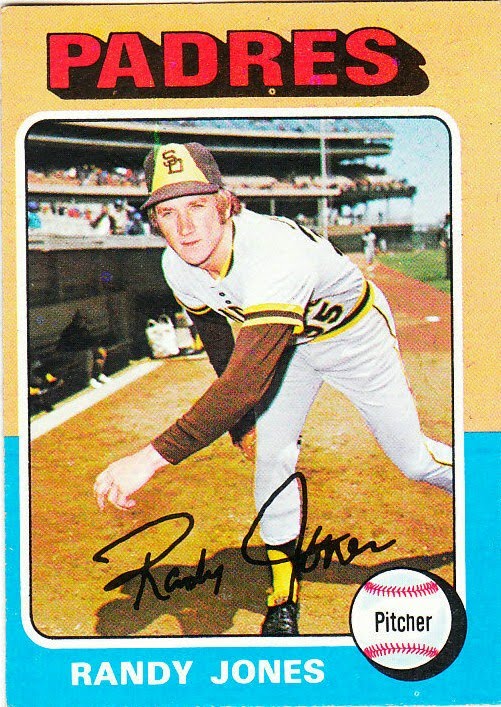
#248 - Randy Jones


Card fact: Do we have a photo at Dodger Stadium? I'm not very good at this, unless it's really obvious.

What I thought about this card then: Didn't see it. My introduction to Randy Jones was on his 1976 Topps card.

What I think about this card now: It's still odd, after all these years, to see Jones without his perm/afro.

Other stuff: Jones pitched on some lousy Padres teams, but managed back-to-back breakout seasons in which he won 20 games each season. I remember his 1976 season well when he went into the All-Star break with a 16-3 record. Jones started the All-Star Game and received the win, after saving the National League's victory the previous season.

Jones suffered a nerve injury near the end of the year and didn't enjoy another winning season the rest of his career. He was traded to the Mets in 1980 and endured two rocky years before calling it quits after 10 seasons. Jones now runs a caterng business, is the maker of his own barbecue sauce, and does radio announcing with the Padres.

(EDIT: Randy Jones died on Nov. 18, 2025 at age 75).


Back facts: It appears Topps really doesn't want to tell you about Jones' 1974 season. Let's all talk about 1973 and hope nobody notices that 8-22 record.

Other blog stuff: This is the third straight card to feature the color tan in the border. Sadly, that streak will end at three.

Monday, June 7, 2010

#222 - Dan Spillner


Card fact: This is Dan Spillner's rookie card.

What I thought about this card then: This is one of the cards that I remember pulling out of a couple of packs while my family was on vacation in the summer of 1975. I remember sitting on the hotel bed and opening the pack. I liked this card because the border matched with Spillner's very colorful uniform.

What I think about this card now: Those were some crazy get-ups the Padres wore.

Other stuff: Spillner was a hard-throwing right-hander who was known mostly as a reliever but did have a couple of decent seasons as a starter, particularly when he won 16 games with the Indians in 1980. Spillner didn't get the luxury of playing for decent teams. Both the Padres and Indians were lousy in the '70s and '80s. Eventually, Spillner landed with the White Sox, which were fairly decent during his brief stay there.

In a "where-are-they-now" article, Spillner remembers not having to throw a curve ball for the first three years of his major league career, and getting shut out by owner's collusion in the mid-1980s. Claiming he could have pitched for a couple of more years, he received a $486,000 settlement.


Back facts: How is it possible that Sam Jones did not swallow a bunch of toothpicks during his career?

Also, I enjoy the write-up. The Padres' pitching hoard was so good that they didn't win a single thing until the mid-1980s.

Other blog stuff: I still have the old card that I pulled out of that pack. Here it is:


Not too bad.

Monday, April 12, 2010

#168 - Bill Greif

Card fact: This is the second of four Topps cards that Bill Greif would have during his career.

What I thought about this card then: I had the mini card. I didn't have many thoughts other than feeling sorry for the Padres players, whose stats were always horrid in the mid-1970s. Well, as sorry as a Dodger fan could feel, anyway.

What I think about this card now: Greif has a semi-quizzical look on his face in most of his cards. Also, the photo work is not very good. Not only is the stadium tilted in the background, but the cropping job makes it appear as Greif doesn't have arms.

Other stuff: Greif was a 6-foot-5 starter who was coming off the second of the two best seasons of his career. His stats weren't great, but he played for some horrible San Diego teams and was one of the team's more reliable starters during that period.

Greif was converted to a reliever for the 1975 season, and after a slow start in 1976 was shipped to St. Louis. The Cardinals traded Greif to the Expos in the offseason of '76, and Greif is airbrushed into an Expos cap and uniform on his 1977 Topps card. But he never played in the regular season for the Expos. He was released in March of 1977 and that was the end of his major league career.

Back facts: Take a good look at the information on the back of this card. Now tell me the most interesting thing, besides the word "fastball" behind hyphenated.

That's right. The Phillies and Padres played in a game that took an hour and 30 minutes to complete! Those were the days.

Other blog stuff: If I don't come up with a name for this color combination -- or someone doesn't offer a suggestion that works -- by the time the next green-yellow card comes along, I'm putting up a poll.

Saturday, March 20, 2010

#146 - Padres/John McNamara


Card fact: This is John McNamara's first appearance as the Padres' manager on a baseball card. He replaced Don Zimmer, who was let go after a 60-102 season. McNamara managed San Diego to the exact same mark in 1974, yet got to keep his job.

What I thought about this card then: I thought McNamara looked like an elf.

What I think about this card now: McNamara is still somewhat elfian, but I'm also distracted by the guy on the right with what appears to be a towering mound of hair. Or maybe it's a shadow.

Other stuff: McNamara started his major league managerial career with the A's in 1970, but my first encounter with him was with the Padres. I didn't like him much when he managed the Reds, and liked him a little more when he took over for the Red Sox. Of course, Boston fans don't have much nice to say about him. And Dave Stapleton really has unkind things to say about McNamara. Let's just say he thinks he should have replaced Buckner on defense in Game 6.

Back facts: Nate Colbert is listed on the Padres checklist, but he is listed as a Tiger on his own card. He was traded to the Tigers on Nov. 18, 1974.

Other blog stuff: Time to see if Topps left any key Padres players out of the '75 set.

The Padres used 43 players in 1974. That is the most of any of the teams we have seen so far. San Diego was five years removed from expansion and absolutely sucked. The Padres didn't even have a winning season until they had existed for 10 years. So they threw a lot on the wall and hoped some of it stuck.

Out of the 43 players, Topps featured just 24 in the set. That is just 55.8 percent, the worst percentage so far. Also, three of the players from that '74 team are featured with other teams -- Colbert (Tigers), Steve Arlin (Indians) and Clarence Gaston (Braves). But two of the players in the Colbert trade -- Ed Brinkman and Dick Sharon -- remained Tigers in the '75 set, cutting down even more on the number of Padres in the set. Topps did try to make up for that by featuring two airbrushed Padres who didn't even play for the team in 1974 -- Danny Frisella and Brent Strom.

Topps didn't really leave out anyone notable. The biggest ones were pitcher Mike Corkins (25 appearances) and two hitters at the end of their careers -- Horace Clarke (90 at-bats) and Matty Alou (81 at-bats).

So the Padres sink to the bottom (a position they should know well) as far as the percentage of players representing their team in the '75 set. There were just too many comings and goings for Topps to handle:

1. Tigers 78.37% of players featured
2. Orioles 78.13%
3. Royals 70.59%
4. Expos 68.29%
5. Phillies 62.5%
6. Padres 55.8%

Friday, February 12, 2010

#112 - Larry Hardy


Card fact:
This is the first and only Topps card of Larry Hardy.

What I thought about this card then: I distinctly remember pulling this card out of a pack while I was on vacation with my parents in 1975. Hardy, even though he was 24 years old when this photo was taken, struck me as being about 45. Hey, I was only 9. Everyone looked old to me.

What I think about this card now: It takes a real man to wear what the Padres players wore in the 1970s. That cap looks nothing more than embarrassing, yet Hardy doesn't appear to be fazed at all.

Other stuff: Even though Hardy made a significant showing as a rookie, pitching in more games than any other rookie in history, he was done in the majors by 1976. He started coaching in 1978, and  was a member of the Rangers' coaching staff in the late 1990s.

Back facts: Even as a kid, I thought that Hawaii was a pretty exotic location for a minor league team.

The record for most games pitched by a rookie is now held by Sean Runyon of the Tigers, who appeared in 88 games in 1998.

Other blog stuff: There are a number of players in this set that were born on Feb. 12: Pat Dobson, Don Wilson, Ray Corbin, Len Randle, Enzo Hernandez and Don Stanhouse.