Thursday, September 8, 2011
#644 - Bill Fahey
Card fact: This card seems to illustrate to me, more than any other in the set for some reason, how difficult it is to be a catcher -- simply from the stance that the position requires. Personally, I try to avoid squatting as often as I can. And if I have to do so on some rare occasion, I'm instantly happy that I don't have to do that again. But catchers squat hundreds of times in a single game. Either I'm a wimp or they've got a really crummy job (that pays a lot, I realize).
What I thought about this card then: I didn't see it. The first card of Bill Fahey's I saw was his 1976 Topps card. We couldn't get over his awful .194 career batting average. Imagine how we would have reacted to his 1975 card when his career average was .168. (Or his 1974 card when it's .157).
What I think about this card now: I just documented it above.
Other stuff: Fahey was a backup catcher for the Senators/Rangers, who eventually found some offense later in his career. He played a little more often for the Padres in 1979 and 1980, then played three years for the Tigers.
Fahey coached for the Tigers in the minors after his career ended in 1983. He also was a coach for the Giants. He is the father of former Orioles utility player Brandon Fahey, who was with Baltimore between 2006-08.
Back facts: I think it's nice they put a cartoon about a catcher on the back of a card of a catcher.
Other blog stuff: Actress Michelle Johnson was born on this date in 1965. I don't bring this up because she once was married to former major league player Matt Williams. I bring it up because I saw "Blame It On Rio" in 1984. And she's never left my head.
Sunday, August 7, 2011
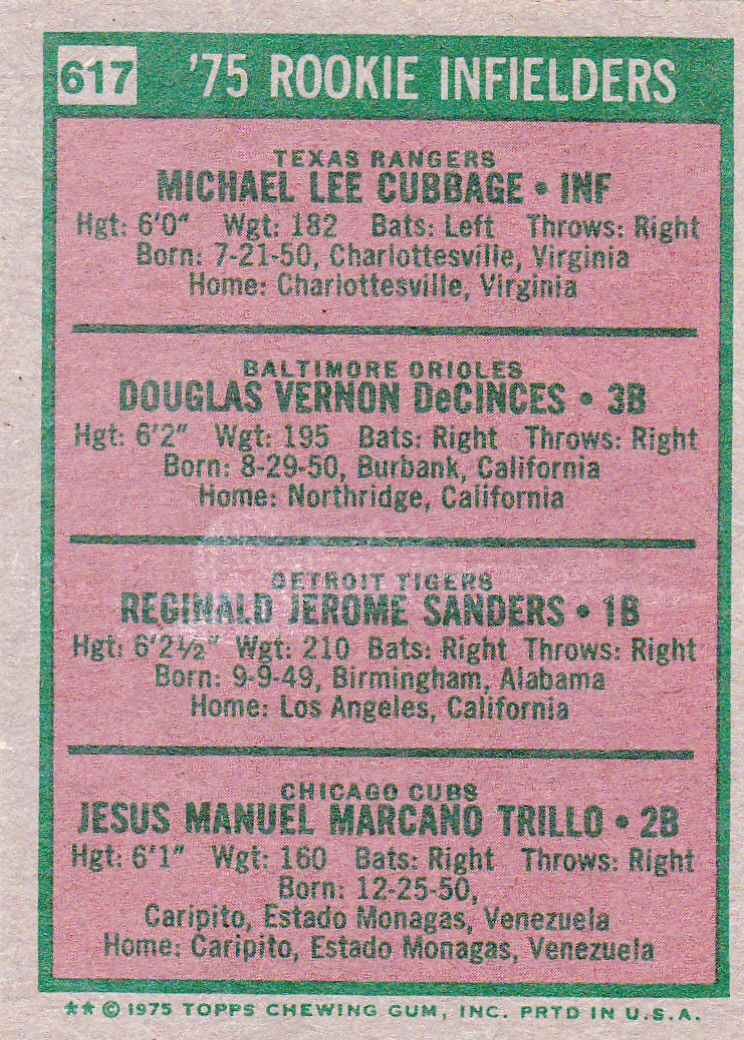
#617 - 1975 Rookie Infielders
Card fact: You never knew Reggie Sanders played for the Tigers, did you? But it's not that Reggie Sanders.
What I thought about this card then: Did not see it.
What I think about this card now: Manny Trillo is not wearing a live Cubs hat. It is most likely an airbrushed A's cap.
Other stuff: Each player's first solo Topps card:
Mike Cubbage, Rangers: 1976 Topps
Doug DeCinces, Orioles: 1976 Topps
Reggie Sanders, Tigers: no solo card. His career lasted 26 games in 1974. He died in 2002.
Manny Trillo, Cubs: 1976 Topps
Most successful player: Toss-up between Doug DeCinces and Manny Trillo. DeCinces played 19 seasons in the majors and hit 237 home runs. Trillo played 17 seasons, was an All-Star for the Cubs and Phillies and had a great 1980 NLCS.
DeCinces was just in the news last week for a bit of ugliness.
Most awesome middle name: U.S.-born players are so boring. Have to go with Manuel Marcano.
Other blog stuff: On this date in 1975, actress Charlize Theron was born. The world would never be the same.
Sunday, June 12, 2011
#567 - Jim Sundberg
Card fact: This is Jim Sundberg's rookie card.
What I thought about this card then: I didn't see a Sundberg card until his 1977 Topps card.
What I think about this card now: Sundberg was one of those guys who seemed to look the same no matter what year it was or how long he had been in the majors. Unchangeable.
Other stuff: When I was a kid, I would only hear about Sundberg from TV broadcasters. The Rangers were never on TV, except when they played the Yankees. But during the Game of the Week and This Week in Baseball, I would hear about the catcher from Texas being one of the best catchers in the game. I'm sure Joe Garagiola, who always talked up catchers, mentioned him a lot.
Sundberg is known as one of the best defensive catchers to have played the game. He played from 1974 to 1989 and won six straight Gold Gloves between 1976-81. Sundberg was a fairly decent hitter, especially during the peak of his career. He tailed off offensively in the early '80s.
The Rangers dealt him to the Brewers after the '83 season. Then Sundberg was traded to the Royals ahead of the 1985 season. He was the primary catcher for Kansas City when they won the World Series. Sundberg later played for the Cubs and the Rangers again.
After his career, he was a TV broadcaster and now works as a VP of public relations for the Rangers.
Back facts: One of the longer write-ups that you'll see in the set. Topps was really tested by guys who had just a year or two in pro ball.
Other blog stuff: While looking up "on this date" items, I always come across airplane crashes. Plane crashes, I have noticed, don't happen nearly as often as they did when I was growing up. It used to be commonplace in the '70s and even '80s to read about large plane crashes maybe 7-8 times a year, many of which happened here in the U.S. I've done absolutely no research on this, but they don't seem to happen nearly as often anymore, which is terrific. I don't remember this being publicized -- I'm sure some airline has, though.
Sorry about that detour. Baseball-reference is acting loopy and that's the best that I could do.
Wednesday, May 18, 2011
#542 - Pete Broberg
Card fact: This card marks the debut of Pete Broberg's mustache. It rises to spectacular levels on his 1976 Topps card, but is never the same after that. Some of his latter cards feature him sans mustache or with a more modest one.
What I thought about this card then: I had the mini card. Like all of the Rangers cards, I thought it was great. Rangers cards with players who had mustaches were doubly great.
What I think about this card now: Still a terrific card. The batting cage in the background adds something extra.
Other stuff: Broberg was a pitching star for Dartmouth College who went straight from college ball to the major leagues with the Washington Senators. He spent two years with Washington and Texas before he was sent down for the 1973 season.
He was back in business in the majors in 1974, although barely (with an 8.07 ERA in 12 games), but a trade to Milwaukee revived him. In his best season in 1975, he went 14-16 with a 4.13 ERA. He played another rocky season for the Brewers, then another one for the Cubs, before ending his career with a 10-12 mark with Oakland in 1978. He was signed by the Dodgers for the 1979 season but released before he got a chance to play for them.
After his career, Broberg went to law school. He's been a practicing attorney in Florida for the last 20-plus years.
Back facts: Well, there's the last minute addition of Broberg's trade to the Brewers at the end of the write-up. I never realized there were so many of those in this set until I did this blog.
Also, Sven is a tremendous middle name.
Other blog stuff: RIP, Mr. Killebrew.
Saturday, April 23, 2011
#518 - Leo Cardenas
Card fact: This is the second-to-last Topps card of Leo Cardenas issued during his career. Topps listed Cardenas by his nickname "Chico" during the first part of his career. He was "Chico Cardenas" on his cards from 1961 through 1969. Then, Topps listed him as "Leo Cardenas" from the 1970 set through 1976.
What I thought about this card then: Never saw it. It was decades before I knew who Cardenas was. I'm still not entirely clear.
What I think about this card now: The batting cage is the star of the show in this photo, isn't it?
Other stuff: Cardenas was a starting shortstop mostly with the Reds and Twins. He still has a connection to the city of Cincinnati, making regular appearances at club functions. He enjoyed his best seasons with the Reds and was a four-time all-star there. He won a Gold Glove in 1965.
Cardenas was traded to the Twins on Nov. 21, 1968. He played there through the 1971 season and was a regular part of the Minnesota A.L. West champion teams of the late '60s/early '70s. He closed out his career with the Angels, Indians and Rangers.
Back facts: Pretzel Pezzulo (not "Pretzels") was a pitcher for the Phillies in 1935 and 1936. All but one of his 42 games pitched came in 1935 when he was 3-5 in 84 innings pitched.
Other blog stuff: The pink-yellow border combo is now just one card away of catching the orange-brown combo for the No. 1 spot. Can you feel the excitement?
Sure you can.
Saturday, April 16, 2011
#511 - Rangers/Billy Martin
Card fact: Let's see if I can convince myself that Billy Martin is wearing Rangers garb in the inset photo. He is airbrushed into a Rangers cap in the 1974 set. This cap looks more realistic, but the jersey almost looks like a road Twins jersey. Martin was manager of the Twins in 1969, but I don't believe he had facial hair at the time. And why would Topps drag out a five-year-old photo of Martin, especially when he managed the Tigers from 1971-73? So I'm saying Martin is definitely wearing a Rangers get-up.
What I thought about this card then: Just like the last team card featured, the Astros, I had this card in mini form. No thoughts other than it was itty-bitty.
What I think about this card now: The Lone Star scoreboard rules. Also, I believe Jim Bibby and Fergie Jenkins are book-ending the back row. They always grow pitchers bigger.
Other stuff: The Rangers had their first real encounter with contention in 1974, thanks to Martin's first full season with the team. Texas finished second in the A.L. West after being dead last in 1972 and 73. The Rangers were third in 1975, but Martin didn't make it to the end of the season. He was fired when the Rangers got off to a 44-51 start.
Back facts: There is not one thing out of place on this checklist. No misspellings, players out of order, unlisted players. Nothing. Probably not the first one in the set, but there's probably only been 5 or 6.
Other blog stuff: Here is where we see how well Topps represented the 1974 Texas Rangers.
The Rangers used 38 players to get out of the basement in 1974. Topps featured cards of 25 of those players. That includes Alex Johnson, who is airbrushed into a Yankees cap in the 1975 set. Nobody significant from the team was overlooked. Catcher Duke Sims, at the end of his career, had the most at-bats of players not featured with 118. There were an awful lot of fringe players on the team, though.
So that puts Texas at 65.8 percent, which is in the bottom third of the list so far:
1. Twins 81.25% of players featured
2. Tigers 78.37%
3. Orioles 78.13%
4. Dodgers 74.29%
4. Astros 74.29%
6. Giants 71.43%
7. Indians 71.11%
8. Royals 70.59%
9. Red Sox 70.27%
10. Angels 68.89%
11. Expos 68.29%
12. Brewers 66.67%
13. Rangers 65.79%
14. Cardinals 65.12%
15. White Sox 65.0%
16. Phillies 62.5%
17. Mets 62.16%
18. Pirates 61.5%
19. Padres 55.8%
Monday, March 28, 2011
#493 - Don Stanhouse
Card fact: Don Stanhouse returns to Topps after sitting out the '74 set. He made his debut in the 1973 set.
What I thought about this card then: I never saw it.
What I think about this card now: Good god, look at that mustache. How in the hell did he feed himself?
Other stuff: Stanhouse became remembered as the closer for the 1979 World Series finalist Baltimore Orioles. But before his time with Baltimore, he served as both a starter and reliever for the Rangers and the Expos.
Stanhouse was an all-around star athlete in high school and began his career as an infielder. He didn't have great success with the Rangers and was shipped to Montreal in the Willie Davis deal prior to the 1975 season. After a year of inactivity, Stanhouse enjoyed a decent 1976, starting 26 games and going 9-12. The following year, Montreal switched him to the bullpen and Stanhouse responded with his best season, going 10-10 with 10 saves.
Baltimore than acquired him and Gary Roenicke in a deal that sent Rudy May and Bryn Smith to the Expos. Stanhouse was installed as a full-time reliever and quickly became known for his flaky behavior. He had an unsual pitching delivery in which he held the ball forever before sending it to the plate. Hitters hated it. He was nicknamed "Stan the Man Unusual" and "Fullpack" because manager Earl Weaver would go through a pack of cigarettes while watching Stanhouse work himself in and out of jams on the mound.
I remember broadcasters yukking it up as TV showed Weaver hiding in the hallway between the dugout and the clubhouse, sneaking a cigarette because he couldn't stand to watch Stanhouse pitch.
After the 1979 season, the Dodgers acquired Stanhouse in its first big entry into the free agent market. Stanhouse hurt his back and tanked, with an ERA over 5.00 in 1980. He didn't even pitch for L.A. in 1981. He came back to Baltimore for a season in 1982, but struggled again and his career ended.
Stanhouse is now a venture capitalist and an entrepreneur, married for almost 30 years and the father of three grown children. And the mustache is gone.
Back facts: I don't know why they didn't use this cartoon on Dave Nelson's card.
Other blog stuff: This is just the 16th yellow-green bordered card. That is four fewer than the next lowest border color total.
Friday, March 4, 2011
#470 - Jeff Burroughs
Card fact: This card recognizes the first time a Texas Ranger started in the All-Star Game. Burroughs was selected to start in 1974 and played left field for the American League.
What I thought about this card then: My brother had the mini card, and I'm quite sure it was the whole reason why he liked the Rangers so much in his early days of collecting. We both treated this card as something precious, and I'm sure I was jealous that my younger brother had such a cool card.
What I think about this card now: Burroughs is not wearing glasses on this card or in his 1976 Topps card. But he is wearing them on the 1974 Topps card that is also featured in the 1975 Topps MVPs subset.
Later, Burroughs is pictured wearing glasses almost exclusively while a member of the Atlanta Braves. As a kid, I considered the glasses-wearing Burroughs as a different person than the non-glasses-wearing Burroughs. I thought of the glasses-wearing Burroughs as inferior, which was inaccurate on my part since in his two best years -- 1974 and 1977 -- he is wearing glasses on his cards.
Other stuff: Burroughs was a No. 1 overall pick of the Washington Senators in 1969. He was always considered a strong hitter, and he showed it when he became the first Ranger to win the MVP award in 1974. After that seasons, Burroughs' average plummeted and he was dealt to the Braves in 1976 for five players that didn't amount to much for Texas.
With the Braves, Burroughs slammed his way through two good seasons (he hit 41 home runs the same year George Foster hit 52) before running out of steam. His at-bats decreased, he was dealt to Seattle, and he operated as a part-time player with the Mariners, A's and Blue Jays.
Burroughs later became known as the Little League coach for his son, Sean Burroughs, who as a former top prospect had a mediocre major league career, mostly with the Padres. Sean reappeared with the Diamondbacks in the 2011 season.
Back facts: I missed posting on Burroughs' birthday by three lousy days.
Other blog stuff: Let's add Burroughs into the American League lineup for the 1974 All-Star Game:
AL
1B - Dick Allen
2B -
3B - Brooks Robinson
SS - Bert Campaneris
OF - Bobby Murcer
OF - Jeff Burroughs
OF -
C - Carlton Fisk
P -
NL
1B - Steve Garvey
2B - Joe Morgan
3B - Ron Cey
SS - Larry Bowa
OF - Hank Aaron
OF - Pete Rose
OF -
C - Johnny Bench
P - Andy Messersmith
Thursday, January 27, 2011
#435 - Dave Nelson
Card fact: Here is another one of the set's weaker excuses for a player getting a card number ending in "5." Nelson hit .236 for Texas in 1974.
What I thought about this card then: This is one of the most prominent cards in the entire set in terms of evoking memories from that first year of buying and collecting cards. The Nelson card was obtained in a pack purchased late at night (it was probably around 8 in the evening, but it seemed like late at night to me) at a drug store. I had been sick and gone to the emergency room. It couldn't have been too serious because my dad took me to the store for a little cheering up (and no doubt to get a prescription filled). Nelson is the only card I clearly remember pulling out of that pack, but it became one of my favorites out of the whole set.
What I think about this card now: There are so many spring training shots in this set, that a photo obviously taken prior to a game really stands out.
Other stuff: Nelson was a speedy second baseman for the Indians, Senators/Rangers and Royals from 1968-77. His real emergence in the majors came after he was traded from Cleveland to Washington and then after the Senators moved to Texas. In 1972 and '73, Nelson became one of the top base-stealing threats in the American League. He was second in the league in stolen bases in '72 and third in '73.
By today's standards, Nelson accumulated a few too many CS's and also didn't get on base as often as you'd like for a lead-off guy. After back-to-back down years, the Rangers sent Nelson to the Royals for Nelson Briles. That's right, one Nelson for another Nelson. Dave Nelson played for K.C. in '76 and '77.
After his playing career, Nelson coached and worked in the minor leagues for a variety of teams. He also dabbled in broadcasting, which led him to his current career, working Milwaukee Brewers games for FSN.
(EDIT: Nelson died at age 73 on April 23, 2018).
Back facts: The trivia question in this cartoon was one of the first that I ever absorbed. I've known about that Dodgers' switch-hitting infield all of my collecting life. Also, because of the way the bats are drawn in the cartoon, I thought the baseball player was carrying two shovels.
Other blog stuff: Here is the card that I pulled out of that pack while fresh out of the hospital:
Tuesday, January 4, 2011
#412 - Bill Hands
Card fact: Bill Hands is airbrushed into a Rangers cap. You can see he is still wearing his Minnesota Twins jersey. He seems none too pleased about the entire situation.
What I thought about this card then: I remember my brother having this card. We were struck by the look on Hands' face. He looked so angry.
What I think about this card now: Hands has about the same look on his face on his 1976 Topps card. They are the only cards in which he is featured as a Ranger. On all his other cards, he doesn't appear nearly as cranky. Coincidence? Did a Texas Ranger kill his father? We may never know.
Other stuff: Hands toiled in the minors for almost a decade before getting called up to the majors. In a big break, he was traded from the Giants to the Cubs. He became a key part of the Cubs' pitching staff of the late 1960s and won 20 games for the 1969 Cubs, the team that blew the pennant to the Miracle Mets.
Hands continued as a regular starter until he was traded to the Twins after the 1972 season. He played two years for Minnesota, then was acquired by the Rangers in 1974, where he finished out his career. After baseball, he worked in the oil business. He now lives on Long Island.
(EDIT: Bill Hands died on March 9, 2017).
Back facts: Hands actually wasn't deal to the Rangers. The Twins waived him and the Rangers picked him up. But you can see that the date on which it happened probably threw Topps into a panic. Therefore, the crazy airbrushing.
Other blog stuff: Only one player in the set is celebrating a birthday today. It is Tito Fuentes, who is 67. His card happens to be arriving fairly soon. Rats, I barely missed out on a birthday posting yet again.
Sunday, December 5, 2010
#387 - Jim Spencer
Card fact: It's been a dozen cards since we last saw a bat pictured on one of these cards. That's just too long if you ask me.
What I thought about this card then: Never saw it.
What I think about this card now: Jim Spencer looks like he could fill out a cap.
Other stuff: Spencer started out as the regular first baseman for the California Angels in the early 1970s. He was know for his glove -- he won two Gold Gloves -- and could hit a little. He was traded to the Rangers where he started DHing, then went to the White Sox in the Bill Melton deal.
It was during that time that I discovered Spencer. He was part of the Southside Hitmen team, although a relatively small part. But he had 18 home runs in 1977 and I was really annoyed when he was traded to the Yankees for virtually nothing. Spencer played in the postseason for the Yankees in the 1978, 1980 and 1981, and I no longer liked him.
He finished his career with Oakland in 1982. Spencer died of heart attack in 2002.
Back facts: According to baseball-reference, Richard Darwin Miller was actually Ralph Darwin Miller. He played in 1898 and 1899 for Brooklyn and Baltimore.
But he's not the only major leaguer to have reached 100 years of age, according to several sources, including this one, which says there have been at least 15 major leaguers to live to be 100. Tony Malinosky, who played a single season for the Brooklyn Dodgers in 1937, is believed to be the only living major league centenarian.
Other blog stuff: On this date in 1978, Pete Rose left the Cincinnati Reds to sign with the Phillies.
Friday, November 5, 2010
#362 - Steve Hargan
Card fact: This card marks Steve Hargan's return to the Topps set after a three-year absence. His previous Topps card was in the 1972 set. He had a card ever since 1966, but he fell into rough times in the early '70s.
What I thought about this card then: This is what a Texas Ranger should look like, and Hargan is probably one of the reasons why I think all the Rangers should have wild hair and a mustache. This was one of the early cards I received in that first year of collecting and I thought Hargan was at least 8-feet tall. Later, I saw his 1968 Topps card for the first time, and I couldn't believe it was the same person.
In fact, Hargan is also clean-shaven in his 1972 card, too. That was right before he "went away" for two years. By "went away" I mean he toiled in the minor leagues, but given his drastically changed look doesn't it seem like he did hard time?
What I think about this card now: It looks like his uniform shirt is untucked. I hate that Prince Fielder crap. Tuck your shirt in mister.
Other stuff: Hargan was a steady but unspectacular starter for the Indians during the 1960s. In 1970, he went 11-3 for Cleveland with a 2.90 ERA. But the following year, he was a dreadful 1-13 with a 6.19 ERA. He struggled early in 1972 and was sent to the minors for two years.
During that time, he was acquired by the Rangers. He bounced back in 1974 with a decent season, then had two so-so years before getting drafted by the expansion Blue Jays. He finished up his major league career with Atlanta in 1978.
(EDIT: Steve Hargan died at age 83 on Oct. 30, 2025).
Back facts: I'm quite sure I didn't take the cartoons literally when I was a youngster, otherwise I would be really freaked out that there was a scoreboard that actually EXPLODED.
Other blog stuff: I'll just take a moment to remember Mr. Anderson:
RIP, Sparky. I think your enthusiasm and positive attitude will continue to serve you and your family well.
Wednesday, October 13, 2010
#339 - Jim Fregosi
Card fact: You're looking at one of my brother's first favorite cards. It's among the first cards he ever owned, if not THE first, and it's the main reason why he and I liked the Rangers when we were youngsters.
What I thought about this card then: I associate it with my brother. There was a time when his favorite team was a tie between the Red Sox and the Rangers. That's long behind him, though.
What I think about this card now: The card had kind of mystical, hazy feel when I was a kid. I don't know how else to explain it. But looking at it as an adult, it seems like a boring old batting pose. All the mystery is gone.
Other stuff: Jim Fregosi started out as one of the first stars of the Los Angeles Angels. During the 1960s, Fregosi was a regular All-Star, winning five straight selections. His hitting was respectable for the time, although nothing great now. He hit for the cycle twice. He could also field and was the Angels' regular shortstop throughout the 1960s.
Fregosi then became the answer to a trivia question as the player who was traded to the Mets for Nolan Ryan in December 1971 (the Angels also received three other players). Fregosi was a bust, suffering through injuries during his time with the Mets, who allowed him to be purchased by the Rangers in the middle of the 1973 season. From there, Fregosi was a role player with Texas and then Pittsburgh.
Immediately upon his departure as a player in 1978, he found instant success as manager. He led the Angels to the American League West title in 1979. But he couldn't repeat that success, and his next few teams struggled. A stint with the White Sox yielded only a series of fifth-place finishes. But he made it to the World Series as the manager of the Phillies in 1993. He later briefly managed the Blue Jays and is now a scout for the Braves.
(EDIT: Fregosi died at age 71 on Feb. 14, 2014).
Back facts: I've had a heck of a time finding this card without crooked borders. Every time I look for an upgraded Fregosi card, the borders are off. I've upgraded enough times so the front of the card doesn't look terrible, but the back is WAY off.
Also, the cartoon question is a bit confusing: "What was Lefty Grove's name?" Well, I think you just mentioned it there, son.
Other blog stuff: You may have noticed I posted a Rangers card immediately after the Rangers clinched a spot in the ALCS. Did I do that on purpose? Nope. But it does give me an opportunity to say: GO RANGERS.
It's the only team left that I actually wanted to advance.
Saturday, September 18, 2010
#316 - Jackie Brown
Card fact: Surprisingly, even though there have been 82 players with the last name of "Brown" in the major leagues, this is one of just two players named Brown in the set. Two other players with that last name retired the year before this set came out.
What I thought about this card then: I've mentioned before how my brother and I liked the Rangers a lot in 1975. This was probably the most favorite of those Texas cards. I'm not sure why, but if I was pressed for a reason, I'd have to say it's the chaw in Jackie Brown's mouth. Yes, as kids, we were impressed by dirty, disgusting habits.
What I think about this card now: Well, other than being pleased that I can add a third person to the chaw list, the photo is rather disturbing if you stare at it a while. Brown has a glazed-over look on his face with the chaw jutting from his cheek. He looks like he's been zombified.
Other stuff: Brown was mostly a relief pitcher for seven seasons with the Senators, Rangers, Indians and Expos. The only seasons he did a lot of starting were in 1974 with the Rangers, '76 with the Indians and '77 with the Expos. His 1974 season was his best as he set several personal highs in stats, starting 26 games and winning 13 with 134 strikeouts.
After his playing career, Brown worked as a pitching coach for a number of major and minor league organizations.
Brown's brother, Paul, pitched in the majors in the early 1960s for the Phillies, the same team that signed Jackie.
(EDIT: Jackie Brown died on Jan. 8, 2017).
Back facts: Whether Topps did this by accident or on purpose, I like that the cartoon is about a "cowboy" on the back of a Rangers card. James Winford was a pitcher with a modest career in the 1930s with the Cardinals. He also played two games for the Brooklyn Dodgers.
Other blog stuff: Here is the mini card that I pulled when I was a kid, featured next to the regular-sized card. I have no idea what I got on the card to create that blotch to the left of Brown's head. If we were pretending to chew tobacco and then spitting stuff on the card in imitation of Brown, I wouldn't be the least bit surprised.
Monday, August 16, 2010
#283 - Steve Foucault
Card fact: There aren't too many cards in the set where the border colors match the team colors as well as this one. ... Yeah, I know, that's an opinion. I don't care.
What I thought about this card then: I've mentioned before that my brother and I liked the Rangers cards as kids. I had this card in mini form and it was probably my most favorite Rangers card. I'm not sure why. Maybe it's the fact that the colors match or maybe because Steve Foucault resembled a much younger version of my grandfather.
What I think about this card now: I have never known how to pronounce Foucault's name. As kids, we went around calling him "Fo-cat." I'm sure that's not right, but it has stuck in my brain all these years and that's what I call him. Not that his name comes up a lot.
Also, Foucault is clean shaven in his 1974 card -- his first card. Then, suddenly, he appears with plenty of facial hair on his 1975 card.
Other stuff: Foucault was a pure reliever in the majors. He pitched in 277 games in his six-year career and did not start a single one. He enjoyed probably his best season in 1974 with a 2.24 ERA, but was still effective for the next three or four years. He was traded to the Tigers for Willie Horton, had one good year for the Tigers, then was waived by Detroit in mid-season the following year. The Royals picked him up for a few games, and Foucault's major league career ended in 1978.
He is now a pitching coach for an independent league team in Evansville, Indiana.
Back facts: I'm hoping that ball hit the ump in the stomach.
Other blog stuff: Here is big Foucault and little Foucault:
Monday, July 19, 2010
#259 - Len Randle
Card fact: Even though Randle did not have more than 250 at-bats in a single season until 1974, this was already his fourth Topps card.
What I thought about this card then: Well, I had the mini card and what a fantastic card it was/is. I don't think it ever crossed my mind to think what he was doing. If I had, I probably could have figured out it wasn't anything good.
What I think about this card now: Damn, Randle is disgusted! What did he just do? Did he foul out? Strike out? Get his pitch but not hit it square? I suppose he could be yelling in pain, but with his bat position it looks like he's reacting to a swing. It's certainly an interesting card photo.
Other stuff: Randle reached the majors in quick fashion, never playing lower than Triple A. He switched between the minors and majors until 1974, when he had a solid season playing at a variety of position. He was a regular starter from that point, but all hell broke loose in 1977.
Randle had been the regular second baseman until that point. But the Rangers went with rookie Bump Wills as the starter in spring training. During a meeting with manager Frank Lucchesi, Randle punched Lucchesi in the face, breaking the manager's jaw. Randle was fined and suspended 30 days and then traded to the Mets before his suspension ended.
I remember reading about this incident in the newspaper as a kid. I was too young to know about the Swingin' A's inter-team squabbles and fights. Instead, the Lucchesi-Randle incident, the Sutton-Garvey locker room fight, and the Martin-Jackson yelling match in the dugout were my introductions to the fact that players on the same team don't always get along.
Randle played for the Mets a couple of years, landing on another fantastic baseball card in the 1978 set. He also played for the Yankees, Cubs and Mariners. It was with Seattle in 1981 that he made "This Week in Baseball" immortality when he got on his hands and knees and attempted to blow foul a ball hit by Amos Otis.
(EDIT: Lenny Randle died at age 75 on Dec. 29, 2024).
Back facts: Wow, that's a violent cartoon. Could Topps have known about Randle's future outburst?
Randle also made my all-middle name team. Completely made up of 1975 cards, of course.
Also, how often does the word "spry" make the back of a baseball card?
Here are the regular-sized card and the mini card side-by-side. I scanned them a little crooked unfortunately. As you can see, the mini I pulled out of a pack back in '75 had issues. So many miscut cards back then!
Other stuff: The No. 1 song in the country on this date in 1975 was "Listen to What the Man Said," by Paul McCartney and Wings. This man says, "my vacation is over." But there's another one coming in a week! Woo-hoo!
Saturday, June 19, 2010
#234 - Tom Grieve
Other blog stuff: Birthday greetings to former Dodger, current Dodger broadcaster and baseball card blog reader Jerry Reuss. He is 61 today.
Friday, April 23, 2010
#178 - Cesar Tovar
What I thought about this card then: This was the first card that my brother ever pulled from a pack of baseball cards. Now that I think of it, it is the reason why Texas was his second favorite team as a kid. The card looks strange without scuff marks, because I saw it in its worn state so much when I was young.
What I think about this card now: The card border is crooked. It's a constant problem with '75 Topps.
Other stuff: The first thing I think of when I hear Cesar Tovar is that he is one of four players to play every position in one game. He did it against Oakland in 1968.
Tovar was known for his versatility. He was a valuable member of the Twins' teams of the late 1960s and early 1970s, playing at least 150 games a season, but not necessarily having a primary position. He received AL MVP award votes five consecutive seasons.
Tovar died in 1994. He is in the Venezuelan Baseball Hall of Fame.
Back facts: Back-to-back cards with cartoons featuring a catcher. I've written before about my feelings concerning left-handed catchers.
Other blog stuff: Valerie Bertinelli is 50 years old today. Damn.
Monday, March 29, 2010
#155 - Jim Bibby
What I thought about this card then: Jim Bibby was a Ranger, and we held the Rangers in high regard in my house for inexplicable reasons. I believe Bibby was one of the first Rangers cards that we ever saw. He had the mustache and the hair going, so he was definitely a cool cat.
What I think about this card now: Still a classic card. One of the better ones in the set in my opinion.
Other stuff: Bibby just died last month so his career has been mentioned quite a bit lately. Bibby was a hard-throwing right-hander, who was signed out of college by the Mets, but known mostly for his time with the Pirates. He was a starter for the 1979 World Series champions and the starting pitcher for the National League in the 1980 All-Star Game. He went 19-6 for the Pirates that year.
Bibby also threw a no-hitter against the A's when he pitched for the Rangers. In the early stages of his career, he spent two years of active duty in the Army and was a truck driver in Vietnam.
Bibby is one of six members of the 1979 Pirates who have died. The others are Willie Stargell, John Milner, Bill Robinson, Dave Roberts and Dock Ellis.
Back facts: I wasn't aware that Bibby came up with the Cardinals until reading the back of this card. I just looked up his rookie card from 1972. It's one that he shares with two other players. It's rather comical. It's obvious he's wearing a pinstriped Mets jersey, but his cap is airbrushed bright red.
Other blog stuff: Former Brewers closer Danny Kolb was born on this date in 1975. He had a great season in 2004, then imploded when acquired by the Braves in 2005. Never the same after that.
Wednesday, March 3, 2010
#131 - Toby Harrah
Card fact: The only player with a palindrome name (reads the same forward and backward) in the set. Later, collectors would be graced with Mark Salas and Robb Nen.
What I thought about this card then: I did not see it. But, later, I saw the 1976 Toby Harrah card. Like, the '75 card, Harrah was sans mustache and it didn't look right. Because this is the way I was used to Harrah looking:
You can't top that card. It's fantastic.
What I think about this card now: The man needs a mustache.
Other stuff: Harrah was one of my favorite players of that time period. I was a bit disappointed when he was traded to the Indians for Buddy Bell, because I liked the Rangers quite a bit. But that didn't compare to the disappointment that I felt when he was traded to the Yankees in 1984. Fortunately, he lasted just a year with New York.
Harrah was a fine infielder who was known for his great batting eye. He was also the last active player to have played for the Washington Senators, beginning his major league career in 1969.
Back facts: I know for a fact Rizzuto was still being called "Scooter" at the time this card was issued. No need for past-tense in the cartoon.
Also, I like the reference to Colbert Harrah's "good humor" in the write-up.
Other blog stuff: I mentioned I would call this the "ketchup-mustard" color combo, but I never recorded it on the sidebar. It is now officially recorded.