Showing posts with label Reds. Show all posts

Thursday, September 22, 2011

#656 - Bill Plummer


Card fact: We're getting down to the wire here. This is the last card featuring a photo of a player posing with a bat.

What I thought about this card then: I never saw it.

What I think about this card now: I upgraded this card a year or so ago after being blissfully unaware that there was a significant crease running through the right side of the card. This card has a little ding at the top, but I'm much happier with it.

Also, on many of Plummer's cards, he's featured with a major chaw in his cheek. I'm disappointed that isn't displaying one on this card.

Other stuff: Plummer spent most of his major league career as a back-up to Johnny Bench. He filled in for Bench between 1972-78. Plummer was your typical good-field, no-hit backup backstop. He finished with a career .188 batting average after 367 games between 1968-78.

Plummer played his final season with the Mariners in 1979. He then went into coaching in the Seattle organization. He later worked as a third base coach for Seattle, then managed them for a year in 1992 before the Mariners hired Lou Piniella.

Plummer went on to manage in independent leagues (he managed a player from my area, and I had planned to talk to him about the player. But the player was notorious for not wanting to talk about himself, so the story never happened and I never talked to Plummer). He is now an instructor in the Diamondbacks organization.

(EDIT: Bill Plummer died at age 76 on March 12, 2024).


Back facts: The write-up reads like an explanation as to why Topps is giving Plummer a card.

Other blog stuff: Dodger blue legend Tommy Lasorda was born on this date. He is 84 years old.

Tuesday, August 16, 2011

#622 - 1975 Rookie Outfielders


Card fact: The Cincinnati Reds are abbreviated as the "Cinn. Reds" on this card. Apparently someone thought they were the "Cinnamon Reds."

What I thought about this card then: Didn't see it.

What I think about this card now: This was the toughest of the rookie cards for me to obtain and one of the toughest cards in the whole set to finally land. No one likes giving up their Fred Lynn rookies. That's why this one is off-center, miscut and there's a weird printing flaw next to Lynn's head.

The funny thing is I found another version of this card in a rummage sale a couple years ago. It's in similar shape -- maybe slightly better -- and I've replaced this card with the rummage sale one.

Other stuff: Each player's first solo Topps card:

Ed Armbrister, Reds: 1976 Topps
Fred Lynn, Red Sox: 1976 Topps (with the rookie cup!)
Tom Poquette, Royals: 1977 Topps (with the rookie cup!)
Terry Whitfield, Yankees: 1978 Topps

Most successful career: Lynn was a huge favorite in Boston, my brother's favorite player, an MVP his rookie year, and hit more than 300 career home runs.


Most awesome middle name: As intrigued as I am about what a land of Berts might look like, I have to go with "Rosanda." It sounds like something you'd get tattooed on your chest underneath a giant heart.

Other blog stuff: A happy 81st birthday to former Monday Night Football announcer Frank Gifford.

Monday, August 15, 2011

#621 - 1975 Rookie Pitchers


Card fact: This is the first of the rookie cards to feature a player who never made the majors. Juan Veintidos was featured here on the strength of his 14-5 record in the minors in 1974, but he never got the call in 10 minor league seasons.

What I thought about this card then: If it's an orange-yellow bordered rookie card then I never saw it.

What I think about this card now: Veintidos appears to be the happiest of the four, yet he didn't enjoy the success of the others. I guess you had to be cold and ruthless to succeed as a major league pitcher in 1975.

Other stuff: Each player's first solo Topps card:

John Denny, Cardinals: 1976 Topps
Rawly Eastwick, Reds: 1976 Topps
Jim Kern, Indians: 1977 Topps
Juan Veintidos, Twins: no solo card

Most successful career: Both Eastwick and Kern got off to quick success as relief pitchers, Eastwick becoming a force for the Big Red Machine in the '75 World Series, and Kern wowing Cleveland fans with his arm and quirky behavior. But each faded almost as quickly. I'm going with starter John Denny, who pitched 13 fairly consistent seasons and won the Cy Young for the National League champion Phillies in 1983.


Most awesome middle name: Jackson is not as awesome as Rawlins, but there's not much to go on here.

Other blog stuff: For those of you who spend all of your time in vintage cards and vintage only, I would be remiss if I didn't mention that there is a new set out this month that pays tribute to the 1975 Topps minis. Current and past players are featured on mini cards that are similar in size and look to the '75 minis. They are inserted randomly into packs of 2011 Topps Lineage.

Unfortunately, the backs do not feature the '75 backs we all know and love. And the cards are made from that same slick crap that has plagued the Topps base set for the last decade. But I appreciate the thought by Topps and am trying to collect as many as I can. I owe it to my 9-year-old self.

Friday, August 5, 2011

#615 - 1975 Rookie Pitchers


Card fact: We've got back-to-back "rookie pitchers" cards here. Unlike the previous one, I believe everyone is wearing a non-airbrushed cap.

What I thought about this card then: Never saw it.

What I think about this card now: Hank Webb looks like he's just spotted the team mascot that has always freaked him out.

Other stuff: Each player's first solo card:

Pat Darcy, Reds: 1976 Topps
Dennis Leonard, Royals: 1976 Topps
Tom Underwood, Phillies: 1976 Topps (with a rookie cup!)
Hank Webb, Mets: 1976 Topps (his only solo Topps card)

Most successful player: Dennis Leonard was a three-time 20-game winner who won three postseason games. Tom Underwood, who died in November 2010, pitched for 11 seasons.


Most awesome middle name: Gaylon Matthew proves that more is better. Also, how cool is it that two players on this card have "Patrick Leonard" in their name?

Other blog stuff: On this date in 1975, the first seven Phillies who come to bat in a game against the Cubs get a hit against starter Bill Bonham to set  a major league record. Mike Schmidt hit a home run to make it 5-0 and send Bonham to the showers. The next batter, Johnny Oates, proceeds to single for the eight straight hit. Pitcher Dick Ruthven's sacrifice bunt is the first out.

Saturday, July 23, 2011

#602 - John Vukovich


Card fact: John Vukovich is airbrushed into a Reds cap. He was traded from the Brewers to the Reds on Oct. 22, 1974.

What I thought about this card then: I never saw it. In fact, I didn't even know Vukovich existed until his final card, from 1981 Fleer. By then his career was a matter of at-bats from being over. Also, I thought he was Brewers pitcher Pete Vukovich's brother for a long time. They are not related.

What I think about this card now: The two Vukovichs don't look alike at all. I don't know what I was thinking.

Other stuff: Vukovich is associated mostly with the Phillies. He came up to the majors with Philadelphia and spent 1970, 1971 with the team. After two years with the Brewers and one with the Reds, he returned to the Phillies and stayed there the rest of his career.

Actually, he rarely played for Philadelphia the second time around. But the fans liked him.

After his career, he became a coach, mostly with the Phillies, even serving as interim manager for Philadelphia in the late '80s. His coaching career lasted almost two decades, despite being diagnosed with a brain tumor in 2001.

Vukovich remained a coach through 2004. Despite surgery back in '01, he became ill again in 2006 and died at age 59 in 2007.


Back facts: It is almost painful when I see high school exploits brought up in the card bios of major leaguers.

Other blog stuff: The orange-brown border color combination reties the green-light green border combo for the overall lead with its 51st card.

Tuesday, June 28, 2011

#581 - Darrel Chaney


Card fact: Darrel Chaney is one of only two major leaguers to spell his first name like that. The other is Darrel Akerfelds, a pitcher for the Phillies and Indians, among other teams. I know this is a player fact, not a card fact. But it's all I've got.

What I thought about this card then: I didn't see it. But my brothers and I were absolutely horrified by his 1976 Traded card. Mercy.

What I think about this card now: This was one of my more beat-up cards in the set at one point. I've upgraded, but there's still an annoying streak going down the right side of the card.

Other stuff: Chaney was known as a good-glove, no-hit infielder for the championship Cincinnati Reds. He mostly backed up shortstop Dave Concepcion, who knew a thing or two about fielding himself.

After serving in Vietnam in the late '60s, Chaney played seven seasons with the Reds, appearing in three World Series and winning one. He was dealt to the Braves after the '75 Series and enjoyed his first season as a starter at shortstop. He did fairly well in '76, but couldn't hold on to the starter's role. After 3 more years, he was released by the Braves in '79.

Chaney later did some broadcasting work with Atlanta.


Back facts: Regarding the cartoon question: After about the sixth unsuccessful stolen base attempt wouldn't you call it a day?

Other blog stuff: The late, great Gilda Radner was born on this date in 1946. As a kid, when I had a chance to sneak a peak at Saturday Night Live, the comedian who made me think that this skit show was something strange, weird and amazing was not Belushi, Akroyd or Murray. It was Radner. I wish I knew what skit she was in that struck me, but I do remember thinking: "So. This is adult humor. I don't get it. But it's funny."

Tuesday, June 7, 2011

#562 - Gary Nolan


Card fact: Gary Nolan received a card in the set even though he missed the entire 1974 season after shoulder surgery. He also barely pitched in 1973, appearing in just two games.

What I thought about this card then: I didn't see it. But Nolan was one of those inexplicable favorites of mine when I was a kid. Inexplicable because 1) he was a Red, and 2) I had no idea who he was.

What I think about this card now: It's a classic. But I'm wondering how old the photo is considering he hadn't had a full season since 1972.

Other stuff: Nolan was a hard-throwing phenom who appeared in the major leagues as a 19-year-old after being the Reds' number 1 pick in 1966. Nolan struck out 206 batters in 226 innings and went 14-8 in 1967, finishing third in the Rookie of the Year voting.

In what would become a recurring theme, Nolan dealt with arm and shoulder issues the next two years. He recovered to go 18-7 in 1970, starting Game 1 of the World Series against the Orioles. He helped the Reds to the World Series against in '72, but then disappeared from baseball for two seasons with shoulder issues.

By the time he returned in 1975, he was a control pitcher with admirable accuracy. He won 15 games in back-to-back seasons as the Reds won the World Series each year. But arm troubles occurred again, Nolan was traded to the Angels, and he retired in 1978.

Nolan became a casino dealer in Las Vegas after his playing career, and later a casino host at the Mirage. He recently patched up a falling out with the Reds and returns for Cincinnati hall ceremonies.


Back facts: I'm sure the cartoon would have thoroughly confused me if I saw it as a kid. Gene Autry's singing career was a dated reference even in 1975.

Other blog stuff: The 1975 Topps (it's far out, man) blog eclipsed 50,000 unique visitors in the last 24 hours. Thanks all, for viewing.

Sunday, June 5, 2011

#560 - Tony Perez


Card fact: Tony Perez's cards between 1972-75 are very similar and rather boring. However, I loved his 1976 Topps card, and the 1977 Topps Perez is phenomenal.

What I thought about this card then: I didn't see it.

What I think about this card now: Already mentioned it. But I like Tony's signature.

Other stuff: Perez and the RBI went hand-in-hand during the 1970s. He finished second behind teammate Johnny Bench in total RBIs for the 1970s. He is 27th all-time in career RBIs with 1,652.

Perez was considered the heart of the Big Red Machine teams of the 1970s by manager Sparky Anderson. While Perez was with the team, Cincinnati went to the World Series four times and won in 1975 and 1976. Although I always knew him as a first baseman, Perez broke through the Reds lineup as a third baseman. He started at third between 1967-71 as Lee May played first. Perez then moved over to first when May was traded to Houston in the Joe Morgan deal.

Perez was traded to Montreal after the Reds' Series title in 1976. The Reds received two pitchers, Woody Fryman and Dale Murray, from the Expos. Perez continued to be productive with Montreal, and then with Boston after signing with the Red Sox as a free agent. But Cincinnati wouldn't return to the World Series after Perez's departure (until 1990). Many believed Perez's departure was too much for the Reds to overcome.

Perez returned to the World Series (along with Morgan and Pete Rose) in Philadelphia in 1983. He then spent his final three seasons back with the Reds. He was elected to the Hall of Fame in 2000.

Perez managed for a year with the Reds and a year with the Marlins. His son Eduardo Perez played 13 seasons in the majors.


Back facts: Joe Morgan now holds the N.L. career putout record for a second baseman with 5,541. Eddie Collins holds the major league record with 6,256.

Other blog stuff: The best part of having the '75 set in a binder is that it is so colorful with all of the various borders shining back at you. Because of that, I never liked it when back-to-back cards featured the same border color as Tony Perez and Bob Montgomery do.

But I'm enjoying it on the blog. I don't have to change the color settings on the header.

One less thing to do! (Hey, it's the weekend).

Friday, May 6, 2011

#531 - Reds/Sparky Anderson


Card fact: This is the sixth orange-yellow bordered team card. That ties it with the tan-light blue border combination as the color combo on the most team cards.

What I thought about this card then: Team card, shmeem card.

What I think about this card now: This is the one card in the entire set that I had the most trouble obtaining in respectable shape. For a long time, my complete collection featured a Reds team card with fully rounded corners because it was all I could find. Repeated trips to card shows and shops failed to yield anything any better. Fortunately, I now have one that is up to my not-so-exacting standards.

Other stuff: In 1974, Sparky Anderson and the Big Red Machine suffered through the one black mark in their five-year reign in the National League West. The Reds won the N.L. West in 1972, 73, 75 and 76, but finished second to the upstart Dodgers in '74.


Back facts: John Vukovich, listed last on the checklist, is the only player on that list who did not play for the Reds in 1974. He played for the Brewers and is airbrushed into a Reds cap on his card.

Other blog stuff: The Reds were a well-known team in 1974, so I doubt Topps left anyone notable off the team, but let's take a look.

Cincinnati used 35 players in 1974. Topps featured cards of 27 of them, plus one of airbrushed Vukovich, in the 1975 set. It also produced a card of Reds pitcher Roger Nelson, who is airbrushed into a Cardinals cap on his '75 card. So, 27 out of 35 is a 77.14 percentage, which is one of the higher ones yet.

All of the top players are present and accounted for. Utility player Andy Kosco (37 at-bats) and relief pitcher Dick Baney (22 games) had the most appearances among players without cards. Both were at the end of their careers (although Baney was only 27 at the time).

So, here is where the Reds rank with the other teams featured so far:

1. Twins 81.25% of players featured
2. Tigers 78.37%
3. Orioles 78.13%

4. Reds 77.14%
5. Dodgers 74.29%
5. Astros 74.29%
7. Giants 71.43%
8. Indians 71.11%
9. Royals 70.59%
10. Red Sox 70.27%
11. Angels 68.89%
12. Expos 68.29%
13. Brewers 66.67%
14. Rangers 65.79%
15. Cardinals 65.12%
16. White Sox 65.0%
17. Phillies 62.5%
18. Mets 62.16%
19. Pirates 61.5%
20. Padres 55.8%


Only four more chances for the Padres to get out of the basement.

Tuesday, April 12, 2011

#507 - Tom Carroll


Card fact: This is Tom Carroll's rookie card. He was featured on just two cards by Topps, 1975 and 1976.

What I thought about this card then: I had the mini card. So, this is one of those cards that to this day  looks right only in mini form. The regular size looks too LARGE.

What I think about this card now: I never understood the collared look with the uniform jersey.

Other stuff: For a long time, I thought Tom Carroll was related to fellow Reds pitcher Clay Carroll, but he's not.

Carroll had a two-year major league career with the Reds. He pitched in 28 career games, going 8-4 in 125-plus innings. After two years with Cincinnati, he spent all of 1976 in the minors. He was then traded to the Pirates but didn't make the majors and retired soon afterward.

Carroll later became an analyst for some engineering/information technology corporation. I won't go deeper into it than that because his job profile makes my head hurt. It's safe to say he's a pretty smart dude.


Back fact: The cartoon might look a little familiar to you if you read my other blog. I used this cartoon -- altered, of course -- and placed it on the sidebar.

Here it is. All professional-like and everything:


Other blog stuff: I recently went to a card show and upgraded a handful of '75s. Some of the off-center cards look OK in person, but are glaring on the blog. I don't plan to scan these new cards in place of the ones I have on the blog already, so I'm not sure why I'm mentioning it here.

But I suppose if it has to do with '75s then it should be mentioned here. So here are the upgrades:


Collecting the 1975 set never ends.

Wednesday, March 16, 2011

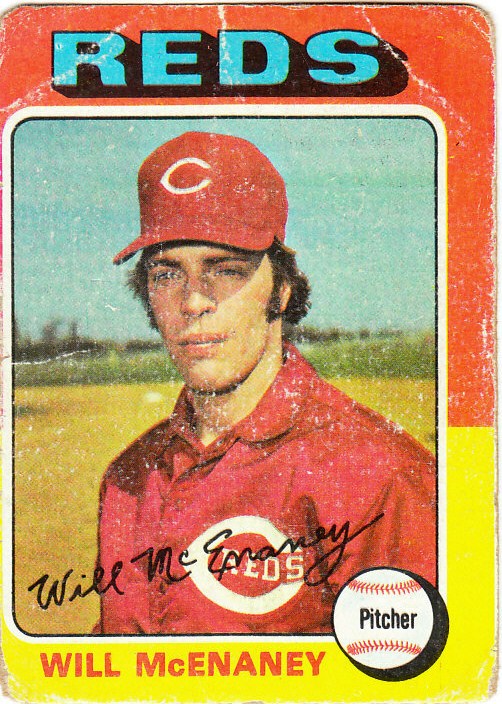
#481 - Will McEnaney


Card fact: This is Will McEnaney's first solo Topps card.

What I thought about this card then: The card I had was just as miscut as this one. But I don't recall having a problem with it. Off-center cards were much more common back then, and we barely batted an eye.

What I think about this card now: It's off-center! I need a replacement!

Other stuff: McEnaney is known mostly for getting the final out in both of the Reds' World Series-clinching wins in 1975 and 1976. He also appeared on a pretty famous Sports Illustrated cover at the tender young age of 23.

McEnaney pitched in 124 games in his career, all in relief. After three years with the Reds, he bounced around with the Expos, Pirates and Cardinals, and his career was over before the '80s began.

McEnaney ran a business for several years and most recently was featured in a newspaper article because he was the scoreboard operator for a Class A team for the Florida Marlins.


Back facts: I always thought players were fortunate when they received a cartoon about their team on the back of their card.

Other blog stuff: Here is the McEnaney card I pulled out of a pack in 1975:


Maybe all of the '75 McEnaneys are off-center.

Wednesday, February 9, 2011

#447 - Terry Crowley


Card fact: Terry Crowley is airbrushed into a Reds cap and uniform. In fact, this is almost positively the same photo shoot that led to Crowley's 1974 Topps card when he was still with the Orioles. Crowley is pictured in Yankee Stadium on each card. You can see the Anacin sign in each photo.

What I thought about this card then: Didn't know about it.

What I think about this card now: Topps had quite a bit of time to get Crowley in a Reds uniform. He was acquired by Cincinnati in mid-March of 1974. I know the majority of the photos back then were from spring training. Perhaps Crowley didn't arrive in time for Topps' photographer.

Other stuff: Crowley was an outfielder/first baseman/designated hitter who is most known for his years with the Orioles. He started out with Baltimore before being acquired by Texas at the end of 1973 (he's featured as a Ranger in a 1974 Topps Traded card even though he never played for the Rangers). The Reds then picked him up four months later.

After a couple of years with the Reds and a very brief period with the Braves, the Orioles reacquired Crowley, and thus began the most successful portion of his career. Crowley was a key part of manager Earl Weaver's platoon system, and Crowley enjoyed his best years in 1979 and 1980 as a pinch-hitter.

Crowley ended his career in 1983 with Montreal and ranked in the top 10 in all-time pinch hits when he was done. He later became a hitting coach for decades for both the Orioles and Twins. It was recently announced that Crowley would not return to the Orioles as full-time hitting coach and work only part-time in the Orioles' organization.


Back facts: I've often wondered when the phrase "The Big Red Machine" began. I always associated it with the 1975 and 1976 Reds teams, but I suppose it could have started as early as 1970 when the Reds reached the World Series.

Other blog stuff: This is the first orange-brown bordered card in 45 cards. It's still first overall, but let's see if it hangs on to No. 1 in the next couple of weeks.

Saturday, January 15, 2011

#423 - Clay Kirby


Card fact: The purple-pink border combo has just tied the green-light green border combo for third place overall with this card. It will move ahead of green-light green with the next card.

What I thought about this card then: I didn't see it. The first Clay Kirby card I knew was his last one, in the 1976 Topps set. He's displaying a chaw on that card. Unfortunately, no chaw on this card.

What I think about this card now: It's no match for his 1972 In Action card, which is one of my favorites.

Other stuff: Kirby started out in the Cardinals organization, but he was selected by the Padres in the expansion draft and became a starter for that first San Diego team in 1969. He ended up leading the league in losses with 20, just as a pitcher for an expansion team should.

Kirby remained a regular part of the Padres' starting rotation until after the 1973 season when he was 8-18. He was traded to the Reds for a disgruntled Bobby Tolan and Dave Tomlin. Kirby won 22 games over two seasons for the pennant-contending Reds, but he didn't pitch in the postseason for Cincinnati in '75. In the offseason, he was dealt to Montreal for Bob Bailey. He went 1-8 in 22 games for the Expos in 1976 and that was his career.

Kirby died in 1991 of a heart attack at age 43.


Back facts: I don't know, that cartoon looks more like Fred Flinstone than Tarzan. Still a nifty little cartoon. Leroy "Tarzan" Parmelee pitched mostly for the New York Giants in the 1930s.

Other blog stuff: Charo was born on this date. The year is up for debate. When I was a kid, Charo was one of those actors that was on TV everywhere, and I couldn't figure out why. She'd be on The Love Boat one minute, The Tonight Show the next, the Donny & Marie Show the next. She'd come out, do her little "cuchi, cuchi" act and leave me totally perplexed as to why people were laughing. That '70s humor. I couldn't figure it out sometimes.

Tuesday, December 14, 2010

#396 - Fred Norman


Card fact: Fred Norman's pose on this card is quite similar to the one on his 1976 Topps card. But they were definitely taken at different times as he's featured in different stadiums. Either that or Topps did some cutting and pasting.

What I thought about this card then: I acquired it fairly early in 1975. I still have that card. It has a crease that travels down the center of the card, top to bottom, from the top part of the card to about the mid level of Norman's cap.

What I think about this card now: It's nice. For a Red. A Norman card was once the oldest card I owned. So that's the card I think of when his name comes up.

Other stuff: Norman began in the majors as a 20-year-old pitching for the Kansas City A's in 1962. He ran through quite a few teams before emerging as a consistent starter for the Padres in the early '70s. But Norman is most known for being a starter with the Big Red Machine teams of the mid-1970s. He pitched with Cincinnati for seven years, winning in double figures each year. His final year was with Montreal in 1980.


Back facts: "Tiny" Bonham was a 20-game winner for the Yankees in the 1940s. He's listed as 6-foot-2, 215 pounds. That's not tiny. But it's not fat either.

Other blog stuff: Bill Buckner is 61 years old today.

Friday, November 12, 2010

#369 - Merv Rettenmund


Card fact: People took so much more pride in their penmanship then than they do now. There is no chance, if Merv Rettenmund played now, that you would be able to make out more than the "R" in his last name when he signed an autograph.

I know that's not a fact. It's an observation. I suppose I should have made this category "card observation."

What I thought about this card then: This was one of my favorite cards in the set. I don't know why. I do know it came from a pack that I bought after a summer walk to the drugstore. Those were the best walks. The only destination was to a place where you would purchase cards.

What I think about this card now: It's a strange one. If you squint a little, it appears if that stadium construction in the background is a UFO. And Rettenmund looks a bit wacky with the helmet on his head and that stupid backswing pose that they made players do back in the day. There is no way you're hitting a ball anywhere with a lazy backswing like that.

Other stuff: Rettenmund played 13 years for the Orioles, Reds, Padres and Angels. He started off quickly as a key part of the Orioles' World Series teams between 1969-71. He hit very well in '70 and '71. But his hitting declined to below average year after year until he was a part-time player and reliable pinch-hitter.

Rettenmund then built a second career as a hitting coach for a number of major league teams. He has a rather, um, promotional, web site.

(EDIT: Merv Rettenmund died at age 81 on Dec. 7, 2024)


Back facts:

1. The cartoon question forgot the word "the." But drawing Marilyn Monroe could get a little distracting, I guess.

2. Mervin Weldon Rettenmund has to be in the top 10 of best baseball names ever.

3. You should never put on the back of a baseball card that someone is "a fine athlete." If he's playing major league ball, he's "a fine athlete," no matter what John Kruk says.

4. "Hits ball solidly." Not in 1974.


Other blog stuff: That's the original card that I pulled out of that pack at the drug store.

Tuesday, October 19, 2010

#345 - Clay Carroll


Card fact: I am semi-certain that the photo for this card and for Clay Carroll's 1976 Topps card were taken at the same time.

What I thought about this card then: Never saw it. However, I did think that Carroll and Tom Carroll, who appears later in this set and also played for the Reds, were brothers. It turns out they're not related at all. Funny what you learn after all these years.

What I think about this card now: I need to upgrade. Air bubbles all over this card.

Other stuff: Carroll pitched for five major league teams between 1964 and 1978, but he's mostly known for his eight years with the Reds. Carroll was a valuable reliever for the Big Red Machine. He led the National League in saves in 1972 with 37, which was a league record for 12 years, and finished fifth in the Cy Young Award voting.

Carroll continued to be a key reliever during the Reds' run, until Rawly Eastwick came along and the Reds traded Carroll to the White Sox. Carroll, who began his career with the Braves, played for the White Sox, Cardinals and Pirates to close out his career.


Back facts: Jim Rice now holds the record for most double plays in a season with 36 in 1984. In fact, out of the top 10 all-time in grounding into double plays, seven are Red Sox players.

Other blog stuff: Yesterday was a lousy day for the Dodgers in baseball history. Today is much better. On this date in 1981, Rick Monday hit a 9th-inning home run against Steve Rogers of the Expos to clinch the National League pennant. Also on this date in 1988, the Dodgers beat Dave Stewart of the A's to take a 3-1 lead in the World Series. In 1996, Raul Mondesi was named National League Rookie of the Year, the third straight year a Dodger had won the award.

Wednesday, September 22, 2010

#320 - Pete Rose


Card fact: This was the most identifiable signature out of anyone in baseball for me as a kid.

What I thought about this card then: Well, it was very cool. I never had the card myself, but someone I knew did. I don't remember who, but I know I saw it. I'm sure I was quite envious.

What I think about this card now: Even though the world is sliding away behind him, Pete Rose remains focused on the pitcher.

Other stuff: Pete Rose was everywhere when I was a kid. It was Reggie Jackson, Pete Rose and then everyone else. He was on after-shave commercials. He did that sprinting to first base thing every time he walked. He got made fun of a lot in my family because I didn't like the Reds, and my dad didn't like his hair.

Rose, like his former teammate Joe Morgan, had a habit of playing for teams I really disliked. For Rose it was the Reds and then the 1983 Phillies (it was extremely weird when I found out that Rose would play for the Expos).

Although he was very talented and knowledgeable on the baseball field, Rose didn't seem very smart. Obviously, he did some dumb things to get himself banned from baseball. He's become a tragic figure in the sport, even though it's hard for me to have sympathy for him.

(EDIT: Pete Rose died on Sept. 30, 2024 at age 83).


Back facts: I believe this is the third card to feature a cartoon about the player on the front of the card. Ron Reed and Steve Garvey are the other two. But I may have missed someone.

Also, the write-up at the bottom is slightly inaccurate. It was impossible for Rose to lead both leagues in doubles because he didn't play in the American League. What Topps meant was Rose "led the major leagues in doubles."

Yes, it's picky. But I'm paid to be picky. Although not here.

Other blog stuff: The last three All-Star cards have all been Reds. Here is the All-Star lineup as featured by Topps as of the Pete Rose card:

AL

1B -
2B -
3B - Brooks Robinson
SS - Bert Campaneris
OF -
OF -
OF -
C - Carlton Fisk
P -

NL

1B - Steve Garvey
2B - Joe Morgan
3B -
SS -
OF - Hank Aaron
OF - Pete Rose
OF -
C - Johnny Bench
P -

Tuesday, August 17, 2010

#284 - Ken Griffey


Card fact: This is Ken Griffey's first solo card. He appeared on a four-photo rookie card in the 1974 Topps set.

What I thought about this card then: Didn't see it.

What I think about this card now: Not as iconic as his son's first solo card, but, damn, are those 20-plus bats lined up in the background? That's kind of cool.

Other stuff: Long before Griffey was known as "Ken Griffey Sr." or "Ken Griffey Jr.'s dad," he was a key part of the Big Red Machine teams of the 1970s. He was the Reds' regular right fielder and nearly won the National League batting title in 1976.

Griffey was also my hero for hitting a home run off of Dodger traitor Tommy John in Dodger Stadium in the 1980 All-Star Game. Griffey went 2-for-3 and won MVP honors as the National League won that game.

Later Griffey went to the Yankees and I liked him a lot less. He then went to Atlanta, returned to Cincinnati, then joined Seattle, becoming the first major leaguer to play in the same game as his son, and also the first to hit back-to-back home runs with his son in a major league game. His career seemed to last way longer than anyone expected it to, but it's a good thing for him that it did.

Griffey is now a coach in the Reds' minor league organization.


Back fact: The Ron Blomberg-knishes cartoon has appeared more than once on Topps cards. It's also on the back of Blomberg's 1973 Topps card.

"George Griffey Jr." just doesn't have the same ring to it, does it?

Other blog stuff: A happy 69th birthday to big Boog Powell today. We'll get to your card eventually, Boog. It's a great one.

Tuesday, July 20, 2010

#260 - Johnny Bench


Card fact: This might be THE card of the 1970s. I know that's opinion, but I probably could write an essay on why it should be fact.

What I thought about this card then: I've said this several times before, but when I held this card in my hands as a 9-year-old, it had me so freaked out that I thought it would vanish, either via a gust of wind or by someone stealing it, or simply through spontaneous combustion. The card was just too cool to be possessed by someone like me.

I can remember where I was when I held the card. I was on a city street, standing in front of a store that had an awning over it. The only reason I would be at that particular site is because I was on my way home from the drug store after buying a pack of cards. So I must have been opening them on the way back and I pulled this card out of a pack. But I no longer own that Bench card that I pulled when I was 9. I must have traded it away. I was probably too freaked out by it.

What I think about this card now: For me, it's one of the iconic cards of the '70s. I know Bench's 1976 Topps card is great, but this one just means more to me. Bench has that catcher's crouch down pat, his glove looks like it just came out of the box yet it's perfectly broken in, and his signature is tremendous. Hell, I don't even like the Reds and I'm saying that.

Other stuff: Johnny Bench was at the height of his popularity at this point, one of the biggest stars in all of sports. I think, as a kid at that time, there were two sports figures that ruled above all others: Johnny Bench and Joe Namath. Later it would be Reggie Jackson and Roger Staubach, but Bench especially ruled right during the time that I became interested in baseball.

This was at the start of the Reds' back-to-back World Series titles and Bench had a kick-ass performance against the Yankees in 1976, so that just made him seem immortal.

Bench was also the closest thing to a sports TV star for me at that time, appearing on the Bubble Yum and Krylon Spray Paint commercials. He was always appearing on This Week in Baseball. Later, he hosted "The Baseball Bunch," but I was a teenager by then and too old for kiddie shows like that.

As for his playing ability, I could list his achievements forever. I think it's enough to say that he changed the perception of the catching position forever.


Back facts: I don't remember Sparky Lyle being referred to as "The Count." That was John Montefusco's nickname. Montefusco didn't have a card until 1976, though.

Other blog stuff: It's been 80 cards since we've had an All-Star. So I'm looking forward to adding another name to the All-Star list for 1974:

AL


1B -
2B -
3B - Brooks Robinson
SS - Bert Campaneris
OF -
OF -
OF -
C - Carlton Fisk
P -

NL

1B - Steve Garvey
2B - Joe Morgan
3B -
SS -
OF - Hank Aaron
OF -
OF -
C - Johnny Bench
P -

Sunday, June 20, 2010

#235 - Jack Billingham


Card fact: This is just the eighth card in the set displaying the red-orange color combo (the "Burger King" combo). It is the least featured color combination so far.

What I thought about this card then: Did not see it.

What I think about this card now: It's in need of some upgrading. It's a bit worn on the edges and miscut.

Other stuff: Jack Billingham was at the height of his career in 1975, having just won 19 games in back-to-back seasons. He remained a solid starting pitcher for the Reds when they won back-to-back World Series titles in 1975-76. After being traded to the Tigers, he enjoyed another good season for Detroit in 1978 before eventually reaching the end of his career in 1980.

Billingham began his career as a reliever with the Dodgers. But he was taken by the Expos in the expansion draft, then sent to the Astros. Billingham went to the Reds in the deal that also brought Joe Morgan and Cesar Geronimo to Cincinnati -- a major steal for the Reds.


Back facts: Not much to say here. Even about the fact that Billingham is a cousin of Christy Mathewson. Just too tired, I guess.

Other blog stuff: On this date in 1975, the movie "Jaws" was released.